Author: davemacq

  • Why We Ignore Climate Change, Part 1

    distrust02I’m going to spend the next few posts examining a précis I did of George Marshall’s book Don’t Even Think About It: Why Our Brains Are Wired To Ignore Climate Change (2014)[1]. Marshall has been a major figure in the international environmental movement, and his book seeks to answer the question of “why, when the evidence is so strong, and so many agree that this is our greatest problem, are we doing so little about climate change?[2]

    I encountered his book last year when I was attempting to come to my own answers about this question, and I was surprised by some of the research that he himself encountered. Unfortunately, amongst other sources, the book has only added to my sense of how deeply we are stuck as a society.

    However, if we do not find a way through the morass of global warming, the outcome is less than desirable. Hence, I believe it important to disseminate his findings.

    I do it also because The Climate Mobilization group to which I belong is developing a process called Crisis Reading groups, providing reading to explore the morass. Although this book is likely too long for this process, a précis of the book might be useful to them.

    There are 42 short chapters in Marshall’s book; here in this blog I intend to cover 8-10 chapters per posting, and hence there are likely to be six or so posts on this topic. As format, I shall first list the notes I kept on a given chapter, and then follow each note with reflection as to what I believe to be its importance.

    So . . .

    Chapter 1. Questions. How is it possible, when presented with overwhelming evidence, that we deliberately choose to ignore something while being entirely aware that this is what we are doing?

    As a culture, we both demonstrate awareness of the problem, and ignore the necessary action. In spite of all the rhetoric and disinformation, I continue to believe that the evidence is overwhelming, and that the major problem is the complex nature of our acedia. But understanding is the booby prize. We are currently on a tightrope between disaster and response; I wonder when we will overcome the massive difficulties of response, as well as what environmental disaster will be needed to initiate this mobilization.

    Chapter 2. We’ll deal with that lofty stuff some other day. Why disaster victims do not want to talk about climate change. Following the survival of threat, people choose to emphasize the positive, and minimize the negative.

    Obviously a survival mechanism, and an useful one for acute issues. The fact that “we survived,” then means that we can feel good about our resilience and the likelihood that we can deal with the next issue. However, it makes it difficult to recognize that there is an underlying chronic problem — a narrative of recovery is more hopeful than impending doom.

    Chapter 3. Speaking as a layman. Why we think that extreme weather shows we were right all along. We interpret events in the light of our prior assumptions and prejudices (confirmation bias). We fail to recognize that weather (short-term experience) is different from climate (long-term pattern). Because we are familiar with weather, we tend to interpret climate in a manner that confirms the current weather. For example, cold weather means cold climate; however, periods of cold weather are simply part of the instability of global warming.

    Familiarity confuses us! The convincer for people is their own interpretation, confirmed by discussion with the group they trust. It is so difficult to create change because the need is to change the pattern of trust, not the kind or amount of information.

    Chapter 4. You never get to see the whole picture. How the Tea Party fails to notice the greatest threat to its values. For many Republicans, the nature of climate change fits perfectly into a set of pre-existing ideological grievances about the distribution of power. They are outsiders driven by their values, defending their rights, and deeply distrustful of government and corporations.

    They too want change! Marshall maintains that Republicans, even those as entrenched [my intentional wording] as members of the Tea Party, are seeking the same thing as staunch environmentalists [who, of course, are not entrenched] — they want good information in an age of information overload. Personally, despite having six university degrees, all of them in some kind of science, I do not trust modern science — for me, it is so entrenched in scientific materialism.

    Chapter 5. Polluting the message. How science becomes infected with social meaning. Attitudes on climate change have become a social clue as to which group the individual belongs. [NB: the TIC model.]

    Science, as imperfect as it is, is not a social issue — it is one of our best attempts at truth. I’ve previously written about Whom Do You Trust, and the TIC Process whereby people are entrenched in their own trust issues. One of the ways, then, of dealing with information overload is to use social cues to group (and assess) information, thus creating a bias of data based on the group presenting the data. Again, trust is the basic issue.

    To be continued.

    [1] Marshall, G. (2014). Don’t even think about it: Why our brains are wired to ignore climate change. New York, NY: Bloomsbury.

    [2] Marshall, G. http://climatedenial.org, accessed 20170121.
  • Anger #04 The Triune Brain


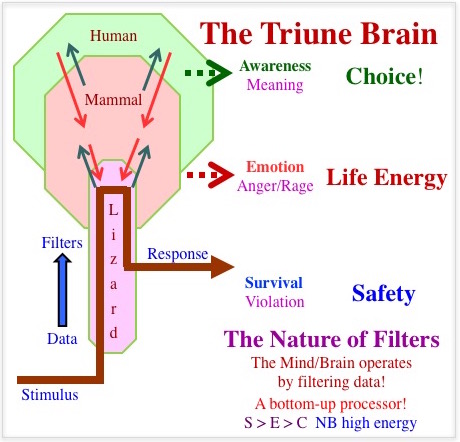
    MacQuarrie Email Program #04 — How We Function: The Triune Brain

    angry04-thetriunebrainCommentary: A huge advance in knowledge of the brain has occurred in the past century; it is astounding what we have learned. However, at the same time, we have learned relatively little about the mind. An assumption of the modern neurosciences is that mind and brain are synonymous (a reflection of scientific materialism) — it is not an assumption with which I agree (nor do I agree with scientific materialism). But I don’t often know where to draw the distinctions, so I often use the term mind-brain when I am unclear.

    The Triune Brain

    One area that seems fairly clear is the concept of what is called the triune brain, referring to the layered structure of the brain, and the apparent layering of the mind. Simplistically, the mind-brain acts as a set of filters of incoming data. Think of sunglasses — they are a filter to reduce the glare of sunlight. They serve a purpose, but they also change what you see. Similarly the filtering aspect of the mind-brain serves a purpose, and distorts how you behave. (What follows is relatively simplistic, but accurate enough to be useful.)

    The Filter of Safety

    Neurologically, 99% of the data that you have been observing in the Now I Am Aware Of exercise of the last email enters the base areas of the mind-brain, the brain stem or Lizard Brain, where it is selectively scanned for your safety. If you not safe, you will immediately go into survival mode to protect yourself; this takes about 200 msec or 2/10th of a second. When in survival mode, the words that would be used to describe you might include serious, anxious, cold — it is from this level that you would violate others. In survival mode, others don’t matter! You are in action to defend your very existence.

    The Filter of Life Energy (Emotion)

    Most of the time this mode of survival is not necessary, so the incoming data advances through the Lizard Brain up to the Mammalian Brain (or Limbic System); the other 1% data (smell) goes here directly. Here the data is assessed (in about 300 msec) for whether the result will be pain or pleasure, pain or gain. It is at this level that most of our emotional experience develops:

    • pain may lead to some kind of moving against or away from, manifest as anger, fear, sadness, disgust, and other so-called negative emotions, or
    • pleasure/gain, with a movement towards, manifest as excitement, interest, enthusiasm, et cetera.

    If the emotion is really intense, the information is processed at this level, and it appears in your awareness together with as the inability to think clearly. This is especially so with the emotions of powerlessness such as rage. Then, in an attempt to get back to a place of power, you may move into survival mode, and violate from a stance of righteous indignation.

    In any event, information is sent back down to the lizard brain (the seat of all movement) for movement into action.

    The Filter of Choice (Awareness)

    Finally, if the experience is energetically less intense, the data rises still further to the cerebral cortices, the Human Brain, the seat of memory and language, the ability to “think,” and make choices. This requires about 400 msec of processing time. Almost all of this brain processing takes place at the other-than-conscious mind level, and seems to be under conscious choice, but like a pot of stew, what surfaces is only a small part of that actually present in the pot.

    Again, information is sent back down for the initiation of movement into action.

    Safety precedes Life Energy precedes Choice (S > E > C)

    It is essential to recognize that this entire process is a bottom-up processor: safety is more important than life energy, which in turn is more important than choice. Consider, for example, what happens with New Year’s Eve resolutions — the vast majority fail. Why? Suppose you are a smoker, and you decide to stop New Year’s Eve. Almost certainly some part of you wants to smoke (derives pleasure from smoking), and you then attempt to impose the “choice” of not smoking onto that part of you than does want to continue. It doesn’t work! The emotional mind-brain is far more powerful than the human mind-brain.

    If you really want to stop smoking, you need certain requirements:

    • Can you find an alternate way of satisfying the emotional system?
    • Can you have a goal of health (in a felt pleasurable sense) rather than a get-away from mode of not smoking?
    • Can you find ways to reward yourself, both intermittently (small pleasures to replace the momentary cigarette) and long-term (something desired to purchase with the money saved)?

    All this and more will allow safety and pleasure to support choice, rather than conflict with choice.

    Task for this email: Write down two or three instances when you have wanted to change something about your life, and have been unsuccessful. What happened? How did you attempt change? How did you deviate from the goal you set for yourself? Consider to what extent the ideas of safety, pleasure-pain and choice entered into your lack of success? Knowing all this, what could you have done differently.

    Coming next: The Role of the Unconscious

  • Donald Trump — Endless Possibilities

    civildisobedience2

    Donald Trump — the possibilities are endless (from dangerous strong man to major statesman — see below).

    However, given:

    • that Donald Trump is soon to be inaugurated as US President, and
    • the intelligence report jointly released on 2017 January 6th by US intelligence services (jointly by the CIA, the FBI, and the NSA) indicating illegal activities in the electoral program by the Russian government, and
      • possibly with the collaboration of the President-elect,

    there is a growing movement in the United States (and abroad):

    • to refuse to acknowledge the legitimacy of Donald Trump as President of the United States, and
    • to insist upon a full and comprehensive investigation of these illegal activities.

    For example, US Congressman John Lewis has recently stated publically that Trump is not a legitimate President. Another example is this blog post from Jim Garrison, President of Ubiquity University, promoting an important petition. (I totally agree with all that Jim states in this latter example — see below for another post by Jim.)

    One outcome of such investigations could be the potential impeachment of the President, followed by a government more in alignment with the dangers we face from global warming. Whether such movement will have this impact is unclear, but from my perspective, at the very least, they will assist in legitimizing the electoral process. Given the chaos of this process last year, such legitimization is essential.

    Potentially these processes are also the beginning of non-violent civil disobedience, both as regards maturation of our culture and for their impact on global warming. Given that I do not know of other healthier processes, I hope that this is the case.

    Yet, the inauguration of Donald Trump could be transformational in a positive sense — greatness is within his grasp. Here, Jim Garrison has also written a brilliant summary of what Trump could accomplish if he has the maturity to transform from strong man to statesman.

    We live in such interesting times!

  • Anger #03 Awareness and Discipline

    PersonalGrowth1

    The tasks in this post: the development of awareness (task #1) and discipline (task #2).

    The work of change may seem massive, but really it’s just one step after another, and once you know the steps, you simply keep stepping (and find ways to keep yourself stable in the meantime).

    However, it is easy to get into despair and/or overwhelm. What follows are primary skills, both for personal growth and for getting out of feeling overwhelmed.

    Awareness

    Awareness is “attention to my spontaneously emerging experience.” Awareness is NOT thinking — it is experiencing, noting what is actually happening, especially in my body. Fundamentally, I can be aware of three areas:

    • what is happening outside me (my so-called five senses),
    • what is happening within my body, and
    • third, the story I am creating as a result of these two ongoing experiences (generally what I call my thinking).

    Awareness allows me to be present NOW, HERE! My story is usually about the past or the future — potentially useful, but not awareness, and not with any of the power of awareness.

    Discipline

    Discipline is “doing what I want to do, even when I don’t want to do it.” I want an outcome, and yah, it takes work to get it. Discipline is doing the work because I want the outcome, recognizing that often I don’t want to do the effort, but I do it anyway.

    The skill is to make it easier. For example, I practice yoga. I enjoy it, I want the benefits, but often I don’t really feel like doing it. So my discipline is to do “two minutes of yoga.” Not much, eh! Well, every day, I do my two minutes of yoga, even when I don’t want to do it. And, by the end of two minutes, I often feel better; I like how I feel, so I do 45 minutes, because I like it. But, if at the end of two minutes I don’t like how I feel, I stop, and congratulate myself — I have kept my commitment. No self-criticism, ever.

    Task(s)

    For 20 consecutive minute each day for the next week, sit quietly and repeat the following: “Now I am aware of …” and name a body sensation. Don’t describe it, just name it (one or two words), and move on to the next sensation. “Now I am aware of … my fingers tingling … the coolness of my toes … the tension under my eyes …).

    You will lose track. You will drift off into thoughts, day-dreams, etc. That is what the mind does. When you notice you have done so, gently come back to NIAA (now I am aware of …).

    Commentary

    As you get used to the process, lightly give attention to various components (mainly to sharpen your skill): external body sensations (what you feel at skin level), internal body sensations (those truly within), external sounds, internal sounds (including talking to yourself), external visual (with eyes open), internal visual (with eyes closed, including mental images). I say lightly, and I mean lightly — no one does this practice perfectly. The nature of the mind is that it wanders, and the discipline is to gently bring it back, without criticism of self.

    If you will do this for 6 months, I guarantee you will change your life. This skill of awareness is subtle, and powerful. Essentially as you become aware of what you are actually doing, there will be occasions where you don’t like what you are doing. You will choose to stop, and you will change your life for the better, a little bit. The results accumulate over time, and eventually you are in a much better place.

    In a later email when I describe the skill of knowing your own truths, I will say more about this. For now though, how do you know when you are speaking your truth, and how do you know when you are telling a lie.

    Ideally, you will continue this practice of awareness for the rest of your life — because you want to! You may eventually change it to what is today called mindfulness practice or vipassana meditation, all just variations on a theme.

    My personal choice is a vipassana retreat (I suggest 10 days) — largely because I can recommend such a retreat to anyone. Vipassana is a Buddhist practice, but as compared to other “religions,” Buddhism does not emphasize belief systems, only practice.

    Vipassana also operates from a principle called dana — the teachings are free. If there are any changes for a retreat, they are minimal, and only to cover costs; sometimes the entire retreat (days to months) are free, and costs are covered by donation. If able, sign up for a retreat.

    Coming next: How We Function — The Triune Brain

  • A Number of Interesting Articles

    technology7
    Technology: dazzling, but distracting

    There have been a number of interesting articles have come across my desk in the past few months (some technological, one on civil disobedience), so I thought I would describe them briefly. I recommend that the interested reader explore them all from the original sources listed.

    First, some fascinating technological results:

    20161128 A way to turn our carbon emissions into rock

    As regular readers of this blog will likely know, I do not accept that global warming is a technological issue. However, we have been so resistant to deal with the problem, that our major current need requires technological solutions. Most importantly, we need to stop the production of the greenhouse gas sources of climate disruption. And at this stage, we likely also will need ways in which to safely remove carbon dioxide (amongst other gases) from the atmosphere; most of the possible means of geoengineering a cooler planet as simply too unexplored, and consequently of high risk to unexpected, and dangerous, outcomes.

    This article describes a process that is still in the developmental stages, but likely can be safely scaled up to global levels for safe permanent removal. Unfortunately, part of the developmental process is currently through the US Department of Energy, and thus will likely require approval by the new Trump administration.

    20170109 The Vertical Farm

    One of the major needs of our growing world population will be reliable food production. This article describes a fascinating process, utilizing aeroponic farming (more efficient than hydroponic) in vertical layers, again likely one that can be scaled to global levels. To quote from the article:

    a complex of two hundred buildings, each twenty stories high and measuring eighty feet by fifty feet at its base, situated in some wide-open outlying spot . . . could grow enough vegetables and rice to feed everybody who will be living in New York City in the year 2050.

    The footprint of such an buildings would only be a few city blocks, yet provide food for many millions. Amazing. (Incidentally, typical of The New Yorker, there are a number of cartoons scattered throughout the article. Enjoy.)

    20170111 Your Breakfast Is About to Take a Weird Turn

    Again in the line of food production, this article describes some of the many ways in which genetically-modified organisms are contributing to our culture. Although I have some reservations concerning GMO processes (the underlying safety is still poorly explored — but for me it will take several hundred years to have adequate information; I also recognize that modern technology offers fascinating opportunities.

    GMO yeast are now able to produce what is likely to be an adequate “milk,” with 98% less water consumption and 65% fewer greenhouse gas emissions. It remains to be seen as to what such substitutes will offer, but as indicated earlier, it is one of the fascinating technological advances that may offer considerable relief of the consequences of our culture.

    Now some comments.

    From my perspective, the problem of technology is that it is both potentially part of the solution and part of the problem. Modern technology is both dazzling, and distracting from the issues with which we need to deal.

    Even one hundred years ago, many major philosophers (Bredyeav, Ellul, Lewis — see my book Acedia for details) recognized that technology was dehumanizing and took on a life of its own, distracting from the issues of how to have a mature culture. Even at its best, technology is a means to reduce greenhouse gases, perhaps also to reduce cultural impact in other ways — but technology does not manage our incessant need for consumer products, nor over-population. On the force field of change, technology moves us away from negativity, but does not move us to a vision of who or how we want to be as a culture.

    A final reference, then, on some cultural movement — an interview with several individuals who are engaged in civil disobedience, to which I append an open letter to former President Obama written by one of these individuals.

    We have a choice as to how we live our values. As indicated earlier, I believe that civil disobedience is a necessary exploration in our current cultural psychosis.


  • Anger #02 What Is Anger?

    This is the second of my email anger program so that the program is not lost. It is a duplicate of a previous sampler post of 20160809.

    angerface3
    Anger is a masque of deeper issues.

    This one is fairly long. Apologies.

    To begin: Are you still reading your outcome title (Email #01), at least once a day? If yes, great. Congratulations. If not, that is the difficulty of discipline — you are not wrong, your behaviour is not wrong, but to the extent that you made a commitment, you did not keep your commitment. And people who do not keep commitments are much less likely to get outcomes that they want. Simple, yes; painful, yes! I did not say this program would be easy; I did suggest that it is effective. Please continue to read your outcome statement each day.

    Task for this email: After reading this email, monitor your emotions for a few days (don’t attempt to change them, just monitor them). When you notice an obvious anger-based emotion, answer the following questions:

    • Do you have a sense of power? Can you move forward with it? If so, likely it is anger.
    • Do you feel overwhelmed? Is there an underlying powerlessness? If so, likely it is rage.
    • Do you feel indignant, determined “it” should not be. If so, likely it is self-righteousness.
    • Where in your body are you feeling this emotion.

    What is anger? Most people know that they are emotional, but often they do not know what emotions are. Most people know when they are angry —  you, for example, wouldn’t be reading this if you weren’t angry, but you do you know what anger is. In this email, we clean up some language. (Suggestion: if you will pay meticulous attention to your language for six months, I guarantee you will change your life for the better. More in another email.)

    What are Emotions? There are many definitions, but my best definition of emotion is “a biologically adaptive action tendency.” What does that mean? Well, you are designed to respond to your environment, and when things change, you as a biologic organism adapt — usually very effectively! When something happens, you (your mind) processes what is happening, usually at the other-than-conscious level and with amazing speed. Your mind then sends a signal to your body to react, to move into action. The very beginning of the experience of action is the felt sense called emotion.

    Another definition of emotion I use is “energy to which I give meaning and direction.” In the so-called pleasurable emotions, I move towards something — I am excited or interested. In the so-called negative emotions, I move against or away from — I am angry, afraid, sad, et cetera. Check it out: notice what you are feeling right now, give it a name, and point to where that feeling is in your body. (Don’t be surprised if you cannot do this — when I first started my own therapy work, I could not do so.) How or to where does this emotion want you to move?(Suppose you are hungry. Where in your body? To where do you want to move?)

    So, what are feelings? Aren’t they emotions also? Sort of. Again many definitions, but I want to make a clean distinction. Examples of emotional words are: angry, excited, afraid, et cetera. Emotions point at my body, and can be described in a single word. Yes, they can refer to something else, but the felt sense is in the body, and can be pointed at. Feeling words point to my relationships: hostile (towards), included (with), ignored (by), etc. Again, one word, but they point outwards. There is usually an underlying emotion, but the feeling points outwards. Then, to make matters more confusing, there are also the feeling judgments — my thoughts about my emotions and feelings: I feel that … (finish with the thought, e.g., “this is wrong.”). There is an underlying emotion or feeling (unnamed), but the description is a thought, and always more than one word is required.

    What is Anger? Anger is an emotion, one that shows that my beliefs have been disrupted, without my intention or permission. Suppose someone in a crowd pushes me — my mind processes this, says this should not be happening (a thought), and sends a signal to my body that I push back: I’m angry. But perhaps I don’t — I also know, perhaps unconsciously, that the consequences might be less than pleasant, so my mind send a second message, very quickly: Stop! Be cautious instead. Angry and afraid at the same time. Did I say emotions, especially anger, were simple?

    Now, suppose the same crowd, only this time we are friends, and we playing football. If someone pushes me, will I be angry? Not likely — because it is expected and allowed as part of the game. Same actions, but different emotions, depending on my beliefs! Complicated, again.

    What about rage? Think about your own rage. Rage is also an emotion, this time more complex. When angry, I feel powerful — I can do something with my anger. But in rage, I feel powerless; I’m overwhelmed, and I puff myself up so as to get back to a state of power. And I don’t think clearly — a dangerous combination. At this point, I am likely to violate others — to violate someone is a behavior — to restrict them without their permission, to hit them, to block them, to scare them, etc. Not fun — for anyone!

    Note carefully! Emotions and feelings are not wrong, or bad; they simply are. They are the way in which my body gives me information, sometimes information that I do not want to recognize. They always have a positive intention — the “negative” ones usually to protect me, in some fashion. What is potentially inappropriate is what I do with my emotions. This behavioral response can certainly be dangerous, unacceptable to yourself or to others, and much else.

    Safety: So, anger and rage can be dangerous, especially if we are unaware of the complexity of what is happening (we will be exploring this in detail over the next weeks). My bottom line is safety, for myself and others — always, and to the best of my ability.

    I sum up safety with two statements: No SAD and STOP. No SAD means:

    • I will not intentionally Scare another human being,
    • I will not Attack another biological creature, and
    • I will not Destroy in anger that which I would not destroy when peaceful.

    My experience, after 25 years of being a therapist (including as I resolved my own issues of anger) is that, if I stay within the parameters of No SAD, I can be fully expressive of my emotions, and both I and those around me are totally safe.

    However, that does not mean that those around me will feel safe (more accurately, they do not feel secure) — my actions may still scare them — what I am doing may remind them of painful times in their own past. I do not intend to scare them, but that does not mean they are not scared.

    STOP responds to this. STOP means that if I am told to stop, I stop immediately (no questions, no argument). Someone is scared — always inappropriate. Then I find another, safer way to deal with my anger. Usually this means I will take a time out  to briefly separate myself from others, and thus allow them to recover from their scare (more about time-outs later).

    Coming next: Awareness and Discipline

  • Civil Disobedience

    civildisobedience1

    One of the issues I am pondering these days is that of civil disobedience. The central issue is that of how to respond to a breach of law when the law goes along with the breach. As such, if we are to resolve our cultural dilemma of climate disruption, we must deal with the negative forces that are leading to global warming. In particular, we must recognize that these negative forces are currently poised in the dominator roles of our culture. These powers are in the position to mandate the continuance of:

    1. consumerism,
    2. the military-industrial complex, and
    3. the fossil fuel industry

    via legal means, imposed by government forces which are in alignment with these forces; it also means that to resist these forces often requires stepping outside the bounds of legality. To oppose these forces thus requires some form of civil disobedience.

    Such disobedience can be placed on a spectrum between sabotage and non-violent civil disobedience (NVCD). Much has been written on NVCD, the earliest being the play Antigone by Sophocles (5th century BCE). The modern writings on NVCD have mainly begun with Thoreau in [On the Duty of] Civil Disobedience, 1848. Thoreau was essentially questioning the distinction between legality and justice, wherein:

    It is not desirable to cultivate a respect for the law, so much as for the right. The only obligation which I have a right to assume is to do what I think right. . . . Law never made men a whit more just; and by means of their respect for it, even the well-disposed are daily made the agents of injustice.

    There is much to be explored in Thoreau’s writing, but essentially he was an advocate of NVCD when government and legal systems were acting in ways that are unjust. His primary suggestions, as elucidated by Gandhi and Martin Luther King Jr, were to:

    • use only moral or legal means to oppose unjust law
      • boycotting, picketing, blocking traffic, non-violent resistance, non-payment of taxes
    • first make an effort to bring about change through legal means
      • work within the system before and during
    • be open and public about actions
      • the disobedience must be fully revealed and public
    • be willing to accept the consequences of such actions
      • prison, fines, deportation, loss of job, social disapproval

    The intention behind NVCD is to induce shame in the dominator by highlighting the discordance between legality and justice. The difficulty is that these processes are slow to induce social change: witness the years required before the British Empire released India from colonialization (Gandhi), or the years of societal demonstration before significant reduction of racial inequality (Martin Luther King Jr). The major difficulty with NVCD in regard to global warming is that we probably do not have time for slow resolution; we are too close to the edge of irreversible global catastrophe.

    Sabotage, on the other hand, is usually illegal, likely violent or violating, action engaged in secretly, and often such that the perpetrators attempt to avoid the personal consequences of their actions. While sabotage might be somewhat satisfying to the perpetrators, I am not sure it does anything other than anger the recipients, and provide a justification on the part of the dominator for the suppression of any kind of civil disobedience.

    In this regard, I have been networking with a group of individuals who seek to offer protection services for groups that engage in civil demonstration, with the purpose being to maintain the principles of NVCD wherein these protest rallies occur. I believe that such protection service is very important, providing safety for all — but it is very easy for individuals to become provocative, or for spectators to provoke, which then leads to antagonistic responses. In particular in the Vancouver area, it appears that a number of neo-Nazi groups are now attempting to be provocative in just this fashion.

    Even for the people who offer such protection services, there is a range of responses. Some say that actions such as sabotage can be done without danger to those who simply practice of NVCD. I totally disagree with this — I doubt that the dominator society makes this distinction, and it is likely that if sabotage occurs at the same time as NVCD, repressive responses will be imposed on all, not just the saboteurs.

    So, what to do? I do not know. What is fundamentally needed is a massive mobilization of the general populous towards all types of civil disobedience, but forty years of attempting this on the part of many parties has been largely unsuccessful. Sooner or later, enough angst from environmental devastation will occur, but likely it will then be too late.

    Sad!

  • Climate Disruption Dispatches

    globalignitionFor those who want fairly accurate information concerning what is happening to our climate, I consider Dahr Jamail of Truthout to be one of the best sources. I highly recommend him.

    This link provides a summary of his monthly posts over the past two years — a vast amount of information, most of which scares me as to its consequences.

    I hesitate to say: Enjoy!

  • Anger #01 Why Change? Personal Power

    As indicated in the last post, I will gradually post my email anger program so that it is not lost. Although many people signed up initially, and feedback has been positive, there has been little in the way of continuing interest. Hence — this series of posts, one every few days until completion (30 emails) …

    I will add additional posts between the series, with a page under Postings dedicated to the anger program for those who want to follow it without having to sort through other posts.

    AngerBlowDown
    Is this you? Is this how you want to be?

    Why Change? Personal Power

    Welcome again. Welcome to a program that can change your life.

    I believe the above statement is absolutely true, partially because the tools I am offering are powerful, but more importantly because I trust the basic goodness of human beings. I believe in the principle that every human being is ALWAYS doing their absolute best at ALL times, and that when they are unhappy with their lives, what they need is not criticism but better resources, better skills to accomplish what they really need. Email me ([email protected]) if you do not believe me, and I will explain my rationale.

    These first few emails (the first eight or so) will provide simple tasks, but more importantly will give you some concepts that I believe are very useful to your progress. Play with the ideas, and if questions, email me as above. But do not attempt to accomplish the 90-day program in two weeks — it doesn’t work that way. Many questions I will defer until a later email when the answer will become clear.

    Also, be aware that, although this program is designed for anger management, almost all of it is applicable to every other emotional experience of your life. So, if you want to work on something else (low esteem, grief, et cetera), simply use your own word  any time you encounter an “anger” word.

    So, your first task, your first skill development. Take out some paper, and answer these questions: Why are you taking this program? What are you wanting? And if you get this (i.e., what you want), what else will you get? And if you get this next piece, what will you get that is even more important? Expand your answers until you can go no further (either you cannot name anything more important, or you are cycling back into previous answers).

    Now look at your answers, and see if you can answer these further questions about what you want. These questions are called the RPMS! of change. (I don’t expect that you will be able to answer them all — if you could, you would likely have what you want already.)

    • Is what I want realistic? (Can some one person, anyone, get this?)
    • Is it practical? (Can I myself get it?)
    • Is it measurable? (Do I have a way to know when I have it?)
    • Is it specific? (Do I know how to get it, the actions involved?)
    • !? (What is the first step for me to get it?)

    Why are these questions important? Basically for two reasons:

    • these questions are the basis of effective outcomes, and
    • people who set goals (outcomes) are more effective in life than people who do not. The likelihood of you completing this program is higher if you set a goal for yourself.

    Now, to complete this task for now, re-write what you want, using your above exploration.

    What outcome do I want?

    Give your description a two or three word title, and post the title (with or without the details) somewhere where you will read it every day: on the mirror where you brush your teeth, at the head of your bed, et cetera. Make a conscious choice that you will read it every day for the next five days, at least until you receive Email #2 of this series.

    As part of the description, add a brief description of yourself, your self-esteem, your sense of personal power. I want you to be able to look back at this description each month and note how you shift in the next three months. Also, be sure to date when you write this goal. If you wish, you may show this information (and any subsequent information) to another person (your life partner, for example), but think carefully before you make that choice — do not set yourself up to be criticized or judged by another person.

    My reflection of this process: I believe that every human being wants power. But power comes in two forms: it can be external power, wherein I dominate others, or personal power, wherein I influence others by my effectiveness as a human being. With personal power, I have a sense of aliveness, personal integrity, authentic relationships, and the ability to contribute. This form of power is available, but it takes skill development to achieve it. I trust that is why you are here.

    The skill of anger management is the ability to turn your power of domination into personal power whereby you influence. The intention of this program is to honor your anger — it is a signal to you that something is wrong, something is happening that is inappropriate to your current situation. But your anger will not tell you what the problem is! It may be that there is something inappropriate with those around you, or it may be a warning to you that there is something inappropriate within your own beliefs.

    Consider for a moment: Are you worthy of what you want? Do you deserve to get it? Do you deserve to be in charge of your anger? Honestly — you do not need to tell anyone else, just yourself. (I believe you are worthy, but do you? Many people don’t! And therefore, they don’t get what they want.)

    If you are one of these people who hate yourselves, who are constantly criticizing yourself, Or perhaps you are constantly criticizing others, at least to yourself? (It is the same problem!) Explore how you learned this? Who told you? How did you learn this? And what gave these others the right to judge you in this way?

    If applicable, I also invite you to put another sign along with your outcome statement:

    God don’t make no junk!

    (You don’t need to be religious — just recognize what it means! about you!)

    Coming next: What is Anger?

  • The Struggle To Engage

    conquest
    The Spanish Conquest of the New World was simply one example of power dynamics.

    I have not written in my blog now for over three months. For me, it has been a major struggle to engage, initially due to travel requirements but especially so after the American election. Since that time, I have been pondering my difficulty.

    My struggle has not been acedia per se (see previous posts beginning 20160802), although that was my immediate concern (given my studies of acedia) — it is more that I have felt traumatized by the election of Donald Trump, and the likely consequences thereby. For myself in particular, I know that I am strongly introverted, and that most of my life, I have defined myself as a poustinik, a hermit who is available when asked. From the past year or so, I have been attempting to engage in climate activism, but have found it to be exhausting. I don’t engage well in groups, and especially I flounder when I do not have a designated task to give me focus. And I am very sensitive to the pain of others.

    All that definitely is part of my personal pattern that predisposes me to acedia in response to climate change. I know for example that I have been avoiding writing (which often gives me clarity of my internal process). And I definitely experience a push-pull regarding global warming — more and more we are at risk of extinction as a species: I want to resolve it, and I want to avoid it. Yet, as noted, I am not at high risk of the profound avoidance that characterizes acedia.

    Regarding the precepts that counteract acedia (wisdom, discipline, hope and playfulness), I have been aware that I do not have the wisdom to know what to do, other than ponder. I am very disciplined (with daily yoga, meditation, and attention to health, amongst other resources). However, given the immensity of the negative forces creating climate change, I have little to no hope that we will survive.

    And I have difficulty being playful with the topic. If there is a God, I am quite willing to turn the issues over to him/her, but I find it difficult to be joyous or playful with this possibility. If there is no God, then humanity is clearly demonstrating its ineffectiveness as a species (and even if there is a God).

    It is this latter possibility, the ineffectiveness of our species, that is my current focus of pondering, especially in light of again encountering some of the writings of E. Richard Sorenson, a cultural anthropologist who has studied numerous isolates of human culture in various domains. In his work, Sorenson distinguished between “preconquest” consciousness, characteristic of many indigenous cultures, and “postconquest,” characteristic of modern life (conquest referring to the Spanish invasion of the New World). In particular, this quote from his writings about the primitive societies he explored has struck me as vital:

    For several years after I began contacting preconquest peoples like those described above, I considered their type of consciousness an oddity, a kind of naive primitive emotionality, one perhaps suitable only for small, isolated groups, but certainly for no one else. It took a long time for me to realize that they had evolved their own sophisticated type of cognition that was simply different from what I (or anyone I knew) was used to. And I came to realize that such mentality could not be considered primitively ignorant if only because it was so sensitively intelligent and beneficially responsive. It moved more facilely, more harmoniously, and more constructively than do the mentalities associated with today’s postconquest world. Furthermore, it provided for an astonishingly rewarding and zestful life [emphasis added].

    Sorenson in particular identified that the encounter between preconquest consciousness and postconquest invariably led to devastation of the richness of preconquest life. What I would add to this is that this devastation is the same process of power that I gleaned from The Parable of The Tribes, written about in earlier posts. Unfortunately, our 10,000 years of civilization are based upon the power dynamics of conquest, and as such are not compatible with effective living as human beings. We must find a way to what I would call transconquest consciousness, combining the richness of preconquest with the technological advances of postconquest.

    I first encountered Sorenson’s writings as a result of working with my PhD advisor Christian de Quincey, professor of consciousness studies at JFK University in California. Christian’s entire approach to living changed when he first encountered Sorenson’s work, realizing that his own conquistadorial approach was not compatible with effective living.

    In retrospect, I now recognize that the distinctions drawn by Sorenson are those that have devastated my life in many ways, ranging from early childhood experience to the defense of my PhD dissertation. They are also fully consistent with all I have learned of human dynamics in my 25 years of being a therapist. They form the basis of the traumas that underlie the mechanisms of cultural acedia (as developed in my dissertation and book Acedia, The Darkness Within, and the darkness of climate change). I feel fortunate that my intellect has allowed me to survive these traumas, although with considerable restrictions.

    Unfortunately this gives me little satisfaction or hope that we will survive as a species. However, I will continue to engage in whatever way I can.

    One of the ways I will do this is to post my email anger program to this blog. I have had good feedback, but limited sign-up. Rather than simply let the program die, I will post it for others to access if desired.


    For the interested reader, I have included two references on Sorenson’s and de Quincey’s writings. I recommend both highly.

    de Quincey, C. (2000). “Consciousness and Conquest.” From Maaber blog, http://www.maaber.org/sixth_issue/epistemology_2e.htm, accessed 2017 January 5th.

    Sorenson, E. R. (1998). “Preconquest Consciousness.” From Ran Prieur blog, http://ranprieur.com/readings/preconquest.html, accessed 2017 January 5th.