
Category: A Mature Culture

  • Ghosts

    Everyone struggles with ghosts, usually the residue of our childhood or other significant emotional traumas.

    These are resolvable — if we will do the work.

    In my case, the ghost has been the disappointments wherein I have attempted to promote myself, either through my workshops or my books. I sincerely believe that the skills and resources I offer are vital in the seeking to be the best human being I can be. They work. They work for me; they work for others.
    But I am a strong introvert and an amateur in promoting myself. I have not been successful and slowly have become discouraged. In the past, I have been strongly self-motivated, and what surprises me now is how strongly dependent I have become on external motivation. It is not a bad thing yet in now engaging with an individual who is both very creative and motivated to promote my work, my enthusiasm seems restored.

    The skills and resources I teach can be learned from a book, but they are best learned by regularly engaging in the work with a good facilitator, in this case —me.

    Up until about 2012, I was a physician-psychotherapist and had my own anger management program. I called it ‘anger management’ for two reasons. First, it was an easy issue that people could identify in their lives. Second, and more important, is my belief that anger is the canary in the coalmine of our culture — it reveals our deep lack of understanding of emotional issues in our culture. My work is not that of anger management — it is that of emotional management, especially how to integrate the emotional and the rational to the transrational.

    My workshop was a 17-hour weekend program, experiential, every two-to-three weeks, in which I engaged with 15-20 individuals who struggled with anger issues in their lives. Because I was a physician in Ontario, my workshop was covered by the provincial health insurance program, and thus individuals (men and women from all walks of life) could attend without charge. They could be doctors and lawyers or individuals who had spent most of their lives in jail. I also used these programs to supply my ongoing groups of people who wanted deeper engagement, meeting weekly as needed.

    For the most part, my workshop came out of my own growth. By age 40, I was a very competent professional anaesthetist yet deeply unhappy with my own ghosts of a very painful childhood. I started to engage with good experiential therapy and soon realized the field to be the most creative experience I have encountered — I switched to training as a therapist and spent years resolving my own ghosts. Amongst other learnings, I came to recognize that the skill I bring as a therapist is my own humanness.

    Although the deeper work of my clients was done in the groups, people changed their lives with the single weekend. There were many occasions wherein an individual could come for the single weekend but did not have the resources for ongoing attendance. It was not uncommon for that someone to show up in my driveway thanking me because their lives changed with that single weekend. Examples are listed in Appendix 4 of my book Blowing Out the Darkness.

    After about 20 years of this practice, I noted how a portion of my group client load did not engage with the work; they watched other people doing the work yet did not do so themselves. Without being pejorative, I characterized them as lazy (they avoided the work) or fearful (they were afraid of the consequences of doing the work). There was no therapy I could offer them other than challenging them to engage.

    As a consequence, I decided to do my PhD studying laziness and fearfulness. When I added self-righteousness to this mix, I recognized an ancient process acedia as having a modern form of any combination of laziness, fearfulness, and self-righteousness that blocked the individual from engaging in authentic living. I also posited that modern acedia is the underlying emotional basis of climate change. Climate change is a technological issue, yet we do not resolve it because of our cultural acedia. (All this is described in my second book Acedia, the Darkness Within).

    I ‘retired’ (semi-retired) fifteen years ago, moved to British Columbia, and since then I do individual work, calling myself a coach. I have spend a lot of time and money attempting to promote my two books, unsuccessfully (again being an amateur).

    With the current encouragement, I have decided to focus on promoting myself. I am available both for individual and corporate consulting, for the management of any emotional issues, including life satisfaction, leadership, burnout, and group functioning. If people find my work useful, the spin-off will be my books are promoted.

    If what I have written tweaks your interest, connect with me at [email protected]. I will also be modifying my website davemacquarrie.com to have less focus on my books and more focus on what I can offer.

    Thanks. Hope to meet you.

  • The Search 3 — The Skills

    In this post, I am going to outline briefly the skills necessary so as to live fully; subsequent post (chapters of the future book) will develop the nature of these skills and the means of acquiring them. Initially, the discussions will be somewhat abstract because I am seeking to develop a common language between myself and the reader.

    As a therapist, I am very aware of the need for clarity; I often define the skill of good communication as the ability to recover from bad communication. Unfortunately, written communication makes that skill difficult to achieve; hence my need to ensure clarity.

    A primary question here is who and what are we as human beings? I will be presenting a variety of answers to this question and invite you the reader to delve deep into both my answers and your own. Let me state first that I am not claiming to be an authority in these answers, only that I have spent much of my life attempting to answer these questions — they define who I am and how I interact with people.

    My first answer is that, like all biological creatures, we are energy transformers (by energy, I mean the ability to do work, which for biological purposes means the ability to create some kind of change). I interact with what life offers, especially the presence of other human beings, process what they offer (their energy) and convert this to my response (my energy, offering my attempt to create change). Between us, we dance with each other’s energy (hopefully under-standing each other in the process).

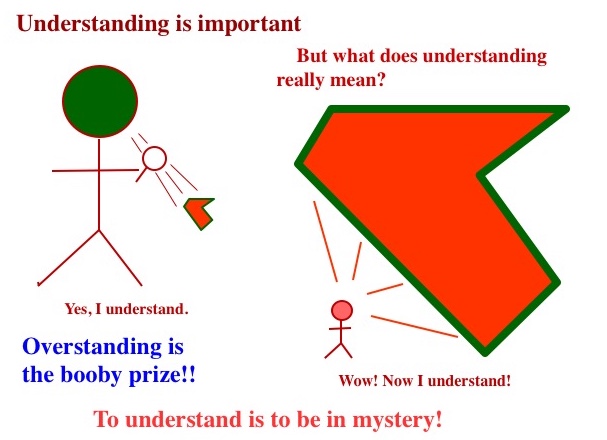
    This word understanding is one that is vital to our conversation. With my clients, I draw two simple diagrams. The first stick figure is using a magnifying glass to analyse an object, saying “Yes, I understand.” The second stick figure is standing under the same object, in awe of the mystery that the object represents. Despite the profound scientific advances of the past few hundred years, we really grasp little of the profound mystery that underlies what we call reality. Thus I call the first analysis over-standing and the second true under-standing, usually spelling the words with a hyphen to underlie the mystery. Over-standing, for me, is the bobby prize!

    My second answer to the question of who and what we are as human beings is that we are meaning makers; the sophistication with which we do this is perhaps unique amongst biological creatures — it is both our profound skill and our trap. Consider the following simple story:

                                                                   The Story
    A business man had just turned off the lights in the store when a man appeared and demanded money. The owner opened the cash register. The contents of the cash register were scooped up and the man sped away. A member of the police force was notified promptly.
         Choose your response to each of these statements about the story: True, False, or Not Sure

    1. A man appeared after the owner had turned off the lights.
    2. The robber was a man.
    3. The man who opened the cash register was the owner.
    4. After the man had scooped up the contents of the cash register, he ran away.
    5. While the cash register contained money, the story does not state how much.
    6. The story concerns a series of events in which only three persons are    referred to: the owner of the store, a man who demanded money and a member of the police force.

    Looks simple — anything but! I contend the answers to the first five are Not Sure. For example, #1, the story says a business man turned off the lights — where does it say the business man and the owner are the same person. #2. Where does it say a robbery took place — perhaps the man was drunk and driving dangerously when he/she sped away in a car. I contend #6 is False — the word only limits the choices to either true or false!

    The point of this story is that we respond to meaning — we make assumptions about the actual data that is available (The Story). We fill in the blanks of our assumptions. You might note that the word assume can be spelled ‘ass-u-me’! Yet we cannot not assume — we never have all the data! The best that we can do is to be aware of our assumptions and be open to other interpretations. Such failure to do so unfortunately underlies much of the crises of our modern so-called ‘civilization.’

    One aspect of being fully alive is such awareness and more. My original training as a therapist was in the field of Gestalt Therapy. For me, it is the basis of being fully alive. There, awareness is the primary skill (in Gestalt, awareness is defined as ‘attention to one’s spontaneously emerging experience — it is much much more than attention to what one is thinking or what one is assuming).

    The second core principle/skill of Gestalt is contact — attention to the actual data that is present, both the data provided by the outside world (this post, for example) and the ongoing moment-by-moment shifts in my body-mind experience as I create my reality. The third core principle/skill is personal responsibility — I alone create my experience. The word blame does not exist in Gestalt Therapy.

    Beyond these skills are others that we will come to. How do I create and manage my own life energy, my emotions? How do I manage my internal complexity, especially my internal conflicts and my judgments of self or others. How do I manage my external relationships, especially my conflicts.

    My third answer to the question of who and what we are is that we are relational. We are never individuals — we are only individuals in relation to others. In the complexity of the modern world, with the risks of nuclear war and climate change, a fundamental question is that of ‘What is mine to contribute?’

    Part of this is my relationship to the grand scheme of the universe. Is there a supreme being or energy/force?’ The loss of religiosity over the past four centuries has had many consequences, some good, some not so good. Many of us recognize a sense of futility and/or sense something missing — sorting this question is a significant part of the search to be fully alive, of what is mine to contribute.

    In future posts, I will offer simple models (concepts and/or metaphors) that allow all of this to be processed — the journey to being fully alive.

  • The Search To Be Fully Alive

    On my last post, I noted my intention to write a third book (beside my first two, see previous) entitled The Search To Be Fully Alive: The What and The How. This choice came about for two main reasons: I was seeking to engage further both with my blog and with my life. In particular, I was dissatisfied with how inactive I have been with this blog (I have been sporatic since 2020). I decided to combine the two issues by using the blog as a stepping stone to the book, hopefully cutting and pasting future posts to form the body of the book. I hope the book will end up at about 80-100 pages: long enough to be comprehensive and short enough to be readable. As part of this, I have asked for feedback from subscribers as to the clarity and interest of such future posts. Appreciations for same.

    Here I want to address three questions (two here; the third, the next post): 1) why a third book; 2) what does the ‘search’ mean, and 3) what do I mean by ‘fully alive’?

    Much of the answer to all three is summed up in the header to this blog: ‘Between Climate Change, the risk of Nuclear War, and the political instability of our times, we are an angry culture. Unresolved anger is dangerous while resolved anger is powerful. This site is about making the shift to resolved anger. It is also about making the shift to being a mature adult, being at peace and being of service to a world badly in need of leadership.’

    More specifically as to why a third book, it is one of my major ways for me to contribute. I am a retired physician (specialist anaesthetist) and psychotherapist. My first book Blowing Out the Darkness: The Management of Emotional Life Issues, Especially Anger and Rage came from my awareness of how angry we are as a culture. My second book Acedia, The Darkness Within, and the darkness of Climate Change came from the recognition of how powerless and overwhelmed we feel as individuals and as a culture, with consequent anger. This book addresses how we contribute.

    I have deliberately called this book The Search … because, for me and a significant number of my therapy clients, it has been a search. Up until 1983 at age 40 (I am currently 82), I was a very competent physician-anaesthetist when my life fell apart; I knew I was heading in the same direction as my father in that he committed suicide when he was 49. Reputedly at one point, he had said ‘Never go to a psychiatrist who is less intelligent than you are’ — in similar fashion, my limited experience of therapy up to that point was not helpful. Fortunately, I found good experiential therapy and my life changed; it cost me a lot of time and money, which I fortunately had as a consequence of my profession. It entailed major searching, not available to most with more limited life circumstances.

    The outcome was I became a very competent therapist, mainly focused on my own anger management program. As I studied my clients, I came to characterize them as falling into what I came to call ‘pony tracks.’ I imagine you the reader has been to the circus and seen the ponys, the ones the kids ride. The kids are having fun but what about the ponys walking around their well-worn tracks, dressed in their pretty bangles — they look bored or in some other kind of emotional pain. Most clients are like this: in pain undoubtedly, frequently hiding their angst, and lost in the same dysfunction day after day.

    I could work with about 90% of people — about 10% wanted to work with a woman therapist or found me too intellectual or something. They might come for a session or two, and then not return. The rest fell into three roughly equal groups of individuals.

    It would normally take me anywhere between one and six sessions to identify the pattern of pain, the ‘pony track’. We would then discuss the nature of the difficulty and decide what next. At this point, about 30% would say to me something like “You know, now that I recognize the nature of the issue, I can live with it, and besides, it would cost me too much to change it (they might have to give up their marriage or a lucrative job or some other cost).” At this point, we would do some clean-up and they would leave. Remotely they might come back in the future.

    The remaining 60% would want to work further. This would usually entail another three to six months of work whereupon they would get out of pain. Half of them would leave at this point as having accomplished what they wanted, in particular out of pain. Perhaps they would also come back at a future time.

    The final third, again out of pain, would be appreciative yet would say something like “You know, now that I am out of that pony track, I recognize another pony track (often one that they could not see because of the first one)”. Over the years, as I worked with this third group, I found that most people have anywhere between three and six pony tracks, which when resolved (perhaps over two or three years of work), resulted in deep satisfaction in the life of that client. It truly was a search for these individuals to come to this point in their lives.

    That search was made easier in that as a physician in the Canadian province of Ontario, my therapy services were paid by the provincial health plan. A blessing for clients, I eventually switched exclusively to group psychotherapy so as to minimize my client list; clients came to my weekend workshops on anger management as well as word-of-mouth (including other therapists), then they joined one of my groups (no waiting list). This became the basis of my first book.

    Thus the financial burden of the cost was significantly reduced; most people cannot afford extensive therapy. The search is further compromised by finding a therapist who is a good fit yet has the skill and maturity to challenge the client to do the work. The deeper work is not understanding; it is emotional at the other-than-conscious level. I tell clients that the work is frequently that of exploring a swamp looking for buried treasure; as therapist, I know how to explore swamps but I don’t know the client’s individual swamp.

    Next post: Being fully alive.

  • A Request re My Blog

    Would you be willing to subscribe to my blog Awakening From Your Anger and give me detailed feedback on my posts. Some of you are already subscribers; the request still applies to you.

    I am currently about to attend an experiential workshop entitled Elders Rites of Passage. An essential theme within the workshop is “What is mine do do?”; a friend of mine reframed this for me as “What is mine to contribute?” I like this better as it is relational (I’ll expand upon this in another post).

    In exploring this question, I have been considering what I do with my blog, for which I have been relatively inactive for the past year. My major theme has always been how to respond to the existential-cultural-political turmoil that is leading us to collapse of our civilization as well as possible extinction as a species.

    To motivate me so as to engage with the blog, I have decided to write a third book (see below), tentative title The Search To Be Fully Alive: The What and The How; I’ll write the posts in a way that (I hope) I will be able to stitch them together later into a relatively well-formed book (with some additional editing). At least, that is my goal.

    My request to you is to give me feedback of any or all future posts as to whether each post demonstrates clarity of ideas as well as emotional appeal in being interesting. Any other comments will of course be welcome. I would certainly appreciate commentary on each post but I do not want the task to become onerous on your part, so please be free to comment or not.

    If you are willing, go to my blog (as above), scroll down to Subscribe and enter your email address. That way you will receive an email each time I publish a blog post. Comments can then be sent back to me either as a comment within the post or by email to [email protected] (please put Post Comment yyyy/mm/dd within the subject line).

    Appreciations, Dave

    FN: For those of you who do not know my writings, I have two self-published books: Blowing Out the Darkness: The Management of Emotional Life Issues, Especially Anger and Rage and Acedia, The Darkness Within: and the darkness of Climate Change. Both are published by The Ewings Publishing (Metairie, LA) as well as by myself under a different publisher (long story there). Feedback from independent reviewers and well as clients suggest that the books are well written and deserve to be more widely available, yet despite investing considerable money, I have been unable to accomplish this.

    For your information as well, I am aware of how difficult it is currently to access former posts. To correct this, I am designing a page which will list all my previous posts as well as a brief comment on each post; please be patient with me as I develop this.

  • Current Status 20250719

    My apology to those who are interested in my blog. I have been very remiss in keeping it up to date; I intend to resolve this.

    In September 2025, I am going to a 5-day workshop entitled Elder’s Rites of Passage, a process further to the Men’s Rites of Passage which I attended in 2017. Both workshops come out of the work of Richard Rohr, a Franciscan monk who for many years has directed the Centre for Action and Contemplation in Albuquerque NM. More than ten years ago, Richard turned this work over directly for the men of Illuman to continue; i have been apart of Illuman since 2016. The work has added greatly to my life.

    At age 82, I have long considered myself an Elder, especially in my role as psychotherapist, but I have not pursued the process in a group setting. It is time for me to do so, especially in the sense that a major focus of the Elder’s Rites is the question of “What is mine to do?” (A friend pointed out a very useful reframe here when he suggested a better focus of “What is mine to contribute? — thereby emphasizing the relational aspect of the question!)

    It is an important question for me, one that has repeatedly challenged me in my life. I am frequently caught between my strong hermit/poustinik nature and my desire to contribute. So at this time, I am intending a deep dive into the question.

    One aspect is that I intend to revise this blog, this time successfully. Anyone who has followed the history of this blog is aware that it was, for a number of years, called The Human Side of Global Warming. Then it was the opportunity for me to expand upon my many reflections on anger/emotional management, essential studies on how we fail to resolve climate change. We are still at that point of failing to resolve, although there has been major improvement in renewable energy resources and how we manage energy. Yet we need so much more in the complexity of climate change.

    Six months ago, I started to revise the blog but failed to mobilize myself enough. Past of the difficulty has been I had too many irons in the fire. First I was busy with studies in Theology — I now have a Diploma in Theological Studies. Those of you who have followed me likely know that I am deeply spiritual, a mystic with a background in many religions, principally Christianity; I strongly believe that a sense of spiritual journey is essential to human maturity yet much of religiosity has sabotaged such journey (fortunately there are major exceptions).

    I have also spent an inordinate amount of time (and money) attempting to promote (also without success) my two books Blowing Out the Darkness: The Management of Emotional Life Issues, Especially Anger and Rage and Acedia, The Darkness Within: and the darkness of Climate Change. I have ended this process (elsewhere — see About>Testimonials — I provide some of the highly positive feedback I received on these two books). In additional, the death of a dear friend who managed my website stalled my process such that I have given up my website. All of this added to a sense of discouragement.

    I am now ready to resume. Initially there will be a considerable modification of the appearance of the blog (that may require a . I don’t yet know how the new blog will develop. I likely will still emphasize emotional management and there will be a greater focus on spiritual journey in action.

    We are still in deep trouble as a culture. I intend to be part of the contribution to healing.

  • Transforming Anger into Emotional Resilience

      There have been a number of posts show up in my email this past week that remind me of the need for this blog. In a recent post, Jack Kornfield, a noted American Buddhist, writes “When self-righteous anger arises, we can let it go. Retaining our own fierce clarity, we too can seek justice, yet do so with a loving heart.” There is a lot of self-righteous anger in our societies, Canadian and American. I agree with the sentiment expressed by Jack yet letting go of anger was never my forte. I could have spend years exploring Buddhist meditation, but it likely would not have touched the Family of Origen issues that underlay my anger — it took nearly ten years of good experiential therapy for me to resolve my issues (such work then became the basic of the anger management program that I developed and taught for twenty years).

      Having developed these skills, I can probably lead others to resolution within a few years (if they will do the work). For a beginning approach, check out the thirty or so postings listed under “Postings / Anger Management”. There were originally a series of 30 emails that I sent out over a period of 90 days, twice a week, with the suggestion to read and practice some simple skills. They generally gave people the necessary skills for better management of emotional issues, and if they wanted more, they could choose to work with me via Zoom or in-person.

      Incidentally, I call it ‘anger management’ because that is what attracts interest — it is really emotional life management; the skills are applicable to any emotional issue. I’ll add to this in a moment.

      Another email post from a few weeks ago described how a dozen hooded and masked individuals in Hamilton, Ontario gathered to rally behind the racist and xenophobic slogan popularized by Trump: “mass deportations now”. Such a process is highly unusual for Canada yet seems to be part of the growing rage throughout North America. From my perspective, it is likely that such intolerance arises from a sense of powerlessness related to the major dysfunctionality of our civilization. It is unlikely that such individuals would want to undertake my anger management program. But they do illustrate the needs of our society — such will likely increase given the current atmosphere in the States.

      Another post added to this: “Lonely, Addicted, and Living Without a Higher Purpose? An open letter to younger men struggling.” A second noted: “Road rage has soared in an increasingly angry nation: People are just overwhelmed.” Both of these were protected by paywalls so I did not read the details — I can imagine though.

      All of these have become common stories; all of these require good anger management.

      I was a physician-psychotherapist practicing in Ontario for more than twenty-five years. As a physician in Ontario, my therapy practice was paid though the Ontario Health Insurance Plan (OHIP); all any Ontario client had to do was say they wanted to work with me — OHIP paid for it. If I moved to a new location, I could have a waiting list within three weeks — lucky for me, lucky for clients.

      Part of my training included a Master’s degree in Applied Behavioral Sciences, functionally a degree in how people function in groups. After a few years, as I developed my weekend anger management program, I got tired to telling people that if they wanted to do individual therapy with me, it was a two-year waiting list. Eventually I switched to exclusive group therapy, and fed my groups from people who attended by anger management weekends. My wife and I had a day-retreat center where we each practiced our careers (my wife is a brilliant trainer in NeuroLinguistic Programming). Eventually also, I wrote my first book Blowing Out the Darkness: The Management of Emotional Life Issues, Especially Anger and Rage.[1]

      I am not interested in blowing my own horn, but my anger management program was effective for a wide range of people. Every three to six months, someone would stop by our center and tell me that their lives changed after a single weekend workshop. A Probation Officer sent me approximately 60 individuals over the years — only one re-offended after that single weekend. A senior Police Officer believed my program to be the best program he had ever encountered. A Justice of the Supreme Court would on occasion specifically recommend my weekend as part of his dispositions.

      I know that all troublesome issues of anger-rage are resolvable — the limitation is the willingness of the client to do the work (which I will describe in ensuing posts). The other major limitation is for the client to find good anger management. From my perspective, most programs are not very good — they mainly tell people what they should be doing. They work for many people because many people are highly motivated. Yet my groups were filled with people for whom such instructions did not work — they were motivated but they needed more. Specifically I did not tell people what they should be doing!

      As a taster of what is to come: What is the matter with being angry? Or being enraged? … Is it the anger, or something else? I suggest it is something else. The basic issue is not the anger or rage. It is that someone did not feel safe in the presence of anger/rage!

      Stay tuned. The next post will look at safety!


    [1] Although written in 2009, I rebranded the book in 2023. The current book is available on Amazon and other sourses from the publisher: MacQuarrie, Dave. Blowing Out The Darkness: The Management of Emotional Life Issues, Especially Anger and Rage. Metairie, LA: The Ewings Publishing LLC (2023), https://www.theewingspublishing.com/product/blowing-out-the-darkness-the-management-of-emotional-life-issues-especially-anger-and-rage/. Or from davidmacquarriebooks.com.

  • Feedback on my Books: Acedia, the Darkness Within

    Acedia, The Darkness Within

    I have continued to promote my books as I still want to have an impact, and I believe what I have written is important.

    My publisher, Ewings Publishing, suggested I hire some professional reviewers who would provide independent objective assessment of my writings. Attached are these assessments.

    The disclaimer provided notes:

    Book Viewpoint Critic

    Overview

    Our book review service comprises a team of readers with a keen eye and genuine passion, for providing thorough reviews to authors, publishers, and literary agents. Recognizing the impact reviews can have on the success of a book we are committed to delivering quality, objective feedback aimed at helping books realize their full potential.

    The Critics

    Our review panel consists of book enthusiasts with an appreciation for literature and a sharp eye for detail in writing. Comprising critics, published authors, librarians, and avid readers, our diverse team ensures a rounded and comprehensive review process from day one. Each reviewer is carefully selected based on their expertise in genres or themes to ensure that every book receives a critique, from someone who truly understands its nuances and context. 

    Disclaimer

    Please be aware: even as we work hard to provide holistic, constructive reviews, all opinions of the external reviewers are strictly subjective and based on the reading experience of the reviewer. Reviews imply value and informational feedback but never guarantee or promise a particular result. Moreover, all reviews are done with integrity and honesty, and our service payment is not biased at all on the outcome of the reviews. The feedback shall only be one of the various tools that authors and publishers use to fine-tune their work.

    Promotional Evaluations: These evaluations are tailored for marketing purposes. Can be used on covers, websites, and promotional materials to enhance book sales.

    Feedback on Acedia, The Darkness Within, and the darkness of Climate Change. (Metairie, LA: The Ewings Publishing LLC, 2023), https://davidmacquarriebooks.com

    Acedia: The Darkness Within

    by

    Dave MacQuarrie

    “Acedia: The Darkness Within” by MacQuarrie is both enlightening and urgent in pointing out acedia. With an interest in battling the depths of human psychology, the truths he writes about psychological avoidance of life’s challenges come very frankly and deeply. Here in this book, he provides much-needed experiential takes on where modern discontent begins and why our emotional underpinnings are linked with cultural and environmental crises. MacQuarrie provides a compelling narrative that is transformative in view toward the addressing and overcoming of pervasive issues.”

    Eliza Montgomery, Book Enthusiast

    “Acedia; The Darkness Within makes an impact, on the conversation about climate change. MacQuarrie effectively connects our challenges to profound spiritual matters offering readers a fresh perspective on sustainability issues. This remarkable book is a must-read for anyone seeking insight, into the underlying aspects of our problems that are often overlooked.”

    Ethan Sullivan, Environmentalist

    “Indeed, the synthesis of ancient wisdom and modern psychological theory in “Acedia: The Darkness Within” by MacQuarrie does impress. The depth of this book lies in the fact that it makes us start over in re-attitude towards personal and social well-being. MacQuarrie furrows deep emotional and cognitive processes standing in the way of our progress. Worthily stimulating at an intellectual level, it is a piece of information usefully applicable to real life. Herein, as much for the learned philosopher as for the layman, MacQuarrie provides a unique perspective that provokes deep study and examination into our collective and individual behaviors in these trying times.”

    Clara Pennington, Philosophy Blogger

    “Tracing the history of acedia from its early Christian origins to modern secular forms, MacQuarrie offers in ‘Acedia: The Darkness Within’ a rich historical view that is at once informative and thought-provoking. He explores how the concept has evolved over the centuries with great care, shedding light on that which bears the impression of an ancient concept on human behavior and social development. MacQuarrie performs an in-depth analysis that not only allows exploration of historical setting but also links past understandings of acedia to contemporary concerns. Therefore, his work turns into a helpful tool for history enthusiasts, cultural scholars, and everyone interested in understanding the intricacies of human nature and the resurfacing of acedia in contemporary times. A really eye-opening book to all those interested in the nexus of history, psychology, and culture.

    Gareth Langley, History Buff

    “MacQuarrie is an erudite, and in this book, he profusely gives his practical advice on the way out of acedia. His touting of wisdom, playfulness, and discipline is in key with current thinking regarding how effective self-help should be conducted. This book provides some concrete, workable strategies to effect real change in everyday life. I would highly recommend it to all those contemplating personal growth and well-being.”

    Sophia Whitmore, Self-Help Blogger

    “Acedia: The Darkness Within offers a deeply spiritual exploration of the pervasive modern problem. Thoughtful integration of theological concepts with a challenge of modernity places MacQuarrie’s work at the top tier of documents in the spirituality genre. He weaves through ancient wisdom and today’s urgent problems to offer readers an in-depth insight into how acedia has undermined contemporary living. Any serious-minded person concerned with deeper levels at the juncture of spirituality and the modern, looming existential crises should read this book.”

    James Carlisle, Spirituality Blogger and Writer

    “MacQuarrie’s urgent and inspiring appeal to address climate change is highlighted in this book, which not only diagnoses acedia but also offers steps, for transformation. It is a must-read for activists and individuals who care about the environment offering insights, into the psychological factors underlying our environmental crisis.”

    Isabel Carter, Environmental Activist

    “Of all the ideas shared, MacQuarrie’s insight into the nature of choice and the place of wisdom was the most valuable to me as an avid educationist. In his book ‘Acedia: The Darkness Within’, he writer delves deep into psychology and philosophy as far as decision making and personal growth are concerned. This should be recommended reading for all teachers because it provides in-depth views on implanting wisdom, resilience, and emotional intelligence in children. It is an important source that educators need to motivate and advise the emerging generation effectively.”

    Henry Beckett, Education Blogger

    “It is in ‘Acedia: The Darkness Within’ that MacQuarrie’s deep understanding of the emotional mind and his creative therapeutic approaches come into their own. Herein lies a useful book about the whims of human behavior and emotional well-being. It is an essential read for mental health advocates and professionals alike, particularly in the real strategies it gives for facing and overcoming the challenges of acedia in modern life.”

    Olivia Kline, Mental Health Advocate

    “MacQuarrie’s revelation of how acedia impacts leadership and health of organizations is a matter of eye-opening knowledge. In ‘Acedia: The Darkness Within’, he investigates how this ancient concept affects modern leadership practices and the general wellness of organizations. This book is timely for all those involved in the development of leadership and corporate training since it comes with hands-on strategies to promote work environments that are healthier and more resilient. MacQuarrie’s work is fertile ground in the category, challenging leaders to deal with emotional and psychological human issues forming the base for organizational success and sustainability.”

    Marion Blake, Leadership Consultant

  • A New Workshop: What Am I Doing Here?

    The Art Of Relating

    The Art of Relating

    What does it take to live a great relationship, a great partnership, a great friendship? Why is it so difficult for most of us?

    There are skills that allow this to happen! Of course, it takes a lifetime to fully utilize these skills — yet much can be done in a few months. And of course, you have to know what these skills are.

    Join us for a one-day workshop as we explore these skills, looking at how they can be utilized in your life, looking at what to focus on. Much can be gained in one day, the first steps of a new life, one that starts you in more successful direction.

    Dave is a retired physician-psychotherapist who has spent his life exploring these skills, focusing on anger management and conflict resolution because he believes anger is the canary in the coal mine of our dysfunctional culture. His qualifications include a Master’s degree in Applied Behavioral Sciences, several diplomas in each of Gestalt Therapy and Neuro-Linguistic Programming, plus a variety of other trainings. He also has a PhD in Wisdom Studies. His major areas of interest were and continue to be those of ‘Anger, Rage and Violation’ and ‘Communication As Emotional Process’. His publications include Blowing Out The Darkness: The Management of Emotional Life Issues, especially Anger and Rage (2008) and Acedia, The Darkness Within, and the darkness of Climate Change (2012).

    Dave has had his own relationship struggles; these form the base of his journey.

    Date:                        Saturday, January 29th

    Time:                       0730am – 1730pm Pacific

    Location:      In Person (Burnaby, BC) and via Zoom, TBA

    Cost: $125 CDN (payable by InterAc to [email protected])

    Further information available upon registration

  • Thoughts On The Pandemic

    This post is a presentation of some of my thoughts on the pandemic and its impact on our culture. Gradually the stressors of our society are increasing, and at some point, we will collapse or move to a more mature culture. I hope the latter.

    In the meantime, anxiety and stress are high. Such periods present not only challenge but the opportunity for growth.

    Truth and Fiction: Gregg Braden (likely 202003)

    Overall an excellent presentation of what we currently know about covid-19.

    What’s Next For CoViD-19: Some Wild Guesses (How To Save The World) (20200329)

    Another post from Dave Pollard, one of my favorite bloggers — I find him to be markedly perceptive of events in our culture (even though I disagree with his basic philosophic ontology). Here, he discusses “flattening the curve” (see the next two links, copied from his blog), as well as many aspects of how the pandemic will potentially persist for an extended period of time.

    Why outbreaks like coronavirus spread exponentially, and how to “flatten the curve” (20200314)

    An article referenced by Dave Pollard above, one that I think needs to stand on its own in its importance. Using visual simulations, it clearly demonstrates the impact of social distancing.

    Pandemics: History & Prevention (20200327)

    Pollard also presents this link to a video on the history of pandemics, produced approximately 2010 but very pertinent to our current situation. We need to stop factory farming of birds and mammals.

    Idle some more: a novel climate solution (20200318)

    Another link denoting the need for our culture to slow down.

    Jack Kornfield — Pandemic Resources

    Many resources for reducing stress in this stress-filled time.

    Margolin: After Coronavirus Response, Older Generations Must Step Up for Youth (20200329)

    This post correctly identifies two components of our current civilization. First, we are capable of responding to emergency measures — we demonstrate this with CoViD-19. Second, in our response and recovery, this is an opportunity to restructure our civilization. The difficulty with this second component is that, as a species (a la Steven Covey), we are very good at responding to the urgent and important, but typically we then next move to the urgent and unimportant! We have yet as a species to move from the urgent and important to the important and non-urgent as our second choice!

    COVID-19 lockdown is already affecting some greenhouse gas emissions (20200320)

    The first part notes that one of the significant impacts of the social distancing of Covid-19 is a major reduction in locally produced greenhouse gases! A potential reflection of how we need to act in the future.

    On Laughter (TEDx) (20150113)

    On the lighter side (and unrelated to the pandemic), one of the funniest presentations I have ever encountered. Partly in response to this, I have set up an email system “Stories I find hilarious” in which once a day I send out a humorous anecdote as a way to add a bit of lightness to the day. If you would like to be part of this, send me an email asking for same — make the subject line “Request: Stories I find hilarious” and send to [email protected]. I will put you on a Bcc list for the latest one.

  • A War Zone

    The sacred Kaaba, empty!

    As most people know, we are now in the midst of a major pandemic. I was shopping in a grocery store yesterday, and in my imagination, the scene was what I would expect of a war zone: many shelves empty, signs limiting quantities, services unavailable! This is perhaps a manifestation of one side of our humanity, our tendency to hoarding when threatened. Yet, there is another side wherein people are learning to connect in other ways (via Zoom, for instance), that in our isolation we also need community.

    For me, this is the beginning of our adaptation to global warming. It may be (hopefully) that many positives will come out of the current stresses to our society. Thus, the links I am providing this time (after a fairly long absence) relate to both resources for the pandemic and to climate change.

    I provide resources for the pandemic because of the vast amount of information circulating, and the need to filter that which is useful (in my opinion, both limited and broad-based).

    I don’t intend the climate change links to bring ‘doom and gloom,’ yet I strongly believe we need to come to terms with the profound dysfunction of our culture. As therapist, I believe this can only be done by confronting and working-through the pain — not an easy process. When I myself first recognized the issues, I entered into three years of profound grief and a further four to five years of recovery. I can only quote Dante: Abandon all hope, ye who enter here, as the transition for release.

    Corona Virus Information

    BC Covid-19 Symptom Self-Assessment Tool

    This sell-assessment process looks very reasonable, but is specific to the recommendations of British Columbia (which overall are quite appropriate).

    New England Journal of Medicine: Corona Virus (free)

    The New England Journal Of Medicine is one of the most prestigious medical journals of American medicine. It is offering free access to clinical reports, and is likely one of the most up-to-date resources available on the medical status. As with all medical resources, beware: a little knowledge is sometimes worse than no knowledge.

    Coronavirus Sanity Guide (free)

    Looks like an interesting site, with many resources.

    The Sober Math Everyone Must Understand about the Pandemic (20200316)

    I believe this article to be fairly reliable. The author is not a virologist or scientist, but he is a respected journalist who has won a number of major awards. As to the math, his assumptions are sensible, perhaps a bit extreme, but as I say, sensible. Even if he is pushing the numbers a bit, the overall approach is still likely to be quite accurate. As you will note by the social restrictions that are being imposed (closing libraries, community centers, bars, restaurants other than take-out, et etc here), these are all measures to flatten the curve. I suggest the major change will occur when a vaccine becomes available (4-12 months). A long period!

    Climate Change Information

    After the harvest — learning to leave the planet gracefully (20140614)

    One of the best articles I have read on the worst case scenario: thoughtful, compassionate, honest, brilliant.

    Deep Adaptation: A Map for Navigating Climate Tragedy (20180727)

    A pdf document that gives a detailed discussion of the consequences if we as a culture are unable to prevent the massive collapse of our civilization. The original paper was rejected as “not to dishearten readers with the claim of ‘inevitable near-term social collapse,’” a form of censorship that prevents us from coming to grips with the despair that is hopefully a transient part of any grief process

    Scientists’ Warning at Foresight Group, EU Commission (20190119)

    A good video that looks at the possibility of social collapse.

    Jem Bendell – Deep Adaptation (20190127)

    A further discussion of the possibility of social collapse.

    Miscellaneous Links

    Why it’s so hard to find affordable mental health care (20200110)

    As a physician-psychotherapist in Ontario, I had the advantage of being able to offer therapy to my ‘patients’ without personal expense. Very quickly my waiting list for individual therapy became such that I would tell patients I would be able to work with them in two years. This was for me a very vivid reminder of how underfunded was the process of emotional health, let alone so-called mental health (that concept would be a long rant in its own right).

    This waiting list was unacceptable to me, and was one of the major factors of my switch to group practice. My anger management weekend became the entry point and, if clients then wanted to work with me, I was able to immediately place them in a group.

    However it did not work very well. The vast majority of clients want individual therapy. My guess is that this is related to the ongoing shame factor associated with “mental health” — we are supposed to be able to “do it” ourselves without outside help, and we need to hide the fact that we are not able to do so (there are many stories I would be able to tell about these shame issues if space allowed).

    It is all part of the craziness of our society, the individualistic model that is part of modern culture, perhaps intrinsic to neo-liberalism.

    The Oakland women who took over a vacant lot to house the homeless (20200107)

    Amongst other ways to contribute, I spend time each week in the Downtown Eastside of Vancouver, Canada’s poorest postal code and an incredible ecosystem of poverty, crime, drug addiction, sex trade, and surprising community. Metaphorically I have described is as ‘stepping blind-folded onto a three dimensional game of Snakes and Ladders.’ It is the flip-side of our individualistic model, representing those who for many reasons have not been able to live into the consumerism of our society. This link is one of many that emphasize the profound community that can develop.

    Alberta’s “war room” is an attack on democracy (20200212)

    One of the major areas of conflict polarization in our present culture, specifically that between British Columbia and Alberta, relates to how to handle the cultural dependence on fossil fuel, and the need for down-grading. This article is David Suzuki’s thoughtful response.