Category: Language Concepts

  • The Search 05 (Gestalt Principles)

    In my last post, I talked about awareness as the essential principle of Gestalt Therapy. Here I want to pick up on two other equally important principles of Gestalt: Contact and Personal Responsibility. I do this because my principal orientation is that of Gestalt — I have many other trainings, but Gestalt remains my basic orientation and emphasizes being fully alive.

    This is not to say that other therapeutic orientations are not equally valid (Family Systems, Cognitive Behavioural, Transactional Analysis, and others); it is simply that Gestalt has been most conducive to who I am. Years ago, a mentor of mine said that there are three basic aspects that a therapist needs: a theoretical orientation, extensive work with clients, and the resolving on one’s own personal struggles. The theoretical orientation is useful when talking with colleagues after the therapy session yet is the least important of the three skill of therapy. During the actual session, one is often flying by the seat of one’s pants — there is limited time to think about theory. The second basic aspect is practical work with clients, especially supervised by a more senior therapist (the colleague after the session); it is essential to learning to be present in session. Third and most important is the personal growth of the therapist — if one’s own issues are not resolved, they almost certainly will become points at which the therapy becomes stuck. This is because the primary tool/skill that the therapist brings is his or her own humanity.

    Translating this into the process of being fully alive means first to understand what you are doing for yourself in the process. Second engage in the skills of living so as to develop an effective toolbox. Finally challenge yourself so as to resolve the issues that hold you back.

    My orientation as therapist is Gestalt; my skill is my own humanity.

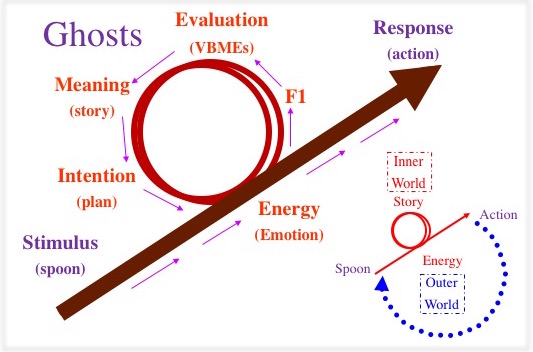
    I noted last post that awareness is “attention to one’s spontaneously emerging perceptions.” Contact is my ability to be present to the immediacy of now. At that time, I introduced the Action Model (reproduced here) with its First Order perception (F1), Evaluation, Meaning, Intention, Energy, and Response. Contact is my ability to hold these various aspects in my awareness without grasping one or more in immediate reactivity. For example, while in heated conversation with another, can I hold the immediacy of tension in my face while I recall a previous conflict with a sibling, while noting my anger and desire be in conflict, perhaps with awareness of my immediate surroundings and the words being spoken by the other. No one of course does all of this perfectly yet the more I can attend to this complexity, the more I am in contact with my environment, the more I am able to choose my responses.

    The skill associated with Contact is that of patience and awareness. For you the reader, as you are able, pause and look at a chair, a bus, a street sign, a person and note that these are all complex images. What are you attending to with your awareness? What body response are you having? What meaning are you giving to your awareness? What (subtle or not) energetic response is there? What immediate action is associated with your experience (even if not overt movement). In training yourself this way over time, you gradually develop the skill of being in contact with now, and you develop associations between these many areas of awareness. All this becomes the basis of how you respond to the immediacy of the present moment.

    Personal Responsibility is also a manifestation of this complex interaction. The best way I can explain this is with another metaphor: a pot of  stew (with a spoon in it) sitting on a stove being heated. It is one of the best metaphors I have of the human mind.

    It is a pot of Energy; the contents of the pot are aspects of who I am — my values, beliefs, memories, and expectations (my VBMEs, the same as noted as Evaluation in the Action Model). All this arises from my past, most of it learned as part of growing up in my Family of Origin (FOO). The heat is my recent past, adding further energy to  the pot: the current stressors influencing my present (finances, relationships, home and work situations, and miscellaneous aspects such as what I saw in my email last night or heard on the internet this morning). There is also a spoon in the pot, my current environment, which adds to, stirs, and adjusts the contents, adding more energy.

    All this leads to movement of the contents within the pot. When stuff comes to the surface, we call it a Thought or Feeling. When it bubbles out of the pot, we can it an Action.

    As noted, I consider it as one of my best metaphor of the nature of the Mind. What does it demonstrate?

    First, actions empty the pot! Actions are the only way in which the pot is emptied. If you want to reduce emotional energy, it has to be turned into action! More about this later.

    Second, imagine if you put a spoon into the pot and brought out a carrot. Would you ever say ‘the spoon made the carrot’?

    No! It makes no sense. The carrot was already in the pot — the spoon merely brought it to the surface.

    Why, then, do you say, “You made me angry” or “You made me do it”? This is saying that ‘the spoon made the carrot’!

    If you take this metaphor seriously (and I do, very seriously), I am fully responsible for all that I think, feel, and do! Certainly there are spoons, yet I create my world! I have no one to blame and I am fully responsible for all my thoughts, feelings, and actions, for all that happens to me. In fact, the word blame does not exist in my vocabulary.

    Note also that this metaphor is a relational model. The output of one pot becomes the spoon of the next pot as we together create what we call reality. Together, these three skills (of awareness, contact and personal responsibility) allow me to dance with my world, both as an individual and as part of a relational system.

  • Transforming Anger: Emotions as Energy for Change

      As noted previously, I had my own anger management program for 25 years, likely dealing with about 4000 people with various issues of anger. I had long concluded that anger is the canary in the coalmine of our culture – it is the measure of how dysfunctional our civilization has become.

      Thus, I focus on anger as the beginning of change. I strongly believe that unresolved anger is dangerous whereas resolved anger is a powerful source for change. Given the current dysfunction of our culture, we need our anger so as to generate change, ideally for the better. If our anger is unresolved, any change generated is likely to worsen our dysfunction whereas if we come to terms with the nature of our anger, we have choice as to how we use it.

      So, what is anger? First of all, anger is an emotion. So, what is an emotion? My working definition is ‘energy to which I give meaning and direction.’ Emotions are the interface between mind (meaning) and body (direction). My best way of describing them is via what is called the Action Model.

      Something happens in life, a stimulus S. Eventually, we respond, R. In the interim, we Sense it (the earliest awareness is called the F1 state). We Evaluate it via our values, beliefs, memories, and expectations (VBMEs), and we make Meaning of it, our story. We develop a Plan of action as to how to respond and we mobilize our Energy to respond, our emotions. And, ideally, we respond (if we feel safe) — we move our energy into the environment. The system works well (and is prone to various glitches, to be described in later blog posts).

      Think of a time that you have been angry. Feel the residual anger as you now experience it. Notice I did not say ‘the anger you had then.’

      Emotions are a present-time body experience — you cannot feel what you experienced yesterday or at any other time; you can only feel ‘now.’ You can think about yesterday, but you can only feel ‘now.’

      That said, feel your anger. Point with one finger to the location of your anger in your body. For most people, they will point to their upper chest, yet some will point to their jaw or their abdomen or other areas. Although we have the single word ‘anger,’ each individual will have their own unique experience.

      Emotions, in general, are describable as a single word, in the ‘now’ moment, and dependent on meaning. As a child when you were learning language, perhaps someone took your toy, and you were upset. Then mummy or daddy said, “Don’t be angry.” You now had a new word to describe both your behaviour and your internal state. You also learned that the word was fraught with difficulty — you shouldn’t be angry. Yet, at the same time, it is likely that no one taught you what to do with this uncomfortable inner state. Now as an adult, when you encounter this body state again, you know to call it ‘anger’ and perhaps you still do not know what to do with it. If you do know what to do, you likely have a sense of power.

      In general, the simple emotions such as anger, sadness, fear, joy are such that they are characterized by a sense of power — you can do something when you experience them. Anger, for example, is an emotion of uninvited or imposed disruption of your boundaries wherein you are capable of pushing back against the disruption. It is the energy of significant difference in a closed space, a relationship.

      If you don’t feel capable of pushing back, the emotion tends to expand, and we give it a different name — ‘rage.’ Rage is the attempt to mobilize action and power in situations of anger where you feel powerless. Furthermore, if the situation becomes overwhelming, one option is to move to self-righteousness as a further protective mechanism in boosting your sense of power.

      In similar fashion, our sadness becomes despair when powerless and laziness (f—k it!) when overwhelmed. Our fear becomes terror and then fearfulness, and our joy becomes ecstasy and then some form of unitive consciousness.

      There are many other emotional words in our language and the definitions of these words varies considerably. The distinctions I make are:

    • Emotions are a single word descriptor of energy to which I give meaning (mind) and direction (body). I can point to my body as to where I experience them.
    • Feelings are a single word description of energy wherein I point to the relationship I have with others. ‘I feel frustrated’ points to an external person or event. Similarly with ‘I feel included [by …],’ ‘I feel honored [about …],’ and ‘I feel betrayed [by …].’
    • Then, there are feeling judgments, multi-word descriptions of my thoughts about my emotions and feelings. ‘I feel [that] you made an error’ or ‘I feel [that] you liked the meal.’ They represent thoughts that carry an energetic load.

      All of the above is relatively simple to describe, yet there is a problem which will be developed in future posts. It is summed up in a personal story:

    Until my forties, my childhood issues were such that I was emotionally numb. After I had done a number of years of therapy, I said to a friend: “I have learned to feel, and I hate it! It is so g..d.. messy!”

      They are still messy yet now I value them.

  • Feedback on my Books: Acedia, the Darkness Within

    Acedia, The Darkness Within

    I have continued to promote my books as I still want to have an impact, and I believe what I have written is important.

    My publisher, Ewings Publishing, suggested I hire some professional reviewers who would provide independent objective assessment of my writings. Attached are these assessments.

    The disclaimer provided notes:

    Book Viewpoint Critic

    Overview

    Our book review service comprises a team of readers with a keen eye and genuine passion, for providing thorough reviews to authors, publishers, and literary agents. Recognizing the impact reviews can have on the success of a book we are committed to delivering quality, objective feedback aimed at helping books realize their full potential.

    The Critics

    Our review panel consists of book enthusiasts with an appreciation for literature and a sharp eye for detail in writing. Comprising critics, published authors, librarians, and avid readers, our diverse team ensures a rounded and comprehensive review process from day one. Each reviewer is carefully selected based on their expertise in genres or themes to ensure that every book receives a critique, from someone who truly understands its nuances and context. 

    Disclaimer

    Please be aware: even as we work hard to provide holistic, constructive reviews, all opinions of the external reviewers are strictly subjective and based on the reading experience of the reviewer. Reviews imply value and informational feedback but never guarantee or promise a particular result. Moreover, all reviews are done with integrity and honesty, and our service payment is not biased at all on the outcome of the reviews. The feedback shall only be one of the various tools that authors and publishers use to fine-tune their work.

    Promotional Evaluations: These evaluations are tailored for marketing purposes. Can be used on covers, websites, and promotional materials to enhance book sales.

    Feedback on Acedia, The Darkness Within, and the darkness of Climate Change. (Metairie, LA: The Ewings Publishing LLC, 2023), https://davidmacquarriebooks.com

    Acedia: The Darkness Within

    by

    Dave MacQuarrie

    “Acedia: The Darkness Within” by MacQuarrie is both enlightening and urgent in pointing out acedia. With an interest in battling the depths of human psychology, the truths he writes about psychological avoidance of life’s challenges come very frankly and deeply. Here in this book, he provides much-needed experiential takes on where modern discontent begins and why our emotional underpinnings are linked with cultural and environmental crises. MacQuarrie provides a compelling narrative that is transformative in view toward the addressing and overcoming of pervasive issues.”

    Eliza Montgomery, Book Enthusiast

    “Acedia; The Darkness Within makes an impact, on the conversation about climate change. MacQuarrie effectively connects our challenges to profound spiritual matters offering readers a fresh perspective on sustainability issues. This remarkable book is a must-read for anyone seeking insight, into the underlying aspects of our problems that are often overlooked.”

    Ethan Sullivan, Environmentalist

    “Indeed, the synthesis of ancient wisdom and modern psychological theory in “Acedia: The Darkness Within” by MacQuarrie does impress. The depth of this book lies in the fact that it makes us start over in re-attitude towards personal and social well-being. MacQuarrie furrows deep emotional and cognitive processes standing in the way of our progress. Worthily stimulating at an intellectual level, it is a piece of information usefully applicable to real life. Herein, as much for the learned philosopher as for the layman, MacQuarrie provides a unique perspective that provokes deep study and examination into our collective and individual behaviors in these trying times.”

    Clara Pennington, Philosophy Blogger

    “Tracing the history of acedia from its early Christian origins to modern secular forms, MacQuarrie offers in ‘Acedia: The Darkness Within’ a rich historical view that is at once informative and thought-provoking. He explores how the concept has evolved over the centuries with great care, shedding light on that which bears the impression of an ancient concept on human behavior and social development. MacQuarrie performs an in-depth analysis that not only allows exploration of historical setting but also links past understandings of acedia to contemporary concerns. Therefore, his work turns into a helpful tool for history enthusiasts, cultural scholars, and everyone interested in understanding the intricacies of human nature and the resurfacing of acedia in contemporary times. A really eye-opening book to all those interested in the nexus of history, psychology, and culture.

    Gareth Langley, History Buff

    “MacQuarrie is an erudite, and in this book, he profusely gives his practical advice on the way out of acedia. His touting of wisdom, playfulness, and discipline is in key with current thinking regarding how effective self-help should be conducted. This book provides some concrete, workable strategies to effect real change in everyday life. I would highly recommend it to all those contemplating personal growth and well-being.”

    Sophia Whitmore, Self-Help Blogger

    “Acedia: The Darkness Within offers a deeply spiritual exploration of the pervasive modern problem. Thoughtful integration of theological concepts with a challenge of modernity places MacQuarrie’s work at the top tier of documents in the spirituality genre. He weaves through ancient wisdom and today’s urgent problems to offer readers an in-depth insight into how acedia has undermined contemporary living. Any serious-minded person concerned with deeper levels at the juncture of spirituality and the modern, looming existential crises should read this book.”

    James Carlisle, Spirituality Blogger and Writer

    “MacQuarrie’s urgent and inspiring appeal to address climate change is highlighted in this book, which not only diagnoses acedia but also offers steps, for transformation. It is a must-read for activists and individuals who care about the environment offering insights, into the psychological factors underlying our environmental crisis.”

    Isabel Carter, Environmental Activist

    “Of all the ideas shared, MacQuarrie’s insight into the nature of choice and the place of wisdom was the most valuable to me as an avid educationist. In his book ‘Acedia: The Darkness Within’, he writer delves deep into psychology and philosophy as far as decision making and personal growth are concerned. This should be recommended reading for all teachers because it provides in-depth views on implanting wisdom, resilience, and emotional intelligence in children. It is an important source that educators need to motivate and advise the emerging generation effectively.”

    Henry Beckett, Education Blogger

    “It is in ‘Acedia: The Darkness Within’ that MacQuarrie’s deep understanding of the emotional mind and his creative therapeutic approaches come into their own. Herein lies a useful book about the whims of human behavior and emotional well-being. It is an essential read for mental health advocates and professionals alike, particularly in the real strategies it gives for facing and overcoming the challenges of acedia in modern life.”

    Olivia Kline, Mental Health Advocate

    “MacQuarrie’s revelation of how acedia impacts leadership and health of organizations is a matter of eye-opening knowledge. In ‘Acedia: The Darkness Within’, he investigates how this ancient concept affects modern leadership practices and the general wellness of organizations. This book is timely for all those involved in the development of leadership and corporate training since it comes with hands-on strategies to promote work environments that are healthier and more resilient. MacQuarrie’s work is fertile ground in the category, challenging leaders to deal with emotional and psychological human issues forming the base for organizational success and sustainability.”

    Marion Blake, Leadership Consultant

  • Our Uncertain Future

    Anxiety2Resilience.org has recently presented an excellent forum entitled Uncertain Future Forum (20190715-20190726) highlighting “If collapse is imminent, how do we respond? Each is short, succinct, and pertinent to the issues.

    Dancing with Grief, Dahr Jamail, 20190715

    I have the greatest respect for Jamail as one of the most authentic writers of the issues of climate disruption. For me, this essay is one of his best.

    Turning Toward Each Other, Meghan Kallman, 20190716

    The need for community is our highest need, yet we are so poor at cooperation in this culture. We have a long way to go.

    The Disabled Planet, Taylor Brorby, 20190717

    An excellent comparison between individual health-disability and planetary health-disability, our need to recognize the huge inequalities inherent in modern capitalism.

    The Seventh Fire, Winona LaDuke, 20190718

    There is a huge need to access indigenous knowledge and skills, but for me, the risk is that they will simply become part of the capitalist system.

    Responding to Collapse: Uncertain Future Forum’s First Week, Daniel Lerch, 20190719

    The bottom line: collaborate with others, be in community, tend to yourself.

    On Listening to the Earth, Dahr Jamail, 20190722

    How do we list for truth, our own truth of how to respond to the coming crisis?

    Three Practices for a Time of Crisis, Meghan Kallman, 20190723

    We need new practices: the practice of grieving so as to make space within, the practice of holding painful paradox, the practice of effective hope (somewhere between idealism and pragmatism where what we do might matter).

    Biting the Hand That’s Fed Me, Taylor Brorby, 20190724

    It is time to stop the insanity that has been so beneficial to us.

    Find Your Mettle, Winona LaDuke, 20190725

    Courage is needed.

    Responding to Collapse: Uncertain Future Forum Wrap-Up, Asher Miller, 20170926

    We have an obligation!

  • ¿Truths? Part 15

    Dave’s ¿Truths?

    CogDiss01The final post of ¿Truths?

    As noted with ¿Truths? Part 1, I am choosing to offer these thoughts simply to encourage growth. I submit them simply for self-study as an example of one person’s searching — such self-study is a very powerful way to come to know yourself. The list of these truths is long and I will submit it over a number of blogs, 25-30 brief statements per posting.

    As previously noted, a comment on language: I am not an advocate of scientific materialism, the philosophic ontology that only science can address truth, and that energy-matter is the only domain of experience in the universe. I value scientific methodology highly, but the overall terminology of scientific materialism has many hidden presuppositions. As much as possible, I will identify them in these posts.

    The following thoughts of Charlotte Kasl seem very appropriate stances.

    The 16-Steps

    (1) We affirm we have the power to take charge of our lives and stop being dependent on substances or other people for our self-esteem and security.

    • An alternative:  We admit/acknowledge we are out of control with/powerless over ________, yet we have the power to take charge of our lives and stop being dependent on substances or other people for our self-esteem and security.

    (2) We come to believe that God/Goddess/Universe/Great Spirit/Higher Power awakens the healing wisdom within us when we open ourselves to the power.

    (3) We make a decision to become our authentic selves, and trust in the healing power of the truth.

    (4) We examine our beliefs, addictions and dependent behavior in the context of living in a hierarchical, patriarchal culture.

    (5) We share with another person and the Universe all those things inside of us for which we feel shame and guilt.

    (6) We affirm and enjoy our intelligence, strengths and creativity, remembering not to hide these qualities from ourselves and others.

    (7) We become willing to let go of shame, guilt, and any behavior that keeps us from loving ourselves and others.

    (8) We make a list of people we have harmed and people who have harmed us, and take steps to clear out negative energy by making amends and sharing our grievances in a respectful way.

    (9) We express love and gratitude to others, and increasingly we appreciate the wonder of life and the blessings we do have.

    (10) We learn to trust our reality, and daily affirm that we see what we see, we know what we know and we feel what we feel.

    (11) We promptly admit to mistakes and make amends when appropriate, but we do not say we are sorry for things we have not done and we do not cover up, analyze, or take responsibility for the shortcomings of others.

    (12) We seek out situations, jobs, and people who affirm our intelligence, perceptions and self-worth and avoid situations or people who are hurtful, harmful, or demeaning to us.

    (13) We take steps to heal our physical bodies, organize our lives, reduce stress, and have fun.

    (14) We seek to find our inward calling, and develop the will and wisdom to follow it.

    (15) We accept the ups and downs of life as natural events that can be used as lessons for our growth.

    (16) We grow in awareness that we are sacred beings, interrelated with all living things, and we contribute to restoring peace and balance on the planet.

    That’s it for my ¿Truths?

    Finally! A long list (hopefully you enjoyed it).

    Almost certainly there is more to come (sometime in the future).

  • ¿Truths? Part 14

    Dave’s ¿Truths?

    Truth3As noted with ¿Truths? Part 1, I am choosing to offer these thoughts simply to encourage growth. I submit them simply for self-study as an example of one person’s searching — such self-study is a very powerful way to come to know yourself. The list of these truths is long and I will submit it over a number of blogs, 25-30 brief statements per posting (now almost at the end).

    As previously noted, a comment on language: I am not an advocate of scientific materialism, the philosophic ontology that only science can address truth, and that energy-matter is the only domain of experience in the universe. I value scientific methodology highly, but the overall terminology of scientific materialism has many hidden presuppositions. As much as possible, I will identify them in these posts.

    (353 — Continuing from previous) So much of cultural/societal tradition encourages me to do good; I validate this.

    (354) To be human is truly to encompass the human process—not the journey that I demand happen (being willful), but the journey to which I need surrender (being willing).

    (355) Other people have done this journey before me—they can guide me. I can learn from them, and I have to do my own journey.

    Guides come in many forms—most important for me is whether or not they have done their own journeying!! If they have, they offer me an example of integration; if they haven’t, they offer me beliefs (and shoulds)! I can read about shoulds in a book.

    At some point(s), I need a guide—they can help me know what I do not know! They have been here before.

    (356) Why do this journey? Why plan? Why work hard at living?

    As a pattern generator, somehow I delight in a good map. And if I do not do this work, I suffer—a lot! I have choice about this!

    (357) There are two major measures of the journey.

    The first involves the development of humility, compassion and respect—for myself and others. Nobody is perfect and we all attempt to do the best we can. We all fall down.

    The first measure is how quickly we get up, from an authentic fall to an authentic stance of getting up, not avoiding the pain!

    The second measure is how we respond when others fall down.

    (358) To be flexible with craziness (my own and yours’s) is also a true measure of maturity.

    (359) There are two major measures of truths, including these truths!

    • how inclusive is the truth. Who is excluded?
    • how persuasive is the truth. How do I resonate with it?

    (360) I seek the current edge of my truths; I chew on my own truths until I am complete with them. Two areas currently occupy my attention.

    • I am clear that much of the/my therapeutic process is beneficial; I am less clear as to its harmful elements.
      • This is still true in my “retirement.”
    • In giving voice to my energy, what is the appropriate balance of my private inner world and the part of me that needs to be heard in the public domain.
      • In my retirement, I am choosing to give more attention to the public. I want my grand-children to know that I did not accept the current insanity of our species, especially in the negatives associated with scientism and consumerism.

    (361) Aspects of guiding/therapy are harmful. Some of my ways of harm are —

    • I attempt to be a mentor, assisting others on their unique journeys. I do not do it perfectly—I make mistakes. I do not intentionally abuse others yet the potential is there, especially with mistakes in judgment. As well, I know that therapist-client abuse is a major societal issue at present.
      • When is my therapy abusive?
    • For the most part, I teach the skills of the inward journey. This is valuable and, I believe, essential to being a presence in the world. Yet I am myself not fully satisfied with the balance of inner/outer; sometimes I get stuck in being too inward, in not being public appropriately.
      • Do I trap my clients in the same way?
    • Often I use metaphor, the “inner child” or “sailors on a ship” as an example. Metaphor provides a frame to understand and experience. I am clear with myself that this is simply a model to aid understanding, yet I often get stuck in understanding, as opposed to action.
      • Do I trap my clients in this way also? Understanding (actually overstanding, as used by society) is the booby prize!

    (362) I believe that each guide/therapist has his/her own ways of causing harm.

    (363) A growing edge for me is to be public in an appropriate fashion, to challenge the stance of others, the judgments of others, in a way that speaks my truth!

    Fritz Perls said that “The only authentic statement is a demand!” For me, this is partly true; another authentic statement is “I stand here.”

    (364) The more something bothers me, the more I have to learn about myself (this is an aspect of the pointing finger).

    What is the troublesome aspect? How does it reflect my own issues?

    (365) Human beings are creative! The above truths can be the basis of a very powerful life, with much choice and much joy.

    (366) ACT!

    I work/play so as to accept (A) what/who I cannot change (especially other human beings), change (C) what/who I can (especially myself), and treat (T) myself well in the process. I only have now (!) in which to do this.

    (367) The road to Hell is paved with good intentions.

    (368) The bog! The pit! Yuk!! How did I get in, this time, again.

    Being confused in some fashion, often lazy or fearful. Saying “Yes” when I mean “No.” Following “shoulds”, my own or others.

    (369) The bog! The pit! Yuk!! How do I get out, this time, again.

    Clarity/choice/voice, especially choosing! ACT! Saying/doing “No” when I mean “No.” Saying/doing “Yes” when I mean “Yes.” Self-care, treating myself well!

    (370) I still have choice about that which I cannot change.

    A major choice involves whether I will continue to suffer or not!

    Acceptance does not mean no pain; it means diminished suffering. And it is an active process, not a passive surrender: valuing the benefits, modifying as possible the costs. Living the Serenity Prayer.

    (371) Human beings are magical. The above truths are not, and do not need to be, consistent—living is paradoxical.

    To live fully, I need on occasion to step outside the bounds of rationality.

    (372) Some additional thoughts—

    • How do you eat an elephant? One bite at a time!
    • I have many questions, and only a few answers.
    • The truth will set you free but first, it will make you miserable (and afterwards, it will bind you!)
    • Honesty without compassion is disguised hostility!
    • I will go as far as I can see; then I will be able to see further!
    • Don’t confuse activity with achievement!
    • 3Ds — desire, determination and discipline; 3Ps — patience, persistence and positive; 3Cs — courage, commitment and confidence
    • Success is getting what you want; happiness is wanting what you get!
    • Do I contradict myself; very well then, I contradict myself. I am large; I contain multitudes. (Walt Whitman)
    • The Chinese pictogram for ‘Crisis’ has been said to mean both danger and opportunity!

    (373) You cannot clarify repeated miscommunication by communicating further about it.

    Gregory Bateson (and later, Robert Dilts expanded upon) the Logical Levels of Experience (Environment, Behavior, Capabilities, Beliefs, Values, Identity, and Spiritual), a holarchy of processes such that significant change at one level requires modification at a higher level.

    Repeated miscommunication is a Behavior, and requires change at the Capability or Belief or higher level rather than more communication.

    (374) You have hit bottom when you stop digging!

    To be continued — one more to go!

  • ¿Truths? Part 13

    Dave’s ¿Truths?

    Truth2As noted with ¿Truths? Part 1, I am choosing to offer these thoughts simply to encourage growth. I submit them simply for self-study as an example of one person’s searching — such self-study is a very powerful way to come to know yourself. The list of these truths is long and I will submit it over a number of blogs, 25-30 brief statements per posting.

    As previously noted, a comment on language: I am not an advocate of scientific materialism, the philosophic ontology that only science can address truth, and that energy-matter is the only domain of experience in the universe. I value scientific methodology highly, but the overall terminology of scientific materialism has many hidden presuppositions. As much as possible, I will identify them in these posts.

    (329 — continuing from previous) These imperatives also form a rich basis for ethical judgment. To ignore them is evil or, at the very least, borders on evil.

    (330) Everything has an appropriate context somewhere/sometime. That which expands is that which contributes to growth.

    (331) A moral/ethical stance does not suppress choice, but educates and allows liberty, encourages growth and fosters relationship. Life exists in relationship.

    (332) Beyond all this, I believe that there exists a profound direct experience with mystery, being at one with the universe, called enlightenment or nirvana (as well as many other names).

    I have experienced it—and I trust the validity of the experience.

    Apparently a gift of mystery, unearned and perhaps not available as gift to everyone, this journey of life serves to allow the gift to be received and held without willfulness!

    (333) The ultimate human journey is to live in joy and glory, free from alienation, in selfless service to life!

    Paradoxically, I believe that I achieve this most effectively by ensuring my own growth, my own truths, my own pleasure and play.

    (334) To be effective is to be loving and playful.

    (335) I am not a human being on a spiritual journey; I am a spiritual being on a human journey!

    My major work is to be grounded, so that I can then fly with the eagles.

    (336) God doesn’t care if I work every day; God cares if I live every day.

    (337) A life of sanctity is one in which I give thanks! To truly give thanks is to be in the presence of mystery and awe!

    (338) My best working hypothesis of life is this—mystery (God) is all-present and all-knowing, yet lacks wisdom.

    We are each a hologram of God—as humans, we are God’s teachers. Each of us is a set of possibilities that may become effective as a human being; in the struggle, God can learn wisdom.

    (339) God don’t make no junk!

    (340) I am capable of every experience, every act, no matter how heinous.

    I don’t however have to act it! I have choice. The same is true of you, another individual!

    The price tags may be different, though.

    (341) The struggle to live fully is painful. From my perspective, I may not succeed; I may make poor choices. From God’s perspective, I am a contribution to God—and I am loved.

    (342) What is the bottom line? For me, the bottom line is that I live in such a way that:

    • I act in a way that is consistent with what I say I want,
    • I live into my wanting what I get,
    • I have integrity in my core moralities, and
    • I have compassion, humility, and respect with others.

    (343) For me, one of the better ways of thinking about God is contained in a puzzle called the 9-dot puzzle

    Form 9 dots into a square, with one in the middle. Join the 9 dots with 4 straight lines without taking your pen off the paper.

    Ask me about the answer if you get stuck. You need to step outside the box!

    (344) God is useless!! God cannot be used.

    I can be used by God though.

    Especially God cannot be used as an excuse or an explanation of why I do not live my journey!

    (345) From God’s perspective, it is likely that nothing will be used in evidence against me!

    (346) The sign of God is that I will be led where I did not intend to go!

    In quite unexpected ways, life presents me with opportunities and/or choices I did not expect, sometimes pleasurable, sometimes painful.

    The occurrences seem more often than I would expect in a meaningless universe. When they occur, I am struck by how meaningful they are to me! This is called synchronicity.

    (347) There are no quick fixes! Life is a journey and even the most rapid growth requires 5-10 years of effort!

    (348) If I always do what I have always done, I will always get what I have always gotten.

    (349) The journey has at least several stages.

    One stage is the psychological journey (the willful journey), a stage of ego development in which I learn to say “I am! I can! I will!” This is the stage in which I struggle with my parents, with what I have been given in life, a stage where my emotions often rule (either consciously or unconsciously).

    This is a necessary stage, being willful of myself. Difficulty occurs when I become willful of others as a substitute for my own growth.

    (350) Another stage is the spiritual journey (the willing journey), a stage of ego transcendence in which I learn to initiate choice, a stage in which the moral imperative is chosen, a stage where the universe seems in charge.

    Jesus said it as “If it is possible, let this cup be taken from me; if not, Thy will, Oh Lord!”. Many others have said it similarly.

    (351) Essential to both of these stages is to learn what I think and feel, what my ongoing awareness actually is; it is often painful. The second component is then to learn what to do with my awareness, what actions are effective.

    This is a life-time process!

    (352) A third stage appears to be the possibility of experiencing the gift of Mystery.

    The earlier growth perhaps allows the gift to be sustained.

    (353) So much of cultural/societal tradition encourages me to do good; I validate this.

    However, to feel good needs to be a major underlying basis of doing good; otherwise I am likely to be trapped in resentment or guilt.

    I choose to feel good rather than do good as my approach to life.

    To be continued — almost done!

  • ¿Truths? Part 12

    Dave’s ¿Truths?

    Meaning2As noted with ¿Truths? Part 1, I am choosing to offer these thoughts simply to encourage growth. I submit them simply for self-study as an example of one person’s searching — such self-study is a very powerful way to come to know yourself. The list of these truths is long and I will submit it over a number of blogs, 25-30 brief statements per posting.

    As previously noted, a comment on language: I am not an advocate of scientific materialism, the philosophic ontology that only science can address truth, and that energy-matter is the only domain of experience in the universe. I value scientific methodology highly, but the overall terminology of scientific materialism has many hidden presuppositions. As much as possible, I will identify them in these posts.

    (304) Part of the program includes my learning of terror and trust.

    (305) If I do not trust the universe, my action options are:

    • Being willful—of others (domination and self-righteousness).
    • Being willful—of self (domination and/or discipline).
    • Running away (scared — fearfulness).
    • Collapsing (scared — laziness).

    Except for the option of discipline, these are all forms of acedia.

    (306) Acedia is the ultimate response to being overwhelmed in my lack of trust.

    It is any combination of profound fearfulness, laziness, or self-righteousness.

    It is a stance in which I object to the effort required to achieve good outcomes of living, to achieve a stance of authentic love and charity.

    (307) If I do trust the universe, my action options are: discipline.

    (308) The way out seems to be trust and discipline.

    (309) Yet this does not mean passivity, especially towards the violations of others.

    One of my favorite definitions comes from the 19th century:

    A gentleman does not hurt the feelings of another unintentionally.

    (310) Much of my life, I have refused to say “Yes!” to life—and I am alienated. How do I learn to turn around, to repent, to live in surrender to the moral imperative!

    To be civil is to live consciously motivated in this stance. A major part of this is to struggle with my own truths and priorities.

    (311) I also do this by contributing to life in all its fullness, taking a moral stance to the universe.

    My core moralities center on:

    • graceful aging,
    • striving for authenticity,
    • midwifery—contributing to the life and growth of others,
    • being in community with others,
    • being my word, and
    • celebrating life.

    (312) Life is irreversible.

    For effective living, I need to gather data and make choices.

    Much of the gathering of data is biologically inherent—if I trust my experiences.

    (313) Each choice I make excludes other options. There is a certain amount of pain in this!

    I lose possibilities, dreams, satisfactions; in my choosing, I may not get everything I want! Especially if my choices are too small and lack integration with who I am.

    (314) Yet, not making choices traps me in the pain of being in limbo, of drifting, of fear of consequences.

    (315) When stuck between a rock and a hard place, I prefer to choose how I am crushed!

    I have more power and freedom when I choose the consequences with which I wish to live.

    (316) It is easier to get forgiveness than to get permission.

    Some of my choices necessitate interaction with others. Others may not want change or forced choice—yet they can often live with the change if I simply act rather than seek agreement before action!

    The cost may be loss of relationship!

    (317) When I change, others will adapt, albeit slowly.

    When I change, it requires approximately 13 weeks or 3 months for the change in the system (the family, work, et cetera) to settle.

    (318) If I can consistently change for 3 months, the system will adapt. If I don’t like the new status, I can change again!

    (319) Frequently I expect the system to adapt within days or at most a week!

    This is a form of suffering!

    (320) I do not know the meaning of this journey and I believe that there is meaning. The universe fundamentally is a mystery, one that mankind has called God. This mystery for me appears to be based in love and play.

    I believe that there is personal mystery, a relationship with mystery. There are many paths.

    I believe that I am a channel for mystery, that mystery uses me to contribute to the betterment of the universe (myself, others and nature), that I have purpose even though I do not know what that purpose is.

    (321) God must have an riotous sense of humour!

    What else could account for this vibrantly chaotic universe? this self-organizing mosaic of every conceivable possibility!

    (322) Ultimately I will die. Not a possibility, nor a maybe—I will die! My life, my contribution, my way of being will cease to exist.

    I will also share in the deaths of my friends and family—to be no more, other than in my memories.

    How will I live? How will I die? I believe that it is possible to be at peace with these questions.

    (323) To the best of my knowledge, there is a moral imperative to the universe, an imperative such that we as humans are in relationship with the universe, with each other, and with our environment.

    When I ignore this imperative, I am alienated.

    (324) I also believe that there is, for lack of a better term, something that is called evil, both a part of mystery and a part of me.

    What expands me is mystery; what contracts me is evil. What alienates me from relationship is evil. Often it is a subtle process, not easily identified. For examples, raging (not my rage per se, but being trapped in my rage) may be a manifestation of evil. My laziness is often a movement towards evil. To be trapped by fear may a form of evil—to be cautious is not.

    A major part of journey is learning authentic response to mystery and evil.

    (325) When sustained, acedia is a major advance towards evil.

    (326) Violation of self or others is ethically unacceptable, a form of evil.

    (327) The universe appears to be based on the moral imperatives of:

    • subjectivity (interiority and choice),
    • differentiation (growth),
    • community (relationship), and
    • change

    There are no obvious absolutes, everything is different, everything grows/matures, and everything is related to everything else. And everything is evolving or devolving.

    (328) Violations however invariably breech one (if not all) of these precepts of the universe.

    (329) These imperatives also form a rich basis for ethical judgment. To ignore them is evil or, at the very least, borders on evil.

    To be continued.

  • ¿Truths? Part 11

    Dave’s ¿Truths?

    As noted with ¿Truths? Part 1, I am choosing to offer these thoughts simply to encourage growth. I submit them simply for self-study as an example of one person’s searching — such self-study is a very powerful way to come to know yourself. The list of these truths is long and I will submit it over a number of blogs, 25-30 brief statements per posting.

    As previously noted, a comment on language: I am not an advocate of scientific materialism, the philosophic ontology that only science can address truth, and that energy-matter is the only domain of experience in the universe. I value scientific methodology highly, but the overall terminology of scientific materialism has many hidden presuppositions. As much as possible, I will identify them in these posts.

    (278 — Continuing from previous) What gets my attention gets me!

     (279) Society has the potential to offer much in the way of authentic living—affection, validation, contribution (participation), and earnings.

    Often this does not occur.

    Is it fair? (What is the agreement that I have with society?)

    (280) In general, this society does not validate authentic living—authentic living is unpredictable.

    Authentic living is usually a risk against the cultural model! It is judged stupid or inappropriate (the crab trap). We lack ways of safe expression (of all emotions, but especially rage), Our current ways of handling/denying rage frequently contribute to the violation of one person by another.

    As a society, we need new ways of being human.

    (281) I want to live authentically, getting what I say I want. How?

    Am I starting from the optimal place?

    (282) For me, the best definition for happiness is ‘wanting what I get’—note the differences from ‘getting what I want.’

    (283) I get trapped in my emotions when I experience them in ways that leave me powerless — shame, despair, raging amongst others.

    All emotion has a positive intent for me — when I determine and validate that positive intent (security, searching, caring), I am empowered.

    (284) Anger and rage are for me paradoxical—they are both the most dangerous, and the most cleansing, of emotions. Dangerous when denied, and most cleansing when used effectively.

    I am angry when my boundaries are invaded without my permission — and as a human being, I have very complex boundaries. I am enraged when I am simultaneously powerless and my fundamental beliefs of identity and spirit are denied.

    (285) To be safe means to be free from damage ¾ danger, or injury, or the risk of damage. To be secure means to be free from apprehension.

    Safety does not mean security! Security does not mean safety!

    (286) To be safe with my anger/rage means that I am responsible for consequences, and that I am committed to safety.

    (287) I have three rules for my anger/rage, summarized in the acronym ‘No SAD!’ When in anger/rage:

      • I will not intentionally scare (S) another human being.
      • I will not attack (A), physically or emotionally, another biological creature.
      • I will not destroy (D) in anger that which I would not destroy in peace.

    (288) I do not give myself, nor do I give others, permission to ignore these rules, unless life is being threatened.

    I will not violate others intentionally, unless it is very clear that I am being violated in a life-threatening manner.

    (289) The second fundamental of safety is “STOP”.

    Saying “STOP” means that someone, usually the person saying “stop,” does not feel secure, and is requesting that all threatening action cease until both safety and security are re-established.

    It is essential that this be honored¾the overlap between safety and security is unclear at this time.

    (290) When I am in internal conflict, I frequently experience this as external conflict in relationship.

    The more I am willing to sort and integrate my internal conflicts, finishing what is unfinished, the more I open myself to love and play.

    (291) When I point my finger at you, when I blame you, I am powerless.

    A powerful metaphor is present in this process—with my finger pointing at you, my thumb stands up, and three fingers point at me! The thumb represents the issue—it needs to be handled, and it is as much part of me as it is of you. My three fingers remind me that

      • what I critique in you is also true of me, often more so,
      • it is easier for me to blame you than to examine myself, and
      • if I change and act more effectively, the issue will also change, and you might also change too!

    (292) An effective leader is one who demonstrates the least blame (thereby avoiding focus on the third limb).

    (293) My society is a society of violence and alienation.

    I have no major issue with violence—life is violent.

    My society is frequently a society of violation—I do not condone violation.

    Violation occurs when freedom is restricted without permission. For me, this is only permissible in the interests of public safety—this is generally called ‘law.’

    (294) My society is misogynist and sex-negative.

    Growth however leads to vibrant sexuality, and is both time-consuming and demanding of authenticity.

    (295) My society is child-negative.

    Children are our resources, both for the future, and for many of the skills we have lost. They have their own wisdom.

    (296) My society promotes knowledge and understanding.

    I have no quarrel with knowledge—wisdom necessitates knowledge, accuracy of map to territory. Yet as a society, we are trapped by too much information, too much knowledge, too many options.

    I also have no quarrel with understanding—authentic understanding means “to stand under,” to experience self as part of something bigger.

    (297) As a society, we value “overstanding” (attempting to dominate) more than “understanding,” and “information” more than “knowledge.”

    (298) My society has made major errors, especially as to the nature of power.

    Fundamentally there are two choices:

      • becoming willful: domination, or
      • becoming willing: cooperation

    (299) Through domination, I can be willful, developing a culture based on power and technology, on empire and slave (with many subtle euphemisms to hide what is actually happening).

    Actions do however speak louder than words. Using domination, I gain significant mastery of life, with major advantages. The cost is loss of humanity, loss of relationship with the universe. Much of post-European society has followed this track.

    (300) The other way is by being willing, to observe and track life, with little intervention or technology. My relatedness increases. I am at risk of starvation! Other cultures, notably the original North American native, have followed this track. Major consequences occurred during the interplay of cultures!

    (301) Somehow there is a balance. (!!!???) Not easy, but then life is not designed to be easy. Life is!

    Given that we overall have chosen domination, the task now is to develop power over power, to learn to use power for the purpose of cooperation. Given the self-righteous greed of domination, this will be a difficult path.

    (302) I am a part of society. Am I part of the solution, or part of the problem?

    (303) I am not a machine. I have inherent variability, within myself (including illness) and outside myself (compared to you).

    I am programmable, especially during early childhood when my brain is developing (this is also perhaps when my mind is developing, at least the inter-relatedness between my mind and my brain).

    Is the program appropriate?

    (304) Part of the program includes my learning of terror and trust.

    To be continued.

  • ¿Truths? Part 10

    Dave’s ¿Truths?

    CogDiss01As noted with ¿Truths? Part 1, I am choosing to offer these thoughts simply to encourage growth. I submit them simply for self-study as an example of one person’s searching — such self-study is a very powerful way to come to know yourself. The list of these truths is long and I will submit it over a number of blogs, 25-30 brief statements per posting.

    As previously noted, a comment on language: I am not an advocate of scientific materialism, the philosophic ontology that only science can address truth, and that energy-matter is the only domain of experience in the universe. I value scientific methodology highly, but the overall terminology of scientific materialism has many hidden presuppositions. As much as possible, I will identify them in these posts.

    (247 — Continuing from previous) When I attempt to change the third limb, I am both willful and stuck, generally without love or play!

    (248) Unhealthy functioning manifests as chronic anxiety within the system. Symptoms of such a system include:

    • lack of well-differentiated leadership,
    • herding (togetherness in competition with individuality),
    • displacement of blame (decreasing personal responsibility),
    • reactivity (deregulation), not available to experience and insight,
    • sabotage proportional to poor leadership,
    • hostility proportional to lack of self-regulations, and
    • a quick-fix mentality.

    (249) My reassurance is a way of telling the other that I have not heard them.

    The other is likely telling me of their struggle with a human issue. How can I possibly predict the future outcome that will be experienced, especially by the other, let alone by myself?

    (250) My stuckness is a measure of my trust: the more stuck, the less trust!

    (251) Sulking and resenting are major forms of being willful and stuck!

    (252) A useful summary that says much of how we create pain is:

    Don’t bitch; don’t blame; Don’t panic; don’t shame.

    (253) Every behavior has an appropriate context, a time and place when it is effective, or at least useful.

    (254) A major part of the journey is dealing with the unfinished business of what I have been given in life: my natural talents, my family of origin, and the consequences of my past choices.

    Especially, these impact my major relationships, my friendships and my marriage(s).

    (255) The family is the fundamental context for the individual, for health and disease and growth.

    It is from my family that I learn my cultural models and my unique intergenerational mythology, my modeling and imprinting of who I should be (and against which I define myself).

    (256) Who taught you how to be in a family?

    The obvious answer is the nuclear and extended family. Yet how healthy were they in their own lives?

    And most of the learning seems to occur in the first few months or years of life, long before we have any choice as to what we learn.

    (257) Given this, if the nuclear and extended family are unhealthy (witness the current divorce rate and the extent of family violations), how can the system be impacted so that children are exposed to healthy lessons.

    I don’t know! The unhealthy aspects of our culture are so interconnected.

    (258) I grow. My most obvious growth took place as a child, in the emotional field of my family of origin.

    It is however a life-long process, one of becoming an individual, able to stand alone yet interdependent on others, living the rules that work for me, and rejecting those that do not.

    (259) The child grows and learns many skills.

    (260) The covert skills are:

    • how to be crazy (learned by modeling the behavior of caretakers),
    • how to avoid the pain of the craziness of others (learned by modeling the behavior of caretakers), and
    • new ways of avoiding pain (learned from his/her coping with the pain of all this)!

    (261) Growth requires that I risk change! Change is often painful!

    (262) Life is painful, and we avoid pain.

    Until we truly learn that pain is inevitable, and life is to be lived!

    Then it doesn’t matter that life is painful.

    (263) Life is not always, or even generally, painful, nor do we avoid pain always.

    Life is in balance—however, in large measure, we attempt to grasp the positives, and avoid the negatives.

    At least, until such time as we grow in maturity.

    (264) Substance abuse (alcohol, drugs, caffeine, work, any avoidance) is just another avoidance.

    Complicated, though, by the dangers and consequences of the substance itself!

    (265) The primary role of the family is nurture and re-creation.

    (266) Parenting is the process of giving a child roots (nurture and rules) and wings (risks and the re-creation of the next cycle of life).

    It is impossible to parent correctly or perfectly. As the child grows, the rules must be tested, and frequently rejected. Life must be risked!

    (267) The best parenting occurs when the parent does not violate the child, and yet the parent lives his or her own truth!

    And allows the rules to be known and spoken — and broken so as to allow learning.

    (268) Very few of us have had perfect parents, and very few of us have identified our own truths.

    In our current society, most of us have been violated in some way, and we continue the cycle by violating others, especially our children.

    (269) I want to end this cycle.

    I believe that this is best done by identifying and living my own truths. And being honest about my mis-takes.

    (270) I need to love my children for who they are, not who I think they should be!

    And I have a responsibility to them to provide an adequate model for them, a mirror for them to seek their own growth.

    (271) Children have a right to be heard; adults (especially parents) have a responsibility to be clear! and generally consistent!

    However, the family is not a democracy. Although children have a right to be heard, their wants and desires must be evaluated within the parameters of safety and equitable distribution of resources.

    (272) If I will listen, I will learn that children have an incredible wisdom; they are not yet stuck with the cultural models, especially the ‘shoulds’!

    (273) Good health (emotional and physical) is an interactive process of living my truths within my emotional network.

    When I define myself, and choose to live my truths, others are also able to do so.

    (274) Despite genetic anomalies and biological predisposition and genuine accidents, most of us, most of the time, create the health and disease that we experience.

    (275) To say “yes” to life means that I am authentically emotional (angry, sad, sexually excited, joyous, scared-excited), and authentically in action.

    I need also hold rage, aloneness, ecstasy, and terror without being trapped.

    (276) My emotions are the way in which my body experiences and expresses my beliefs—the outcome of the delay loop that is my mind.

    When my beliefs do not match what life is presenting, my “negative” emotions surface. Some part of me has been lost, and I hurt.

    Especially when my core beliefs are challenged, my emotions are very volatile! and very powerful!

    This is simply information—often very unpleasant though!

    (277) Some of my core beliefs are quite infantile!

    These beliefs arose from how I experienced life in my family, when I was 1-2-3 years old! Frequently these beliefs are inconsistent and quite impractical to adult living.

    Learning what these beliefs are, and making better choices, is a major task of living.

    (278) What gets my attention gets me!

    Focusing on others, blaming others, gets me pain.

    Focusing on my own process of living, of making better choices, frequently gets me completeness.

    To be continued.