Category: Who Is Dave?

  • The Search 3 — The Skills

    In this post, I am going to outline briefly the skills necessary so as to live fully; subsequent post (chapters of the future book) will develop the nature of these skills and the means of acquiring them. Initially, the discussions will be somewhat abstract because I am seeking to develop a common language between myself and the reader.

    As a therapist, I am very aware of the need for clarity; I often define the skill of good communication as the ability to recover from bad communication. Unfortunately, written communication makes that skill difficult to achieve; hence my need to ensure clarity.

    A primary question here is who and what are we as human beings? I will be presenting a variety of answers to this question and invite you the reader to delve deep into both my answers and your own. Let me state first that I am not claiming to be an authority in these answers, only that I have spent much of my life attempting to answer these questions — they define who I am and how I interact with people.

    My first answer is that, like all biological creatures, we are energy transformers (by energy, I mean the ability to do work, which for biological purposes means the ability to create some kind of change). I interact with what life offers, especially the presence of other human beings, process what they offer (their energy) and convert this to my response (my energy, offering my attempt to create change). Between us, we dance with each other’s energy (hopefully under-standing each other in the process).

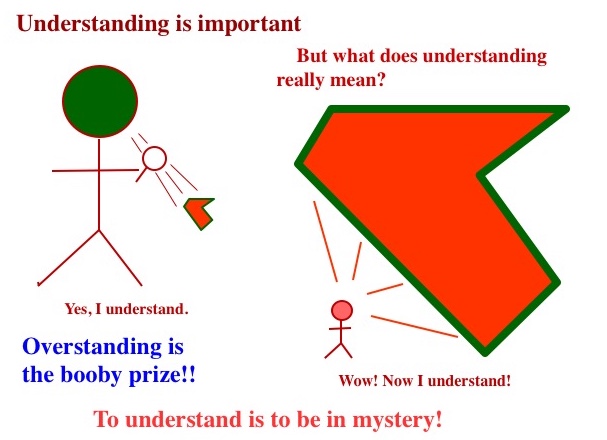
    This word understanding is one that is vital to our conversation. With my clients, I draw two simple diagrams. The first stick figure is using a magnifying glass to analyse an object, saying “Yes, I understand.” The second stick figure is standing under the same object, in awe of the mystery that the object represents. Despite the profound scientific advances of the past few hundred years, we really grasp little of the profound mystery that underlies what we call reality. Thus I call the first analysis over-standing and the second true under-standing, usually spelling the words with a hyphen to underlie the mystery. Over-standing, for me, is the bobby prize!

    My second answer to the question of who and what we are as human beings is that we are meaning makers; the sophistication with which we do this is perhaps unique amongst biological creatures — it is both our profound skill and our trap. Consider the following simple story:

                                                                   The Story
    A business man had just turned off the lights in the store when a man appeared and demanded money. The owner opened the cash register. The contents of the cash register were scooped up and the man sped away. A member of the police force was notified promptly.
         Choose your response to each of these statements about the story: True, False, or Not Sure

    1. A man appeared after the owner had turned off the lights.
    2. The robber was a man.
    3. The man who opened the cash register was the owner.
    4. After the man had scooped up the contents of the cash register, he ran away.
    5. While the cash register contained money, the story does not state how much.
    6. The story concerns a series of events in which only three persons are    referred to: the owner of the store, a man who demanded money and a member of the police force.

    Looks simple — anything but! I contend the answers to the first five are Not Sure. For example, #1, the story says a business man turned off the lights — where does it say the business man and the owner are the same person. #2. Where does it say a robbery took place — perhaps the man was drunk and driving dangerously when he/she sped away in a car. I contend #6 is False — the word only limits the choices to either true or false!

    The point of this story is that we respond to meaning — we make assumptions about the actual data that is available (The Story). We fill in the blanks of our assumptions. You might note that the word assume can be spelled ‘ass-u-me’! Yet we cannot not assume — we never have all the data! The best that we can do is to be aware of our assumptions and be open to other interpretations. Such failure to do so unfortunately underlies much of the crises of our modern so-called ‘civilization.’

    One aspect of being fully alive is such awareness and more. My original training as a therapist was in the field of Gestalt Therapy. For me, it is the basis of being fully alive. There, awareness is the primary skill (in Gestalt, awareness is defined as ‘attention to one’s spontaneously emerging experience — it is much much more than attention to what one is thinking or what one is assuming).

    The second core principle/skill of Gestalt is contact — attention to the actual data that is present, both the data provided by the outside world (this post, for example) and the ongoing moment-by-moment shifts in my body-mind experience as I create my reality. The third core principle/skill is personal responsibility — I alone create my experience. The word blame does not exist in Gestalt Therapy.

    Beyond these skills are others that we will come to. How do I create and manage my own life energy, my emotions? How do I manage my internal complexity, especially my internal conflicts and my judgments of self or others. How do I manage my external relationships, especially my conflicts.

    My third answer to the question of who and what we are is that we are relational. We are never individuals — we are only individuals in relation to others. In the complexity of the modern world, with the risks of nuclear war and climate change, a fundamental question is that of ‘What is mine to contribute?’

    Part of this is my relationship to the grand scheme of the universe. Is there a supreme being or energy/force?’ The loss of religiosity over the past four centuries has had many consequences, some good, some not so good. Many of us recognize a sense of futility and/or sense something missing — sorting this question is a significant part of the search to be fully alive, of what is mine to contribute.

    In future posts, I will offer simple models (concepts and/or metaphors) that allow all of this to be processed — the journey to being fully alive.

  • The Search 2 – Introduction 2

    For simplicity, I have decided to entitle any future posts related to this book The Search To Be Fully Alive as The Search # – Chapter n #. These may change over time but for now provide consistency. Ideally, there will be about two posts per week.

    I ended the previous post by indicating I will discuss what I mean by ‘being fully alive.’ I regard the term as nuanced and in attempting to grasp this term myself, I draw largely on my client experience, especially of that third group of clients who cleared up the pony tracks of their lives[1] (some of this experience is described in more detail in ‘Appendix D – Recidivism’ of my book Blowing Out the Darkness):

    SC, a long history of drug abuse and violent crimes: ‘For almost two years now, I have been working with Dave … I no longer think about not living, or harming others … I am peaceful with myself most of the time.

    DD, 51yo, well-educated, chronically raging: I had been in counselling on and off since my last year of high school. … I really did not know how or when the change occurred that weekend; I just know that it did. … I have been working with Dave for six months now … The results I want are coming. I am getting the results because of the work I do, not because of anything Dave does. He merely offers me the tools, steering me towards the right tool of the job.

    MK, a 53yo lawyer in burnout: I gained clarity about my long-standing and personally debilitating misunderstanding. … I was just holding it together as best I could, and now I don’t have to. I can actually be more effective.

    JS, a Probation Officer of 25 years experience, commenting on the impart on clients of a single 17-hr weekend (most were only able to come to the single weekend because of transport issues): What strikes me most, however, is the way post-MacQuarrie probation clients communicate that ‘something is different’: they often say they “feel more relaxed”, can “let things go”, feel more capable of making choices about whether or not their emotions escalate, especially over trivial matters. And I find that this is often borne out in their behavior.

    Fundamentally, the people who are more fully alive are peaceful and productive; they have resolved any residual trauma from their past and they cope well with the ongoing stresses of life. When they are angry (or otherwise emotional), they are aware of what they want in their emotionality, yet they do not impose on others; they are able to negotiate what they need. They are rational; they understand and accept that life is a series of difficulties; that wisdom comes from working through such difficulties. They are relational, satisfied with their family systems and their communities. Whatever their belief systems, they usually have a deepening spirituality and trust of life. In spite of the turmoil of our civilization, they strive to contribute.

    So what am I doing as therapist and what am I potentially suggesting to clients in their search to be fully alive? One aspect is that I function from what I call High Intention – Low attachment. My intention is to be the absolutely best therapist and human being that I can be – I do not pretend to be other than who I am. My job is to elicit a relationship of compassion and trust, supportive of effective behaviours, and to challenge ineffective patterns. I do my best and I have no attachment to the outcome (it is not in my control). As part of that, I do not ‘should’ my clients, yet I often challenge the ineffective.

    The vast majority of clients first come because of pain in their lives. Imagine you have fallen into a large hole, and you find yourself with a shovel in your hand. What is the first thing you should do? … My suggestion is put the shovel down! At this point, you do not know if you are digging yourself deeper or digging yourself out (likely deeper). Practically speaking, this means calming your energy so that you can think more clearly, not about how you got in but how you can get out! (Thinking about how you got in is usually not useful at this stage; it is much more useful after you get out. The tools for getting out usually are quite different for the tools needed to stop yourself from getting in again.) Getting out may  be complicated, falling back repeatedly. There are many tools for getting out, and even if unsuccessful for this event, they are potential resources for future events. Then, having gotten out, likely you feel much better, more resourceful — and more able to grasp how you got into the hole in the first place.

    Likely, at this point, you can recognize that you actually had not fallen into the hole; you had been digging yourself into the hole without being conscious of it. Now, instead of beating yourself up for your … (stupidity, arrogance, whatever your favourite criticism is) …, you can potentially recognize that there might be tools for you to manage your personal characteristics. So you start learning these tools also. Eventually you end up with a very well-crafted toolbox of life, and you start to gain the benefits of being more fully alive.

    Sooner or later, you also recognize that all human beings struggle with falling into holes; that no one is perfect and that we are all simply on journeys of life. At this point, you start to build better relationships, recognizing that we are relational beings. Perhaps you also start to develop a spirituality of what it is all about — you don’t have to, yet it generally makes more sense when you do. You don’t have to call it God, just that something bigger is going on.

    Personally, since it may come up later in these posts, I do call it God, sometimes Star Maker. I don’t do it to impose on others; rather, it makes the conversations easier and offers more tools to explore.


    [1] I am very clear that this growth on the part of the clients occurred because they did the necessary work. I was fortunate to be the therapist who was able to facilitate that work with them. I regard myself as a very competent therapist and it is entirely possible that the clients could have done their growth work with some other therapist(s). In writing this book, I talk about myself and my own skills, not to laud myself, rather because I know myself. There are other very good therapists, and unfortunately it is often a fishing trip to find them.

  • The Search To Be Fully Alive

    On my last post, I noted my intention to write a third book (beside my first two, see previous) entitled The Search To Be Fully Alive: The What and The How. This choice came about for two main reasons: I was seeking to engage further both with my blog and with my life. In particular, I was dissatisfied with how inactive I have been with this blog (I have been sporatic since 2020). I decided to combine the two issues by using the blog as a stepping stone to the book, hopefully cutting and pasting future posts to form the body of the book. I hope the book will end up at about 80-100 pages: long enough to be comprehensive and short enough to be readable. As part of this, I have asked for feedback from subscribers as to the clarity and interest of such future posts. Appreciations for same.

    Here I want to address three questions (two here; the third, the next post): 1) why a third book; 2) what does the ‘search’ mean, and 3) what do I mean by ‘fully alive’?

    Much of the answer to all three is summed up in the header to this blog: ‘Between Climate Change, the risk of Nuclear War, and the political instability of our times, we are an angry culture. Unresolved anger is dangerous while resolved anger is powerful. This site is about making the shift to resolved anger. It is also about making the shift to being a mature adult, being at peace and being of service to a world badly in need of leadership.’

    More specifically as to why a third book, it is one of my major ways for me to contribute. I am a retired physician (specialist anaesthetist) and psychotherapist. My first book Blowing Out the Darkness: The Management of Emotional Life Issues, Especially Anger and Rage came from my awareness of how angry we are as a culture. My second book Acedia, The Darkness Within, and the darkness of Climate Change came from the recognition of how powerless and overwhelmed we feel as individuals and as a culture, with consequent anger. This book addresses how we contribute.

    I have deliberately called this book The Search … because, for me and a significant number of my therapy clients, it has been a search. Up until 1983 at age 40 (I am currently 82), I was a very competent physician-anaesthetist when my life fell apart; I knew I was heading in the same direction as my father in that he committed suicide when he was 49. Reputedly at one point, he had said ‘Never go to a psychiatrist who is less intelligent than you are’ — in similar fashion, my limited experience of therapy up to that point was not helpful. Fortunately, I found good experiential therapy and my life changed; it cost me a lot of time and money, which I fortunately had as a consequence of my profession. It entailed major searching, not available to most with more limited life circumstances.

    The outcome was I became a very competent therapist, mainly focused on my own anger management program. As I studied my clients, I came to characterize them as falling into what I came to call ‘pony tracks.’ I imagine you the reader has been to the circus and seen the ponys, the ones the kids ride. The kids are having fun but what about the ponys walking around their well-worn tracks, dressed in their pretty bangles — they look bored or in some other kind of emotional pain. Most clients are like this: in pain undoubtedly, frequently hiding their angst, and lost in the same dysfunction day after day.

    I could work with about 90% of people — about 10% wanted to work with a woman therapist or found me too intellectual or something. They might come for a session or two, and then not return. The rest fell into three roughly equal groups of individuals.

    It would normally take me anywhere between one and six sessions to identify the pattern of pain, the ‘pony track’. We would then discuss the nature of the difficulty and decide what next. At this point, about 30% would say to me something like “You know, now that I recognize the nature of the issue, I can live with it, and besides, it would cost me too much to change it (they might have to give up their marriage or a lucrative job or some other cost).” At this point, we would do some clean-up and they would leave. Remotely they might come back in the future.

    The remaining 60% would want to work further. This would usually entail another three to six months of work whereupon they would get out of pain. Half of them would leave at this point as having accomplished what they wanted, in particular out of pain. Perhaps they would also come back at a future time.

    The final third, again out of pain, would be appreciative yet would say something like “You know, now that I am out of that pony track, I recognize another pony track (often one that they could not see because of the first one)”. Over the years, as I worked with this third group, I found that most people have anywhere between three and six pony tracks, which when resolved (perhaps over two or three years of work), resulted in deep satisfaction in the life of that client. It truly was a search for these individuals to come to this point in their lives.

    That search was made easier in that as a physician in the Canadian province of Ontario, my therapy services were paid by the provincial health plan. A blessing for clients, I eventually switched exclusively to group psychotherapy so as to minimize my client list; clients came to my weekend workshops on anger management as well as word-of-mouth (including other therapists), then they joined one of my groups (no waiting list). This became the basis of my first book.

    Thus the financial burden of the cost was significantly reduced; most people cannot afford extensive therapy. The search is further compromised by finding a therapist who is a good fit yet has the skill and maturity to challenge the client to do the work. The deeper work is not understanding; it is emotional at the other-than-conscious level. I tell clients that the work is frequently that of exploring a swamp looking for buried treasure; as therapist, I know how to explore swamps but I don’t know the client’s individual swamp.

    Next post: Being fully alive.

  • A Request re My Blog

    Would you be willing to subscribe to my blog Awakening From Your Anger and give me detailed feedback on my posts. Some of you are already subscribers; the request still applies to you.

    I am currently about to attend an experiential workshop entitled Elders Rites of Passage. An essential theme within the workshop is “What is mine do do?”; a friend of mine reframed this for me as “What is mine to contribute?” I like this better as it is relational (I’ll expand upon this in another post).

    In exploring this question, I have been considering what I do with my blog, for which I have been relatively inactive for the past year. My major theme has always been how to respond to the existential-cultural-political turmoil that is leading us to collapse of our civilization as well as possible extinction as a species.

    To motivate me so as to engage with the blog, I have decided to write a third book (see below), tentative title The Search To Be Fully Alive: The What and The How; I’ll write the posts in a way that (I hope) I will be able to stitch them together later into a relatively well-formed book (with some additional editing). At least, that is my goal.

    My request to you is to give me feedback of any or all future posts as to whether each post demonstrates clarity of ideas as well as emotional appeal in being interesting. Any other comments will of course be welcome. I would certainly appreciate commentary on each post but I do not want the task to become onerous on your part, so please be free to comment or not.

    If you are willing, go to my blog (as above), scroll down to Subscribe and enter your email address. That way you will receive an email each time I publish a blog post. Comments can then be sent back to me either as a comment within the post or by email to [email protected] (please put Post Comment yyyy/mm/dd within the subject line).

    Appreciations, Dave

    FN: For those of you who do not know my writings, I have two self-published books: Blowing Out the Darkness: The Management of Emotional Life Issues, Especially Anger and Rage and Acedia, The Darkness Within: and the darkness of Climate Change. Both are published by The Ewings Publishing (Metairie, LA) as well as by myself under a different publisher (long story there). Feedback from independent reviewers and well as clients suggest that the books are well written and deserve to be more widely available, yet despite investing considerable money, I have been unable to accomplish this.

    For your information as well, I am aware of how difficult it is currently to access former posts. To correct this, I am designing a page which will list all my previous posts as well as a brief comment on each post; please be patient with me as I develop this.

  • Apologies

    Indeed. I have gotten far too busy with a Theology course (massive reading) likely until April.

    I will return. Anger Management is far too important in our culture.

    Dave

  • Transforming Anger into Emotional Resilience

      There have been a number of posts show up in my email this past week that remind me of the need for this blog. In a recent post, Jack Kornfield, a noted American Buddhist, writes “When self-righteous anger arises, we can let it go. Retaining our own fierce clarity, we too can seek justice, yet do so with a loving heart.” There is a lot of self-righteous anger in our societies, Canadian and American. I agree with the sentiment expressed by Jack yet letting go of anger was never my forte. I could have spend years exploring Buddhist meditation, but it likely would not have touched the Family of Origen issues that underlay my anger — it took nearly ten years of good experiential therapy for me to resolve my issues (such work then became the basic of the anger management program that I developed and taught for twenty years).

      Having developed these skills, I can probably lead others to resolution within a few years (if they will do the work). For a beginning approach, check out the thirty or so postings listed under “Postings / Anger Management”. There were originally a series of 30 emails that I sent out over a period of 90 days, twice a week, with the suggestion to read and practice some simple skills. They generally gave people the necessary skills for better management of emotional issues, and if they wanted more, they could choose to work with me via Zoom or in-person.

      Incidentally, I call it ‘anger management’ because that is what attracts interest — it is really emotional life management; the skills are applicable to any emotional issue. I’ll add to this in a moment.

      Another email post from a few weeks ago described how a dozen hooded and masked individuals in Hamilton, Ontario gathered to rally behind the racist and xenophobic slogan popularized by Trump: “mass deportations now”. Such a process is highly unusual for Canada yet seems to be part of the growing rage throughout North America. From my perspective, it is likely that such intolerance arises from a sense of powerlessness related to the major dysfunctionality of our civilization. It is unlikely that such individuals would want to undertake my anger management program. But they do illustrate the needs of our society — such will likely increase given the current atmosphere in the States.

      Another post added to this: “Lonely, Addicted, and Living Without a Higher Purpose? An open letter to younger men struggling.” A second noted: “Road rage has soared in an increasingly angry nation: People are just overwhelmed.” Both of these were protected by paywalls so I did not read the details — I can imagine though.

      All of these have become common stories; all of these require good anger management.

      I was a physician-psychotherapist practicing in Ontario for more than twenty-five years. As a physician in Ontario, my therapy practice was paid though the Ontario Health Insurance Plan (OHIP); all any Ontario client had to do was say they wanted to work with me — OHIP paid for it. If I moved to a new location, I could have a waiting list within three weeks — lucky for me, lucky for clients.

      Part of my training included a Master’s degree in Applied Behavioral Sciences, functionally a degree in how people function in groups. After a few years, as I developed my weekend anger management program, I got tired to telling people that if they wanted to do individual therapy with me, it was a two-year waiting list. Eventually I switched to exclusive group therapy, and fed my groups from people who attended by anger management weekends. My wife and I had a day-retreat center where we each practiced our careers (my wife is a brilliant trainer in NeuroLinguistic Programming). Eventually also, I wrote my first book Blowing Out the Darkness: The Management of Emotional Life Issues, Especially Anger and Rage.[1]

      I am not interested in blowing my own horn, but my anger management program was effective for a wide range of people. Every three to six months, someone would stop by our center and tell me that their lives changed after a single weekend workshop. A Probation Officer sent me approximately 60 individuals over the years — only one re-offended after that single weekend. A senior Police Officer believed my program to be the best program he had ever encountered. A Justice of the Supreme Court would on occasion specifically recommend my weekend as part of his dispositions.

      I know that all troublesome issues of anger-rage are resolvable — the limitation is the willingness of the client to do the work (which I will describe in ensuing posts). The other major limitation is for the client to find good anger management. From my perspective, most programs are not very good — they mainly tell people what they should be doing. They work for many people because many people are highly motivated. Yet my groups were filled with people for whom such instructions did not work — they were motivated but they needed more. Specifically I did not tell people what they should be doing!

      As a taster of what is to come: What is the matter with being angry? Or being enraged? … Is it the anger, or something else? I suggest it is something else. The basic issue is not the anger or rage. It is that someone did not feel safe in the presence of anger/rage!

      Stay tuned. The next post will look at safety!


    [1] Although written in 2009, I rebranded the book in 2023. The current book is available on Amazon and other sourses from the publisher: MacQuarrie, Dave. Blowing Out The Darkness: The Management of Emotional Life Issues, Especially Anger and Rage. Metairie, LA: The Ewings Publishing LLC (2023), https://www.theewingspublishing.com/product/blowing-out-the-darkness-the-management-of-emotional-life-issues-especially-anger-and-rage/. Or from davidmacquarriebooks.com.

  • Navigating My Blog Rebranding Journey

      I had hoped the transition of re-branding the blog would be easy. Unfortunately, no! Amongst the various issues, the home page was weird, the organization of the previous posts was weird, and I don’t have time for resolving such issues. As such, I have over-extended myself.

      However, it just means that I will work through the issues slowly. And, as much as I think this blog is important, I have other more pressing issues.

       First, I am currently being treated for recurrence of prostatic cancer. This is my first priority. It is not a big deal from my perspective; as a physician, I am very knowledgeable of the issues. However, I will be under medical treatment for two years and am at significant risk of muscle wasting and osteoporosis. Thus, I am attending to my diet and my exercise regime plus any other considerations as they occur. This is moderately demanding of my daily time.

      Second, I am a lifetime student, currently attending the Vancouver School of Theology, planning to graduate with a Diploma in Theological Studies this coming Spring. At age 81, the course load is challenging, and also time consuming. After I graduate, I will continue to audit various courses, but they won’t be as demanding of my time.

      And there are the usual issues of daily living in relationship and community.

      To then have the added inconvenience of the blog issues is a nuisance which I will work through slowly, as noted above. But it may be a number of months of reorganization. I intend to keep up with the blog posts, yet they may be a little erratic for the time being.

    That said, on to the next post.

  • Feedback on my Books: Acedia, the Darkness Within

    Acedia, The Darkness Within

    I have continued to promote my books as I still want to have an impact, and I believe what I have written is important.

    My publisher, Ewings Publishing, suggested I hire some professional reviewers who would provide independent objective assessment of my writings. Attached are these assessments.

    The disclaimer provided notes:

    Book Viewpoint Critic

    Overview

    Our book review service comprises a team of readers with a keen eye and genuine passion, for providing thorough reviews to authors, publishers, and literary agents. Recognizing the impact reviews can have on the success of a book we are committed to delivering quality, objective feedback aimed at helping books realize their full potential.

    The Critics

    Our review panel consists of book enthusiasts with an appreciation for literature and a sharp eye for detail in writing. Comprising critics, published authors, librarians, and avid readers, our diverse team ensures a rounded and comprehensive review process from day one. Each reviewer is carefully selected based on their expertise in genres or themes to ensure that every book receives a critique, from someone who truly understands its nuances and context. 

    Disclaimer

    Please be aware: even as we work hard to provide holistic, constructive reviews, all opinions of the external reviewers are strictly subjective and based on the reading experience of the reviewer. Reviews imply value and informational feedback but never guarantee or promise a particular result. Moreover, all reviews are done with integrity and honesty, and our service payment is not biased at all on the outcome of the reviews. The feedback shall only be one of the various tools that authors and publishers use to fine-tune their work.

    Promotional Evaluations: These evaluations are tailored for marketing purposes. Can be used on covers, websites, and promotional materials to enhance book sales.

    Feedback on Acedia, The Darkness Within, and the darkness of Climate Change. (Metairie, LA: The Ewings Publishing LLC, 2023), https://davidmacquarriebooks.com

    Acedia: The Darkness Within

    by

    Dave MacQuarrie

    “Acedia: The Darkness Within” by MacQuarrie is both enlightening and urgent in pointing out acedia. With an interest in battling the depths of human psychology, the truths he writes about psychological avoidance of life’s challenges come very frankly and deeply. Here in this book, he provides much-needed experiential takes on where modern discontent begins and why our emotional underpinnings are linked with cultural and environmental crises. MacQuarrie provides a compelling narrative that is transformative in view toward the addressing and overcoming of pervasive issues.”

    Eliza Montgomery, Book Enthusiast

    “Acedia; The Darkness Within makes an impact, on the conversation about climate change. MacQuarrie effectively connects our challenges to profound spiritual matters offering readers a fresh perspective on sustainability issues. This remarkable book is a must-read for anyone seeking insight, into the underlying aspects of our problems that are often overlooked.”

    Ethan Sullivan, Environmentalist

    “Indeed, the synthesis of ancient wisdom and modern psychological theory in “Acedia: The Darkness Within” by MacQuarrie does impress. The depth of this book lies in the fact that it makes us start over in re-attitude towards personal and social well-being. MacQuarrie furrows deep emotional and cognitive processes standing in the way of our progress. Worthily stimulating at an intellectual level, it is a piece of information usefully applicable to real life. Herein, as much for the learned philosopher as for the layman, MacQuarrie provides a unique perspective that provokes deep study and examination into our collective and individual behaviors in these trying times.”

    Clara Pennington, Philosophy Blogger

    “Tracing the history of acedia from its early Christian origins to modern secular forms, MacQuarrie offers in ‘Acedia: The Darkness Within’ a rich historical view that is at once informative and thought-provoking. He explores how the concept has evolved over the centuries with great care, shedding light on that which bears the impression of an ancient concept on human behavior and social development. MacQuarrie performs an in-depth analysis that not only allows exploration of historical setting but also links past understandings of acedia to contemporary concerns. Therefore, his work turns into a helpful tool for history enthusiasts, cultural scholars, and everyone interested in understanding the intricacies of human nature and the resurfacing of acedia in contemporary times. A really eye-opening book to all those interested in the nexus of history, psychology, and culture.

    Gareth Langley, History Buff

    “MacQuarrie is an erudite, and in this book, he profusely gives his practical advice on the way out of acedia. His touting of wisdom, playfulness, and discipline is in key with current thinking regarding how effective self-help should be conducted. This book provides some concrete, workable strategies to effect real change in everyday life. I would highly recommend it to all those contemplating personal growth and well-being.”

    Sophia Whitmore, Self-Help Blogger

    “Acedia: The Darkness Within offers a deeply spiritual exploration of the pervasive modern problem. Thoughtful integration of theological concepts with a challenge of modernity places MacQuarrie’s work at the top tier of documents in the spirituality genre. He weaves through ancient wisdom and today’s urgent problems to offer readers an in-depth insight into how acedia has undermined contemporary living. Any serious-minded person concerned with deeper levels at the juncture of spirituality and the modern, looming existential crises should read this book.”

    James Carlisle, Spirituality Blogger and Writer

    “MacQuarrie’s urgent and inspiring appeal to address climate change is highlighted in this book, which not only diagnoses acedia but also offers steps, for transformation. It is a must-read for activists and individuals who care about the environment offering insights, into the psychological factors underlying our environmental crisis.”

    Isabel Carter, Environmental Activist

    “Of all the ideas shared, MacQuarrie’s insight into the nature of choice and the place of wisdom was the most valuable to me as an avid educationist. In his book ‘Acedia: The Darkness Within’, he writer delves deep into psychology and philosophy as far as decision making and personal growth are concerned. This should be recommended reading for all teachers because it provides in-depth views on implanting wisdom, resilience, and emotional intelligence in children. It is an important source that educators need to motivate and advise the emerging generation effectively.”

    Henry Beckett, Education Blogger

    “It is in ‘Acedia: The Darkness Within’ that MacQuarrie’s deep understanding of the emotional mind and his creative therapeutic approaches come into their own. Herein lies a useful book about the whims of human behavior and emotional well-being. It is an essential read for mental health advocates and professionals alike, particularly in the real strategies it gives for facing and overcoming the challenges of acedia in modern life.”

    Olivia Kline, Mental Health Advocate

    “MacQuarrie’s revelation of how acedia impacts leadership and health of organizations is a matter of eye-opening knowledge. In ‘Acedia: The Darkness Within’, he investigates how this ancient concept affects modern leadership practices and the general wellness of organizations. This book is timely for all those involved in the development of leadership and corporate training since it comes with hands-on strategies to promote work environments that are healthier and more resilient. MacQuarrie’s work is fertile ground in the category, challenging leaders to deal with emotional and psychological human issues forming the base for organizational success and sustainability.”

    Marion Blake, Leadership Consultant

  • Feedback on my Books, Blowing Out the Darkness.

    Blowing Out the Darkness

    I have continued to promote my books as I still want to have an impact, and I believe what I have written is important.

    My publisher, Ewings Publishing, suggested I hire some professional reviewers who would provide independent objective assessment of my writings. Attached are these assessments.

    The disclaimer provided notes:

    Book Viewpoint Critic

    Overview

    Our book review service comprises a team of readers with a keen eye and genuine passion, for providing thorough reviews to authors, publishers, and literary agents. Recognizing the impact reviews can have on the success of a book we are committed to delivering quality, objective feedback aimed at helping books realize their full potential.

    The Critics

    Our review panel consists of book enthusiasts with an appreciation for literature and a sharp eye for detail in writing. Comprising critics, published authors, librarians, and avid readers, our diverse team ensures a rounded and comprehensive review process from day one. Each reviewer is carefully selected based on their expertise in genres or themes to ensure that every book receives a critique, from someone who truly understands its nuances and context. 

    Disclaimer

    Please be aware: even as we work hard to provide holistic, constructive reviews, all opinions of the external reviewers are strictly subjective and based on the reading experience of the reviewer. Reviews imply value and informational feedback but never guarantee or promise a particular result. Moreover, all reviews are done with integrity and honesty, and our service payment is not biased at all on the outcome of the reviews. The feedback shall only be one of the various tools that authors and publishers use to fine-tune their work.

    Promotional Evaluations: These evaluations are tailored for marketing purposes. Can be used on covers, websites, and promotional materials to enhance book sales.

    Feedback on Blowing Out the Darkness: The Management of Emotional Life Issues, Especially Anger and Rage. (Metairie, LA: The Ewings Publishing LLC, 2023), https://davidmacquarriebooks.com

    Blowing Out the Darkness

    The Management of Emotional Life Issues, Especially Anger and Rage

    by Dave MacQuarrie

    “A masterful blend of practical tools and philosophical insights, “Blowing out the Darkness” delivers a new, innovative route for navigation of all dark emotional realms. In creating this book, Dr. Dave MacQuarrie, MD PhD, has constructed through this book a cast iron guide that doesn’t let one single lapse occur in addressing the pragmatic dimensions of ’emotional regulation while pushing through to the very bedrock of emotional well-being laid by philosophy.’ His wedding of the cognitive and emotional processes is unparalleled, giving the reader a holistic framework that strengthens comprehension and application. This is a must-have volume for anyone who wants to navigate and transform their emotional landscape effectively.”

    Dr. Emily Roberts, Clinical Psychologist

    “This is a game-changer for both therapists and clients. With a focus on authentic personal growth and societal impact, this book offers timely insight for transformative exchanges that will resonate across the world today. Dave MacQuarrie, MD, PhD, gives practitioners tools and viewpoints directed at the enrichment of individual well-being and, therefore, positive social change—making it a must-have volume for any serious person who cares about emotional health and personal development.”

    John Matthews, Therapist

    “Blowing Out the Darkness” is a resource, for anyone seeking to navigate their journey. The book takes an approach to exploring and managing emotions like anger and rage offering solutions along with a deep dive into the theoretical aspects of emotional processes. MacQuarrie guides readers in acquiring the emotional tools for transforming and achieving effective emotional regulation and personal development. This blend of applications and insightful perspectives makes the book engaging not only for therapists and their clients but also for anyone interested, in emotional wellness.”

    Sarah Wilson, Life Coach

    “Blowing Out the Darkness” is a must in the field of mental health. Dave MacQuarrie has particularly nailed the integration of emotional and rational bits in therapy, which has proven very  effective for long-term healing. This is a rather unique, all-rounded approach to combining practical tools with deep philosophical insight. Possible to equip therapists and clientsalike with the right skills toward emotional well-being and personal growth that could last. That should make this very necessary in therapeutic practices.”

    Dr. Karen Brown, Psychiatrist

    “Enlightening and practical, ‘Blowing Out the Darkness’ lays the groundwork for managing one’s emotions in a way that is conducive to the betterment of society. This wonderful book should be read by all who want to improve their emotional well-being and give back some of that to society. Dave MacQuarrie shares his insights, provides actionable strategies, and supports them with powerful examples—a marvelous combination that secures this work for a wide, eager audience.”

    Michael Thompson, Social Worker

    “Blowing Out the Darkness” by Dave MacQuarrie is such an innovative and far-reaching vision of emotional management, skillfully wedding practical strategies with profound insights it makes the most complex emotional concepts anytime relevant and digestible to apply. His analysis is very captivating to the reader because he provides a comprehensive framework for emotional well-being in regards to investigating society’s problems and personal growth. The impact of MacQuarrie’s work does not remain limited to individual emotional challenges but further spreads their occurrence across society. As such, this book becomes a very important source for meaningful personal and social change.”

    Laura Green, Emotional Wellness

    “‘Blowing Out the Darkness’ gives insight into the human emotional system in great depth. The practical use of his theories by Dave MacQuarrie is exceptionally valuable to both professionals and individuals alike. With a thorough explanation of the techniques of emotional management, this book is endowed by what users need to indeed really be abreast of their emotions. The insights are very vital to MacQuarrie, and requisite for every human being desiring to improve in aspects of emotional intelligence and real personal growth.”

    Dr. Steven Harris, Neuroscientist

    “’Blowing Out the Darkness’ by Dave MacQuarrie is an insightful book in every sense of the term, as it seeks to challenge the conventional approaches to emotional health. He gives effective tools and quite a deep, existentially profound setting of philosophical perspective that is very transformative. He provides a balanced approach to both the emotional and rational aspects of treatment, rendering an all-rounded framework for understanding and managing feelings such as anger and rage. The deep exploration in the book is not just another prescriptive guide to the human emotional system. It is rich in furnishing one with many skills to achieve ongoing emotional well-being and growth. ‘Blowing Out the Darkness’ is packed with value both for professionals in the field and anyone seeking ways to enhance emotional wellness.” 

    Rachel Adams, Counselor

    “Dave MacQuarrie has constructed in ‘Blowing Out the Darkness’ a powerful resource for the management of emotional life issues. His emphasis on authenticity and change in society differentiates the book from others in this field. MacQuarrie’s treatment of these highly individualistic emotional challenges also opens onto the effect of such in society as a whole. This exhaustive guide embodies both practical tools and deep insights, making it a very necessary read for any conscientious person concerned about personal growth and positive societal transformation.”

    James Lee, Behavioral Therapist

    “Blowing Out the Darkness” is an enlightening read, replete with practical skills for emotional management. At the same time, what stood out for me was how Dave MacQuarrie could interweave subjective experience with objective understanding. Here is a volume that gives readers tools to effectively manage their emotional landscape. His approach is both insightful and pragmatic; therefore, this book is a must-read for all those interested in improving their emotional well-being and personal growth.”

    Jessica Turner, Educator

  • ¿Truths? Part 15

    Dave’s ¿Truths?

    CogDiss01The final post of ¿Truths?

    As noted with ¿Truths? Part 1, I am choosing to offer these thoughts simply to encourage growth. I submit them simply for self-study as an example of one person’s searching — such self-study is a very powerful way to come to know yourself. The list of these truths is long and I will submit it over a number of blogs, 25-30 brief statements per posting.

    As previously noted, a comment on language: I am not an advocate of scientific materialism, the philosophic ontology that only science can address truth, and that energy-matter is the only domain of experience in the universe. I value scientific methodology highly, but the overall terminology of scientific materialism has many hidden presuppositions. As much as possible, I will identify them in these posts.

    The following thoughts of Charlotte Kasl seem very appropriate stances.

    The 16-Steps

    (1) We affirm we have the power to take charge of our lives and stop being dependent on substances or other people for our self-esteem and security.

    • An alternative:  We admit/acknowledge we are out of control with/powerless over ________, yet we have the power to take charge of our lives and stop being dependent on substances or other people for our self-esteem and security.

    (2) We come to believe that God/Goddess/Universe/Great Spirit/Higher Power awakens the healing wisdom within us when we open ourselves to the power.

    (3) We make a decision to become our authentic selves, and trust in the healing power of the truth.

    (4) We examine our beliefs, addictions and dependent behavior in the context of living in a hierarchical, patriarchal culture.

    (5) We share with another person and the Universe all those things inside of us for which we feel shame and guilt.

    (6) We affirm and enjoy our intelligence, strengths and creativity, remembering not to hide these qualities from ourselves and others.

    (7) We become willing to let go of shame, guilt, and any behavior that keeps us from loving ourselves and others.

    (8) We make a list of people we have harmed and people who have harmed us, and take steps to clear out negative energy by making amends and sharing our grievances in a respectful way.

    (9) We express love and gratitude to others, and increasingly we appreciate the wonder of life and the blessings we do have.

    (10) We learn to trust our reality, and daily affirm that we see what we see, we know what we know and we feel what we feel.

    (11) We promptly admit to mistakes and make amends when appropriate, but we do not say we are sorry for things we have not done and we do not cover up, analyze, or take responsibility for the shortcomings of others.

    (12) We seek out situations, jobs, and people who affirm our intelligence, perceptions and self-worth and avoid situations or people who are hurtful, harmful, or demeaning to us.

    (13) We take steps to heal our physical bodies, organize our lives, reduce stress, and have fun.

    (14) We seek to find our inward calling, and develop the will and wisdom to follow it.

    (15) We accept the ups and downs of life as natural events that can be used as lessons for our growth.

    (16) We grow in awareness that we are sacred beings, interrelated with all living things, and we contribute to restoring peace and balance on the planet.

    That’s it for my ¿Truths?

    Finally! A long list (hopefully you enjoyed it).

    Almost certainly there is more to come (sometime in the future).