Tag: therapy

  • Anger #08 The Blowing Out Process, Part 2

    Blowing Out the energy, as in a candle

    Comment: In emotional issues, the primary requirement is safety; ultimately we need to resolve the underlying difficulties to a place of peaceful resolution.

    MacQuarrie Email Program #08 — The Blowing Out Process, Part 2

    In the previous email, I introduced the Blowing Out process, and noted two essential features.

    • We get stuck because we do not manage our emotional energy.
    • Ultimately we need to resolve the conflict so as to be at peace with the issues.

    Frequently we believe that we need to resolve the conflict before we can resolve our emotions. I suggest that this is nonsense — we can easily reduce the intensity of our emotions without dealing with the conflict directly, and in so doing, we are in much better position to manage the conflict.

    Your task for this email: Answer the following question in your journal — How badly do you want to resolve the conflicts of your life? What follows requires that you sort your own contribution to conflict from that of the other person(s), and become accountable for correcting yourself, as well as apologizing for your own actions. Did I say this would be easy? No, just effective!

    The Blowing Out Process, in detailSo, the rest of the Blowing Out Process.

    The first part of the accompanying diagram is a repeat of what I presented in the past email. But note what follows!

    To repeat, create safety; discharge the energy. This is overall a 10-minute process if approached skillfully (in later emails, I will be addressing issues such as time-outs and the specifics of how to release energy).

    The Message

    At this point, learn the message of the energy. When the energy is released, the mind becomes clearer. You are now able to recognize one of two states:

    • either the energy somehow has seemed familiar (“I’ve been here before”) — which means that an issue of powerlessness has been tapped, or
    • the behaviors of the other have somehow been inappropriate (They said they would do something, and they didn’t; or they lied; or some such). Such states are the issues of true conflict!

    This learning of what I call The Message is key. Usually the distinction is quite clear cut: it might be 90% one and 10% the other; but seldom is it a 50-50 split. If it is, begin with the issues of powerlessness. There is an appropriate statement in the Bible (incidentally, the bible is a great manual of therapy): Deal with the log in your own eye before you deal with the splinter in your neighbor’s eye (you see better!). alternatively, in an airplane decompression event, put on your own mask before you put the mask on your companion. The work is then easier.

    If it is indeed a self-issue, that of powerlessness, it may require extensive work, perhaps with a therapist. In any event, apologize to the other. Tell them, for example, that you have been caught in your own issues, and truly apologize. Indicate that you are working on changing the issue, and if necessary will keep them informed (especially needed if the issue is with a life partner). And get on with it — your own difficulties will recur until you have achieved some kind of resolution.

    Notice the thick line in the diagram. I put it there to emphasize that everything above that line is 100% your responsibility, and within your power to change. Everything! Spoons do not cause carrots! Spoons only bring carrots to the surface.

    What about the conflict?

    True conflict means that in some fashion the behavior of the other has been inappropriate. (It may well be that your own behavior has also been inappropriate. If so, revert back to what I said about powerlessness. It is time to apologize, and correct your own powerlessness.)

    Also note the distinction between resolution and solution. Solution means that the problem goes away; resolution means that all parties are at peace with the outcome (the difficulty may still exist, but it no longer bothers people).

    Note two very important considerations:

    • most life issues (~70%) are not solvable; all of them are resolvable.
    • because I can manage my energy, I can always choose to cooperate. I don’t have to like cooperating in order to choose to cooperate; what I want is resolution.

    The choice now comes down to whether or not the other is cooperative. (NB. If you do not apologize for your own inappropriate contributions, the likelihood of the other being cooperative is small. Other people listen better when you first account for your own contribution — so step up to the plate! You will frequently be surprised by how effective if you sincerely apologize.)

    If the other is cooperative, I maintain that human beings are not stupid — just habitual. Explore together what are the issues, and plan possible resolutions that work for both of you (if it is not successful for both of you, one of you is sure to sabotage the efforts). It may require a number of trial resolutions, but persist, and manage your energy in the interim. This is what is called win-win solutions, and will be explored further in a later email.

    If the other is not cooperative (and here, actions speak louder than words), attempting to make them cooperative will not be successful (more on this later). My standard is that I will make two attempts to elicit cooperation, and if unsuccessful, I then will shift to other skill sets. Again this will be the topic of a later email.

    A hint: the skills of managing non-cooperative conflict are very different from the skills required for cooperative conflict. Bottom line — overall, I will not violate others (I will not dump my energy on them), but I am not a doormat either — I do not easily tolerate people who will not cooperate with me (more later!)

    Coming next: Gathering data — the John James Game Plan

    (as well as a review email of the first eight emails)

  • Anger #07 The Blowing Out Process, Part 1

    Comment: I suggest the Blowing Out process to be the essential means by which human beings can be both safe and emotionally authentic, without being trapped by the issues.

    MacQuarrie Email Program #07 — The Blowing Out Process, Part 1

    The Blowing Out Process, Part 1Two more emails (plus a summary email), and then we start the process of skill development as to how to explore and manage your anger. I hope by now you are starting to recognize that the concepts thus far allow you to get a handle on your anger, but I also imagine you want more specifics — this email is part of the specifics.

    As mentioned, the concepts of the previous emails became the process I call Blowing Out®, a method of utilizing unpleasant experience so as to create positive outcomes. For most people, when something unpleasant happens, they get stuck. The something reminds them of their past (their values, beliefs, memories, expectations, what I call their VBMEs), and they feel powerless. They label the something as some kind of conflict, and they don’t feel safe. Perhaps they are angry, or some such emotion, but lacking safety, they are also afraid or say to themselves, “I shouldn’t feel this way” — the sailors in action. So they stuff their energy — but eventually that doesn’t work, and they become a time bomb of some kind (the pressure cooker). This goes on over time, and eventually they explode outwards (family violation or social massacre) or inwards (depression or suicide). Not a pretty scene, but common in our society.

    Safety for all is absolutely essential.

    In my personal pain, I too recognized that this process of getting stuck did not work, and that the most important aspect was safety — for all! Instead of blowing up or blowing down, I discovered that I could blow out, like blowing out a candle — but instead of blowing out the light, I could blow out the darkness of my pain (the basis of my first book Blowing Out The Darkness).

    We get stuck essentially because we mismanage our energy! First, because we are not safe (both with ourselves and with others around us), and second because we do not safely discharge our emotional energy — we generally dump it on someone else in some inappropriate fashion. We somehow believe that we have to resolve the conflict before we can manage our energy.

    Not only is this nonsense, it is also a recipe for disaster. We hold the energy inside ourselves; the conflict is outside. We can separate ourselves from the conflict, and manage our energy — in so doing, we can then decide if the basic issue is what others are doing (the conflict), or is it what we are doing to ourselves (our powerlessness) because we are caught in issues from our past.

    I indicated in the previous email (The Pot), that as the pressure builds up, three things happen:

    1. the high energy interrupts the ability to think (we become very intense, and foggy).
    2. further intensity results in our not feeling safe, and we shift to Lizard Brain, and
    3. we lose the ability to distinguish what is happening outside (the spoon) from what is happening inside (the pot), thus shifting to “the spoon has caused the carrot.”

    Don’t take my word for this. Think about how you feel and act when you get to the edge of your rage. In some fashion, is this not how you act?

    Task: So your task for this email is to think about what else you could do with your energy. And test out these possibilities; don’t just think — act! safely! An important adage is: You cannot think your way into a new way of acting; you can act your way into a new way of thinking!

    Re-read Email #2 What is Anger? so as to really get No SAD and STOP. (You have probably noticed that all the tasks I assign are really focused on observing yourself — not for the purpose of self-criticism, but for recognition of how you actually create your own experiences. Over time, this will become your most important skill.)

    Some hints: you can discharge energy silently, or you can make lots of noise. You can discharge privately, or you can do it in the presence of others. But if you are going to do it when others around, those others must agree to the parameters of No SAD and STOP — otherwise, they will not likely be secure, and because of that, you will criticized (or worse)! As such, it is very likely that you will shut down, and the time bomb scenario will resume.

    The second most important aspect of Blowing Out is that the conflict must be resolved. Even if you discharge your energy, all that you will be doing is emptying the pot. It is essential that you then stop the pot from filling again.

    The Importance of Blowing Out

    My stance is that I can empty the pot in 10 minutes (I likely need another 10 minutes to process what happened that the pot was stirred — powerlessness or conflict?). Stopping the pot from filling again may take weeks or months of work — but I can keep the pot empty while I do this work! I need not stay stuck with a full pot — ever!

    The goal of this portion of the Blowing Out process is to empty the pot, such that:

    1. everyone is safe
    2. I can think more clearly about the issues, and
    3. I can distinguish the spoon from the pot, the present from my past.

    Most important though, as I empty the pot, I start to recognized either that this experience feels familiar (my powerlessness), or I recognize that the other is behaving inappropriately (a true conflict exists). The message comes through even though my thinking may still be fuzzy.

    A reflection of mine: I’ve worked with thousands of people using the Blowing Out method. It is effective. But in my experience, when first presented with the Blowing Out process, less than 5% of people really want to engage with it. We are incredibly conditioned in our society to avoid violence (yet we are a violent species — war, domestic assaults, football, et cetera).

    I make a huge distinction between violence and violation. Violence is sudden force to create an impact. Violation is restriction of freedom without permission beyond public safety. What we call family violence is actually family violation (frequently the violations are not even violent). Blowing Out can be violent; it is not a violation. We can be safe with violence (e.g., pounding a nail in a wall is violent); we are not safe with violation.

    The bottom line: you can be safe (with yourself and others), and you can be at a place of internal peace. The price tag is doing the required work.

    Coming next: The Blowing Out Process, Part 2.

  • Anger #06 The Pot

    Comment: The metaphor of this email, that of the mind being a pot of stew, is very useful for recognizing the origin of most of our thoughts and feelings, as well as the options of how many people become pressure cookers. It blends well with the previous metaphor of Sailors On A Ship.

    MacQuarrie Email Program #06 — The Pot

    angry06a-thepotMy father (who eventually committed suicide) is supposed to have said: “Never go to a psychiatrist who is less intelligent than you are.” I think it is probably true that he did say this, because I strongly have come to believe: “Never go to a therapist who is less emotionally intelligent than you are!” I say that because, early in my own therapy, I recognized that I could easily out-think most therapists.

    I also learned that, frequently and inappropriately, many therapists are prone to tell clients what they should be doing. Even if that were effective (which it is not), I can simply read what I should be doing in a book.

    I needed someone who would challenge me to act differently!, not just think differently. Fortunately, I found this. I found therapists who would assist me in becoming an authentic person, with a sense of aliveness, personal integrity, and the ability to contribute to others. And I’ve made my mis-takes, many of them. And I learned from them — generally more from my mis-takes than from my successes. (Notice how I spell the word mis-take: a take that missed — that is all it is, nothing more, and certainly not a place for personal judgment.)

    Most importantly, l learned some simple metaphors that have allowed me to act differently, as well as think differently (as noted, the action is more important than the thinking). Examples include the metaphor of Sailors On A Ship discussed in the last email — in a future email, I will show you how to use this metaphor for effective action. (Sorry if I seem to be shifting back and forth between past and future emails — I am attempting to build an integrated model for you.)

    The Pot

    In this email, the metaphor I want to emphasis is called The Pot.

    Imagine a pot of stew, sitting on a stove being heated; only the ingredients in this pot are your VBMEs (values, beliefs, memories, and expectations). The heat is the Current Stressors of your life (financial worries, relationship stresses, home and work situations, plus the many issues that bother you when you watch TV. et cetera). It is a pot of energy, waiting! It is here that your sailors become active — determined by your VBMEs, and activated by your Current Stressors.

    The contents of the pot percolate from the heat; stuff moves under the surface (the other-than-conscious mind) and on occasion something comes to the surface (the conscious mind). When it does, you call it an emotion, a feeling, a thought, a belief — some name that allows you to recognize it. If the “something” surfaces with enough energy, it pops out of the pot, and you call it a behavior. Note that behaviors reduce the energy in the pot!

    Then somebody does something (the Spoon) that stirs the pot. What comes to the surface are more emotions, and what comes out of the pot are more behaviors, all partly determined by what the Spoon has done. But more importantly, your emotions and behaviors are determined by what is already in the pot.

    Consider: if this was an actual pot, and the spoon brought a carrot to the surface, would you say that the spoon caused the carrot? Weird, eh. But that is what you are saying when you say: “She made me angry!” or “He made me do it.” Yes, others can stir, but they do not cause your emotions or your actions — they are your choices, even though they originate with the other-then-conscious mind.

    What happens when the pot is full, or stirred?

    Actions empty the pot, but stuff gets added every day. And when the pot gets full, i.e., when the energy gets high, three things happen:

    1. the high energy limits the ability for information to get to the human brain — you start to lose choice.
    2. if the energy is really high, you act from the lizard brain — survival mode.
    3. you lose the ability to distinguish what is in the pot from what the spoon is doing — you lose the ability to distinguish past pain from present issues. You begin to feel unsafe.

    A full pot, not thinking clearly, not safe (for yourself and possibly others). So you say to yourself (or some else says to you): Put a lid on it! Question: What happens to a pot of stew, on high heat, when you put a lid on it?

    angry06b-thetimebombIt becomes a pressure cooker! From my perspective, there are four kinds of pressure cookers:

    • panic attacks: a loose lid
    • explosions: a tight lid
    • implosion: a sealed lid (de-pressure-is-high!)
    • a time bomb: no escape valve

    It is as a time bomb that the many violent massacres of our society occur — someone is so caught that they eventually take a shot-gun or semi-automatic and blow people away!

    This is not a psychiatric model; this is a sociological model, and for me, is a much more accurate description of what happens in our society under today’s cultural conditions.

    Task: Relate what I have written here to your own life. Especially note when you blame others  because they have brought a carrot to the surface — and recall, the carrot was already there, waiting.

    From all this, I developed the process I call Blowing Out®, the topic of the next two emails.

  • Anger #05 The Other-Than-Conscious Mind

    Comment: Most of us live with many internal conflicts — for me, the metaphor of this post is highly useful as a frame for this style of conflict. Unfortunately, for most human beings, especially those who have not exposed to the skills of living necessary in our complex culture, the other-than-conscious mind is a place of mystery and mutiny. It can be managed, and when successful, the conscious and other-than-conscious can be a powerful team.

    MacQuarrie Email Program #05 — The Role of the Other-Than-Conscious Mind

    Sailors in mutiny
    The internal mutiny by which we live.

    Much has been written about the other-than-conscious mind (the OOC mind — I don’t like the term unconscious; it is too confusing and misunderstood). Some of what has been written is actually very valuable, but relatively little has been written about the value and importance of integration of conscious and other-than-conscious. Together they are a powerful team.

    So, in this email, I’m going to introduce you to some of the most important metaphors I use about the OOC mind (remember please that a metaphor is simply a way to think about something else). Also please note that two images are attached to this email.

    Task: Your task associated with this email is simply to watch yourself in all you do, checking out to what extent the following ideas are useful to you. I suggest you read this email several times a day, especially before you undertake the daily practice of awareness as described in a previous email. I’ll expand the ideas in later emails.

    The first image Sailors On A Ship [above] is based on a loose interpretation of the writings of Plato, and as a metaphor is over 2000 years old. Imagine an old-fashioned sailing ship (sails only, no fossil-fuel based engine):

    The human mind is very much like a ship where the sailors have mutinied, and locked the Captain … in the cabin [brig]. Each sailor believes himself free to steer the ship as he pleases. First one sailor and then another takes over the helm, while the ship travels on a random and erratic course . . . these sailors cannot agree on a goal and, even if they could, they do not know how to navigate the ship to reach it. . . . The task of the individual is to quell this mutiny, and release the captain . . .  Only then is he free to choose a goal, and steer a direct course to reach it.

    Most people can easily recognize that this metaphor describes their daily life in detail — that they make plans, and then sabotage themselves in various ways. Over subsequent emails, you will learn much more about these sailors, and how to manage them. Eventually you will develop a powerful Captain.

    shipatseaThe second image is called A Ship At Sea. Again, imagine an old-fashioned sailing ship, with sails, helm and rudder, potentially managed by an effective Captain and a crew of well-organized Sailors. What would happen to such a ship if there were no helm or rudder? It would drift with the wind. Or such a ship without sails? It would go nowhere. No wind, and even with sails and rudder, it would flounder. Plus the ship needs a good Captain and a well-trained crew.
    Now — considering yourself as the ship, what within you corresponds to the rudder and helm? the sails? the wind? a Captain? the sailors? My answers — please check your own answers (further details will be developed over the course of this program):

    • the helmsman-helm-rudder system: the conscious mind, able to guide the ship once effective decisions are made (and mutiny is no longer an option).
    • the sails: the other-than-conscious mind, that component of myself that actually does the work, the source of my life energy and my vitality.
    • the wind: from whence comes the origin of my life energy. Depending on interpretation, this could be a deeper realm of the other-than-conscious, or it could be an interface with Spirit/Creator/… (your choice).
    • the sailors: principally the means by which I are aware of my other-than-conscious mind. The transformation of the sailors from that of mutiny (this is a very common situation for many people) to that of an effective working crew is one of the major skills to be developed in this email course).
    • the captain: essentially my decision maker, ideally my wise one. Who would you be if you functioned in the way which really satisfied you, a person with authentic personal power? Potentially that occurs when you have developed your own Captain, that part of yourself able to integrate all parts of this ship into authentic living.

    Please note in all this the goal is that of integration of conscious and other-than-conscious (much can be done in 90 days, and it is a life-long task).

    Coming next: The Mind — A Pot of Stew.

  • Anger #04 The Triune Brain


    MacQuarrie Email Program #04 — How We Function: The Triune Brain

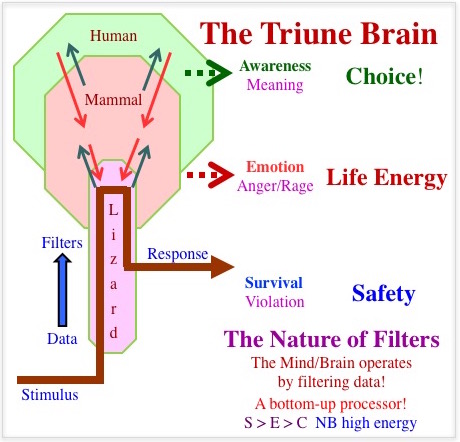
    angry04-thetriunebrainCommentary: A huge advance in knowledge of the brain has occurred in the past century; it is astounding what we have learned. However, at the same time, we have learned relatively little about the mind. An assumption of the modern neurosciences is that mind and brain are synonymous (a reflection of scientific materialism) — it is not an assumption with which I agree (nor do I agree with scientific materialism). But I don’t often know where to draw the distinctions, so I often use the term mind-brain when I am unclear.

    The Triune Brain

    One area that seems fairly clear is the concept of what is called the triune brain, referring to the layered structure of the brain, and the apparent layering of the mind. Simplistically, the mind-brain acts as a set of filters of incoming data. Think of sunglasses — they are a filter to reduce the glare of sunlight. They serve a purpose, but they also change what you see. Similarly the filtering aspect of the mind-brain serves a purpose, and distorts how you behave. (What follows is relatively simplistic, but accurate enough to be useful.)

    The Filter of Safety

    Neurologically, 99% of the data that you have been observing in the Now I Am Aware Of exercise of the last email enters the base areas of the mind-brain, the brain stem or Lizard Brain, where it is selectively scanned for your safety. If you not safe, you will immediately go into survival mode to protect yourself; this takes about 200 msec or 2/10th of a second. When in survival mode, the words that would be used to describe you might include serious, anxious, cold — it is from this level that you would violate others. In survival mode, others don’t matter! You are in action to defend your very existence.

    The Filter of Life Energy (Emotion)

    Most of the time this mode of survival is not necessary, so the incoming data advances through the Lizard Brain up to the Mammalian Brain (or Limbic System); the other 1% data (smell) goes here directly. Here the data is assessed (in about 300 msec) for whether the result will be pain or pleasure, pain or gain. It is at this level that most of our emotional experience develops:

    • pain may lead to some kind of moving against or away from, manifest as anger, fear, sadness, disgust, and other so-called negative emotions, or
    • pleasure/gain, with a movement towards, manifest as excitement, interest, enthusiasm, et cetera.

    If the emotion is really intense, the information is processed at this level, and it appears in your awareness together with as the inability to think clearly. This is especially so with the emotions of powerlessness such as rage. Then, in an attempt to get back to a place of power, you may move into survival mode, and violate from a stance of righteous indignation.

    In any event, information is sent back down to the lizard brain (the seat of all movement) for movement into action.

    The Filter of Choice (Awareness)

    Finally, if the experience is energetically less intense, the data rises still further to the cerebral cortices, the Human Brain, the seat of memory and language, the ability to “think,” and make choices. This requires about 400 msec of processing time. Almost all of this brain processing takes place at the other-than-conscious mind level, and seems to be under conscious choice, but like a pot of stew, what surfaces is only a small part of that actually present in the pot.

    Again, information is sent back down for the initiation of movement into action.

    Safety precedes Life Energy precedes Choice (S > E > C)

    It is essential to recognize that this entire process is a bottom-up processor: safety is more important than life energy, which in turn is more important than choice. Consider, for example, what happens with New Year’s Eve resolutions — the vast majority fail. Why? Suppose you are a smoker, and you decide to stop New Year’s Eve. Almost certainly some part of you wants to smoke (derives pleasure from smoking), and you then attempt to impose the “choice” of not smoking onto that part of you than does want to continue. It doesn’t work! The emotional mind-brain is far more powerful than the human mind-brain.

    If you really want to stop smoking, you need certain requirements:

    • Can you find an alternate way of satisfying the emotional system?
    • Can you have a goal of health (in a felt pleasurable sense) rather than a get-away from mode of not smoking?
    • Can you find ways to reward yourself, both intermittently (small pleasures to replace the momentary cigarette) and long-term (something desired to purchase with the money saved)?

    All this and more will allow safety and pleasure to support choice, rather than conflict with choice.

    Task for this email: Write down two or three instances when you have wanted to change something about your life, and have been unsuccessful. What happened? How did you attempt change? How did you deviate from the goal you set for yourself? Consider to what extent the ideas of safety, pleasure-pain and choice entered into your lack of success? Knowing all this, what could you have done differently.

    Coming next: The Role of the Unconscious

  • Anger #03 Awareness and Discipline

    PersonalGrowth1

    The tasks in this post: the development of awareness (task #1) and discipline (task #2).

    The work of change may seem massive, but really it’s just one step after another, and once you know the steps, you simply keep stepping (and find ways to keep yourself stable in the meantime).

    However, it is easy to get into despair and/or overwhelm. What follows are primary skills, both for personal growth and for getting out of feeling overwhelmed.

    Awareness

    Awareness is “attention to my spontaneously emerging experience.” Awareness is NOT thinking — it is experiencing, noting what is actually happening, especially in my body. Fundamentally, I can be aware of three areas:

    • what is happening outside me (my so-called five senses),
    • what is happening within my body, and
    • third, the story I am creating as a result of these two ongoing experiences (generally what I call my thinking).

    Awareness allows me to be present NOW, HERE! My story is usually about the past or the future — potentially useful, but not awareness, and not with any of the power of awareness.

    Discipline

    Discipline is “doing what I want to do, even when I don’t want to do it.” I want an outcome, and yah, it takes work to get it. Discipline is doing the work because I want the outcome, recognizing that often I don’t want to do the effort, but I do it anyway.

    The skill is to make it easier. For example, I practice yoga. I enjoy it, I want the benefits, but often I don’t really feel like doing it. So my discipline is to do “two minutes of yoga.” Not much, eh! Well, every day, I do my two minutes of yoga, even when I don’t want to do it. And, by the end of two minutes, I often feel better; I like how I feel, so I do 45 minutes, because I like it. But, if at the end of two minutes I don’t like how I feel, I stop, and congratulate myself — I have kept my commitment. No self-criticism, ever.

    Task(s)

    For 20 consecutive minute each day for the next week, sit quietly and repeat the following: “Now I am aware of …” and name a body sensation. Don’t describe it, just name it (one or two words), and move on to the next sensation. “Now I am aware of … my fingers tingling … the coolness of my toes … the tension under my eyes …).

    You will lose track. You will drift off into thoughts, day-dreams, etc. That is what the mind does. When you notice you have done so, gently come back to NIAA (now I am aware of …).

    Commentary

    As you get used to the process, lightly give attention to various components (mainly to sharpen your skill): external body sensations (what you feel at skin level), internal body sensations (those truly within), external sounds, internal sounds (including talking to yourself), external visual (with eyes open), internal visual (with eyes closed, including mental images). I say lightly, and I mean lightly — no one does this practice perfectly. The nature of the mind is that it wanders, and the discipline is to gently bring it back, without criticism of self.

    If you will do this for 6 months, I guarantee you will change your life. This skill of awareness is subtle, and powerful. Essentially as you become aware of what you are actually doing, there will be occasions where you don’t like what you are doing. You will choose to stop, and you will change your life for the better, a little bit. The results accumulate over time, and eventually you are in a much better place.

    In a later email when I describe the skill of knowing your own truths, I will say more about this. For now though, how do you know when you are speaking your truth, and how do you know when you are telling a lie.

    Ideally, you will continue this practice of awareness for the rest of your life — because you want to! You may eventually change it to what is today called mindfulness practice or vipassana meditation, all just variations on a theme.

    My personal choice is a vipassana retreat (I suggest 10 days) — largely because I can recommend such a retreat to anyone. Vipassana is a Buddhist practice, but as compared to other “religions,” Buddhism does not emphasize belief systems, only practice.

    Vipassana also operates from a principle called dana — the teachings are free. If there are any changes for a retreat, they are minimal, and only to cover costs; sometimes the entire retreat (days to months) are free, and costs are covered by donation. If able, sign up for a retreat.

    Coming next: How We Function — The Triune Brain

  • Anger #02 What Is Anger?

    This is the second of my email anger program so that the program is not lost. It is a duplicate of a previous sampler post of 20160809.

    angerface3
    Anger is a masque of deeper issues.

    This one is fairly long. Apologies.

    To begin: Are you still reading your outcome title (Email #01), at least once a day? If yes, great. Congratulations. If not, that is the difficulty of discipline — you are not wrong, your behaviour is not wrong, but to the extent that you made a commitment, you did not keep your commitment. And people who do not keep commitments are much less likely to get outcomes that they want. Simple, yes; painful, yes! I did not say this program would be easy; I did suggest that it is effective. Please continue to read your outcome statement each day.

    Task for this email: After reading this email, monitor your emotions for a few days (don’t attempt to change them, just monitor them). When you notice an obvious anger-based emotion, answer the following questions:

    • Do you have a sense of power? Can you move forward with it? If so, likely it is anger.
    • Do you feel overwhelmed? Is there an underlying powerlessness? If so, likely it is rage.
    • Do you feel indignant, determined “it” should not be. If so, likely it is self-righteousness.
    • Where in your body are you feeling this emotion.

    What is anger? Most people know that they are emotional, but often they do not know what emotions are. Most people know when they are angry —  you, for example, wouldn’t be reading this if you weren’t angry, but you do you know what anger is. In this email, we clean up some language. (Suggestion: if you will pay meticulous attention to your language for six months, I guarantee you will change your life for the better. More in another email.)

    What are Emotions? There are many definitions, but my best definition of emotion is “a biologically adaptive action tendency.” What does that mean? Well, you are designed to respond to your environment, and when things change, you as a biologic organism adapt — usually very effectively! When something happens, you (your mind) processes what is happening, usually at the other-than-conscious level and with amazing speed. Your mind then sends a signal to your body to react, to move into action. The very beginning of the experience of action is the felt sense called emotion.

    Another definition of emotion I use is “energy to which I give meaning and direction.” In the so-called pleasurable emotions, I move towards something — I am excited or interested. In the so-called negative emotions, I move against or away from — I am angry, afraid, sad, et cetera. Check it out: notice what you are feeling right now, give it a name, and point to where that feeling is in your body. (Don’t be surprised if you cannot do this — when I first started my own therapy work, I could not do so.) How or to where does this emotion want you to move?(Suppose you are hungry. Where in your body? To where do you want to move?)

    So, what are feelings? Aren’t they emotions also? Sort of. Again many definitions, but I want to make a clean distinction. Examples of emotional words are: angry, excited, afraid, et cetera. Emotions point at my body, and can be described in a single word. Yes, they can refer to something else, but the felt sense is in the body, and can be pointed at. Feeling words point to my relationships: hostile (towards), included (with), ignored (by), etc. Again, one word, but they point outwards. There is usually an underlying emotion, but the feeling points outwards. Then, to make matters more confusing, there are also the feeling judgments — my thoughts about my emotions and feelings: I feel that … (finish with the thought, e.g., “this is wrong.”). There is an underlying emotion or feeling (unnamed), but the description is a thought, and always more than one word is required.

    What is Anger? Anger is an emotion, one that shows that my beliefs have been disrupted, without my intention or permission. Suppose someone in a crowd pushes me — my mind processes this, says this should not be happening (a thought), and sends a signal to my body that I push back: I’m angry. But perhaps I don’t — I also know, perhaps unconsciously, that the consequences might be less than pleasant, so my mind send a second message, very quickly: Stop! Be cautious instead. Angry and afraid at the same time. Did I say emotions, especially anger, were simple?

    Now, suppose the same crowd, only this time we are friends, and we playing football. If someone pushes me, will I be angry? Not likely — because it is expected and allowed as part of the game. Same actions, but different emotions, depending on my beliefs! Complicated, again.

    What about rage? Think about your own rage. Rage is also an emotion, this time more complex. When angry, I feel powerful — I can do something with my anger. But in rage, I feel powerless; I’m overwhelmed, and I puff myself up so as to get back to a state of power. And I don’t think clearly — a dangerous combination. At this point, I am likely to violate others — to violate someone is a behavior — to restrict them without their permission, to hit them, to block them, to scare them, etc. Not fun — for anyone!

    Note carefully! Emotions and feelings are not wrong, or bad; they simply are. They are the way in which my body gives me information, sometimes information that I do not want to recognize. They always have a positive intention — the “negative” ones usually to protect me, in some fashion. What is potentially inappropriate is what I do with my emotions. This behavioral response can certainly be dangerous, unacceptable to yourself or to others, and much else.

    Safety: So, anger and rage can be dangerous, especially if we are unaware of the complexity of what is happening (we will be exploring this in detail over the next weeks). My bottom line is safety, for myself and others — always, and to the best of my ability.

    I sum up safety with two statements: No SAD and STOP. No SAD means:

    • I will not intentionally Scare another human being,
    • I will not Attack another biological creature, and
    • I will not Destroy in anger that which I would not destroy when peaceful.

    My experience, after 25 years of being a therapist (including as I resolved my own issues of anger) is that, if I stay within the parameters of No SAD, I can be fully expressive of my emotions, and both I and those around me are totally safe.

    However, that does not mean that those around me will feel safe (more accurately, they do not feel secure) — my actions may still scare them — what I am doing may remind them of painful times in their own past. I do not intend to scare them, but that does not mean they are not scared.

    STOP responds to this. STOP means that if I am told to stop, I stop immediately (no questions, no argument). Someone is scared — always inappropriate. Then I find another, safer way to deal with my anger. Usually this means I will take a time out  to briefly separate myself from others, and thus allow them to recover from their scare (more about time-outs later).

    Coming next: Awareness and Discipline

  • Anger #01 Why Change? Personal Power

    As indicated in the last post, I will gradually post my email anger program so that it is not lost. Although many people signed up initially, and feedback has been positive, there has been little in the way of continuing interest. Hence — this series of posts, one every few days until completion (30 emails) …

    I will add additional posts between the series, with a page under Postings dedicated to the anger program for those who want to follow it without having to sort through other posts.

    AngerBlowDown
    Is this you? Is this how you want to be?

    Why Change? Personal Power

    Welcome again. Welcome to a program that can change your life.

    I believe the above statement is absolutely true, partially because the tools I am offering are powerful, but more importantly because I trust the basic goodness of human beings. I believe in the principle that every human being is ALWAYS doing their absolute best at ALL times, and that when they are unhappy with their lives, what they need is not criticism but better resources, better skills to accomplish what they really need. Email me ([email protected]) if you do not believe me, and I will explain my rationale.

    These first few emails (the first eight or so) will provide simple tasks, but more importantly will give you some concepts that I believe are very useful to your progress. Play with the ideas, and if questions, email me as above. But do not attempt to accomplish the 90-day program in two weeks — it doesn’t work that way. Many questions I will defer until a later email when the answer will become clear.

    Also, be aware that, although this program is designed for anger management, almost all of it is applicable to every other emotional experience of your life. So, if you want to work on something else (low esteem, grief, et cetera), simply use your own word  any time you encounter an “anger” word.

    So, your first task, your first skill development. Take out some paper, and answer these questions: Why are you taking this program? What are you wanting? And if you get this (i.e., what you want), what else will you get? And if you get this next piece, what will you get that is even more important? Expand your answers until you can go no further (either you cannot name anything more important, or you are cycling back into previous answers).

    Now look at your answers, and see if you can answer these further questions about what you want. These questions are called the RPMS! of change. (I don’t expect that you will be able to answer them all — if you could, you would likely have what you want already.)

    • Is what I want realistic? (Can some one person, anyone, get this?)
    • Is it practical? (Can I myself get it?)
    • Is it measurable? (Do I have a way to know when I have it?)
    • Is it specific? (Do I know how to get it, the actions involved?)
    • !? (What is the first step for me to get it?)

    Why are these questions important? Basically for two reasons:

    • these questions are the basis of effective outcomes, and
    • people who set goals (outcomes) are more effective in life than people who do not. The likelihood of you completing this program is higher if you set a goal for yourself.

    Now, to complete this task for now, re-write what you want, using your above exploration.

    What outcome do I want?

    Give your description a two or three word title, and post the title (with or without the details) somewhere where you will read it every day: on the mirror where you brush your teeth, at the head of your bed, et cetera. Make a conscious choice that you will read it every day for the next five days, at least until you receive Email #2 of this series.

    As part of the description, add a brief description of yourself, your self-esteem, your sense of personal power. I want you to be able to look back at this description each month and note how you shift in the next three months. Also, be sure to date when you write this goal. If you wish, you may show this information (and any subsequent information) to another person (your life partner, for example), but think carefully before you make that choice — do not set yourself up to be criticized or judged by another person.

    My reflection of this process: I believe that every human being wants power. But power comes in two forms: it can be external power, wherein I dominate others, or personal power, wherein I influence others by my effectiveness as a human being. With personal power, I have a sense of aliveness, personal integrity, authentic relationships, and the ability to contribute. This form of power is available, but it takes skill development to achieve it. I trust that is why you are here.

    The skill of anger management is the ability to turn your power of domination into personal power whereby you influence. The intention of this program is to honor your anger — it is a signal to you that something is wrong, something is happening that is inappropriate to your current situation. But your anger will not tell you what the problem is! It may be that there is something inappropriate with those around you, or it may be a warning to you that there is something inappropriate within your own beliefs.

    Consider for a moment: Are you worthy of what you want? Do you deserve to get it? Do you deserve to be in charge of your anger? Honestly — you do not need to tell anyone else, just yourself. (I believe you are worthy, but do you? Many people don’t! And therefore, they don’t get what they want.)

    If you are one of these people who hate yourselves, who are constantly criticizing yourself, Or perhaps you are constantly criticizing others, at least to yourself? (It is the same problem!) Explore how you learned this? Who told you? How did you learn this? And what gave these others the right to judge you in this way?

    If applicable, I also invite you to put another sign along with your outcome statement:

    God don’t make no junk!

    (You don’t need to be religious — just recognize what it means! about you!)

    Coming next: What is Anger?

  • Living in A Mature Culture, Part 7

    Glitzy and exciting, but  urban sprawl has major disadvantages.
    Glitzy and exciting, but urban sprawl has major disadvantages.

    Daily life in a mature culture — now that we have looked at the possibility of a Victory City, what would daily life actually be like in such a city? As noted, I am proposing that the high-rise buildings would consist of a large number of village-like settings, where people would actually live much of their day-to-day activity.

    A reminder: these postings are simply my thoughts on what it would be like to live permanently in a mature culture; I present them mainly to stimulate your thoughts.

    • Each “village” would consist of three floors within a high-rise complex, each complex perhaps holding approximately 30 “villages.”
      • As such, there would be a communal living floor sandwiched in two floors of private living/sleeping quarters.
        • Much would be modular, both for efficiency and minimal environmental impact.
      • Most food preparation and eating would be within the communal space, or in more central cafeteria-style buildings within the city.
        • There would be an emphasis that such food be both nutritious and of very high quality (not at all like the typical cafeteria of modern life).
      • Each village would consist of about 200 people, likely about 50 families, interacting with each other. There would be about 125 adults (including late teens), and about 75 younger children.
        • There would be extensive day-care facilities for child care (approximately 25 per village, or 625 per high-rise); essentially the village would raise the children, and children would be able to attend every process of village life.
        • school-aged children (approximately 2000 per high-rise) would attend school in the high-rise common area.
        • late teens would attend some kind of college or university, of which there would be 5 – 10 in the city, with the possibility of outreach to other cities.
      • The “adults” would meet several times per week in small groups, perhaps 10 people each, for personal development. Each week, there would also be a variety of local governance groups planning the needs and development of the village community, and a number of meetings with other groups outside the “village,” planning governance on a broader level.
        • The adults would be engaged in work activity 25 hours per week, 5 hours per day, approximately half of which would be virtual meetings or some kind of activity that could be performed without leaving the local village.
          • Children of all ages would be welcome at all activities.
        • Given that the cultural narrative would be that of a permanent state of sustainability, then perhaps most of adult life would be lived out in these environment.
          • We would no longer live the current cultural model of continuous improvement and discovery (such living is not compatible with being the dominant species of a finite planet).

    Your thoughts? Would this be too commune-like? Would this be too sterile? Both Rupert Ross (Dancing With A Ghost) and Louis Herman (Future Primal) have a lot to say about this.

    Ross, when reflecting on “primitive” native culture, notes (pp. 103-108):

    Each generation’s turn at the wheel might include performances better or worse than the last, but they would be essentially the same performance, with the same set and script and plotting. . . .

    We post-industrial societies, in contrast, seem to run a cross-country relay race, passing the baton to a generation that will never set foot upon the ground we have covered . . .

    There is a temptation to conclude that such a repetitive existence would be boring in the extreme, that it would feel binding and imprisoning.

    I suspect . . .  no such sense of limits. . . . they [native peoples] may have perceived their lives as holding a virtually limitless scope for challenge and accomplishment. . . .  their lives did not center on building things, but upon discerning things. Life’s challenge lay in observing and understanding the workings of the dynamic equilibrium of which they were a part, then acting so as to sustain a harmony within it rather than a mastery over it. One aspired to wisdom in accommodating oneself

    . . . they sought that wisdom not only to better ensure survival but also as an end in itself, as something in itself exhilarating.

    Herman notes (Kindle location 7130):

    Our wilderness origins fashioned our creative self-consciousness, which is both expanded and balanced by following the primal dynamic: face-to-face communication within a caring community of individuals, passionate for living and learning in a mutually enhancing resonance with the natural world. This is the truth quest, and it is our primal inheritance. We can ignore it, or we can cultivate it in all our endeavors and bring it into a creative engagement with the reality we find ourselves caught up in: a civilization rushing to self-destruction while displaying tantalizing possibilities of a more beautiful, joyful way of life.

    As a therapist of 25 years’ experience, centered largely in my own emotional growth, I know that exhilaration. Personally, although such “village” life as I am describing would have challenges, it could also be immensely satisfying.

    To be continued.

  • What Is Anger?

    MacQuarrie Email Program #02 — What Is Anger?

    Note: This is a sample of my email anger management program.

    If interested further, please access this link.

    This email is fairly long. Apologies.

    To begin: Are you still reading your outcome title (Email #01), at least once a day? If yes, great. Congratulations. If not, that is the difficulty of discipline — you are not wrong, your behaviour is not wrong, but to the extent that you made a commitment, you did not keep your commitment. And people who do not keep commitments are much less likely to get outcomes that they want. Simple, yes; painful, yes! I did not say this program would be easy; I did suggest that it is effective. Please continue to read your outcome statement each day.

    Task for this email: After reading this email, monitor your emotions for a few days (don’t attempt to change them, just monitor them). When you notice an obvious anger-based emotion, answer the following questions:

    • Do you have a sense of power? Can you move forward with it? If so, likely it is anger.
    • Do you feel overwhelmed? Is there an underlying powerlessness? If so, likely it is rage.
    • Do you feel indignant, determined “it” should not be. If so, likely it is self-righteousness.
    • Where in your body are you feeling this emotion.

    What is anger? Most people know that they are emotional, but often they do not know what emotions are. Most people know when they are angry —  you, for example, wouldn’t be reading this if you weren’t angry, but you do you know what anger is. In this email, we clean up some language. (Suggestion: if you will pay meticulous attention to your language for six months, I guarantee you will change your life for the better. More in another email.)

    What are Emotions? There are many definitions, but my best definition of emotion is “a biologically adaptive action tendency.” What does that mean? Well, you are designed to respond to your environment, and when things change, you as a biologic organism adapt — usually very effectively! When something happens, you (your mind) processes what is happening, usually at the other-than-conscious level and with amazing speed. Your mind then sends a signal to your body to react, to move into action. The very beginning of the experience of action is the felt sense called emotion.

    Another definition of emotion I use is “energy to which I give meaning and direction.” In the so-called pleasurable emotions, I move towards something — I am excited or interested. In the so-called negative emotions, I move against or away from — I am angry, afraid, sad, et cetera. Check it out: notice what you are feeling right now, give it a name, and point to where that feeling is in your body. (Don’t be surprised if you cannot do this — when I first started my own therapy work, I could not do so.) How or to where does this emotion want you to move?(Suppose you are hungry. Where in your body? To where do you want to move?)

    So, what are feelings? Aren’t they emotions also? Sort of. Again many definitions, but I want to make a clean distinction. Examples of emotional words are: angry, excited, afraid, et cetera. Emotions point at my body, and can be described in a single word. Yes, they can refer to something else, but the felt sense is in the body, and can be pointed at. Feeling words point to my relationships: hostile (towards), included (with), ignored (by), etc. Again, one word, but they point outwards. There is usually an underlying emotion, but the feeling points outwards. Then, to make matters more confusing, there are also the feeling judgments — my thoughts about my emotions and feelings: I feel that … (finish with the thought, e.g., “this is wrong.”). There is an underlying emotion or feeling (unnamed), but the description is a thought, and always more than one word is required.

    What is Anger? Anger is an emotion, one that shows that my beliefs have been disrupted, without my intention or permission. Suppose someone in a crowd pushes me — my mind processes this, says this should not be happening (a thought), and sends a signal to my body that I push back: I’m angry. But perhaps I don’t — I also know, perhaps unconsciously, that the consequences might be less than pleasant, so my mind send a second message, very quickly: Stop! Be cautious instead. Angry and afraid at the same time. Did I say emotions, especially anger, were simple?

    Now, suppose the same crowd, only this time we are friends, and we playing football. If someone pushes me, will I be angry? Not likely — because it is expected and allowed as part of the game. Same actions, but different emotions, depending on my beliefs! Complicated, again.

    What about rage? Think about your own rage. Rage is also an emotion, this time more complex. When angry, I feel powerful — I can do something with my anger. But in rage, I feel powerless; I’m overwhelmed, and I puff myself up so as to get back to a state of power. And I don’t think clearly — a dangerous combination. At this point, I am likely to violate others — to violate someone is a behavior — to restrict them without their permission, to hit them, to block them, to scare them, etc. Not fun — for anyone!

    Note carefully! Emotions and feelings are not wrong, or bad; they simply are. They are the way in which my body gives me information, sometimes information that I do not want to recognize. They always have a positive intention — the “negative” ones usually to protect me, in some fashion. What is potentially inappropriate is what I do with my emotions. This behavioral response can certainly be dangerous, unacceptable to yourself or to others, and much else.

    Safety: So, anger and rage can be dangerous, especially if we are unaware of the complexity of what is happening (we will be exploring this in detail over the next weeks). My bottom line is safety, for myself and others — always, and to the best of my ability.

    I sum up safety with two statements: No SAD and STOP. No SAD means:

    • I will not intentionally Scare another human being,
    • I will not Attack another biological creature, and
    • I will not Destroy in anger that which I would not destroy when peaceful.

    My experience, after 25 years of being a therapist (including as I resolved my own issues of anger) is that, if I stay within the parameters of No SAD, I can be fully expressive of my emotions, and both I and those around me are totally safe.

    However, that does not mean that those around me will feel safe (more accurately, they do not feel secure) — my actions may still scare them — what I am doing may remind them of painful times in their own past. I do not intend to scare them, but that does not mean they are not scared.

    STOP responds to this. STOP means that if I am told to stop, I stop immediately (no questions, no argument). Someone is scared — always inappropriate. Then I find another, safer way to deal with my anger. Usually this means I will take a time out  to briefly separate myself from others, and thus allow them to recover from their scare (more about time-outs later).

    Coming next: Awareness and Discipline