
by davemacq
Share
by davemacq
Share

I was going to talk about spirituality but I thought it would be useful first to identify personal growth; I imagine you the reader have heard the term personal growth. What does it mean? For that matter, what do the terms therapy and counseling mean? What is their relation to spirituality?
What follows are my reflections. (I am not an advocate of definitions — they are too static; I have been too influenced by an Aramaic concept wherein the speaker and listener are both aware of the many connotations of words, and thus a much richer possibility of dialogue.)
Growth, in the context of this blog, refers to: Development from a lower or simpler to a higher or more complex form; evolution. Personal Growth refers to the complex act by which human beings challenge themselves to become more mature, usually both more wise and more playful; it can take many forms but often involves some form of counselling or therapy with a wiser mentor.
 Consider the following. A baby (you, for example) comes into the world as a relative blank slate (with much background programming, but a vast amount to learn). The baby is then subject to a huge amount of living, some very caring and some painful (life happens; responses occur). The child copes and adapts: responding, copying, manipulating — developing deeply embedded responses of how to cope with a complex world (these are called the Adaptive Skills[1], patterns of who we are, not just what we know). Many of these responses of the baby are too painful to be kept conscious, so they are hidden behind a wall — these responses are the skills of adaptation.
Individuals who have successfully developed these skills are generally:
- aware of themselves and their impact on others,
- easy to talk with (both by those in authority and by those over whom they have authority),
- emotionally available (able to both express and describe their emotional life),
- cognitively available (able to give and receive feedback cleanly),
- able to delay gratification, and
- flexible to conflict
An impressive list — some individuals have been fortunate to grow up in families where these skills are easily learned. Most of us are not so lucky — but the skills can be learned at a later stage of life.
 That is the role of personal growth and therapy. The two overlap, but they are different for me. Personal growth usually involves expansion of what I already know of myself, deepening who I am in many ways; it can be approached alone, without aid of another, but often involves good mentoring. Therapy acts on what is behind the wall — ideally it punches holes in the wall, allowing the individual to become wiser and more mature in who they are, and especially, therapy allows the development of the adaptive skill set. (The term counseling, for me, is a nebulous term that is supposed to act like therapy, but generally does not have the power of therapy.)
From my perspective, good therapy is experiential and inductive. Action, not just talking about, is required, and neither therapist nor client really knows the outcome, only that it is high risk (perhaps for both client and therapist), and fraught with pain — the wall is there for a purpose.
Finally, a number of my mentors have suggested the characteristics of a good therapist:
- least important, they have a theoretical framework, a way of thinking and talking that allows them to discuss what has happened after they and the client have been in action.
- they have practical experience of working with clients, and a support system that allows them to discuss what mis-takes have occurred.
- they focus on their own personal growth, they themselves being the primary resource they bring to therapy (because therapy is a relationship, not a power trip).
This is a list I agree with — so if I am going to work with a therapist myself, I want to know they have done their own growth work. I want someone who helps me to be myself; I don’t want someone who tells me who I should be — I can read that in a book.
As for spirituality, the opening of the individual to all of who they are is the foundation of spirituality. A truism of therapy is that when an religious individual enters therapy , they usually leave less religious but more spiritual, and if they enter without religious status, they often leave more religious (and still more spiritual). Therapy promotes expansion of spirituality.
[1] Scherer, J. J. (1980). Job-related adaptive skills. Towards personal growth. In J. W. Pfeiffer & J. E. Jones (Eds.), The 1980 annual handbook for group facilitators. San Francisco, CA: Pfeiffer. I am thankful for John’s assistance in my PhD research.
STAY IN THE LOOP
Subscribe to our free newsletter.
Leave A Comment

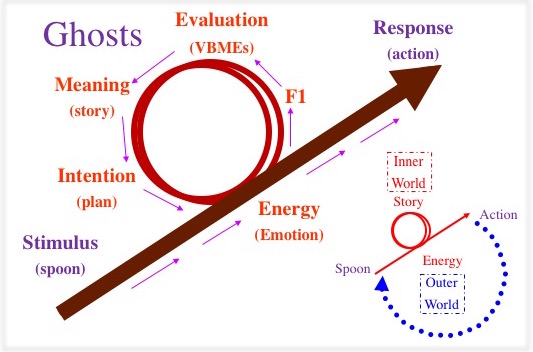
Everyone struggles with ghosts, usually the residue of our childhood or other significant emotional traumas. These are resolvable — if we will do the work. In my case, the ghost has been the disappointments wherein I have attempted to promote myself, either
In my last post, I talked about awareness as the essential principle of Gestalt Therapy. Here I want to pick up on two other equally important principles of Gestalt: Contact and Personal Responsibility. I do this because my principal orientation is that
I will be taking a break for a couple of weeks from posting to this blog; I will be in the mountains of Washington State for a week (without internet connection) and then going to Ontario for a couple of weeks —