
by davemacq
Share
by davemacq
Share
Comment: In some fashion, we all want intimacy, but we are unwilling to risk, and thus we shift to psychological games with predictable negative outcomes. “Here we go again!” Sad.
MacQuarrie Email Program #28 — Intimacy and Relationship

The Skills Of Relating
A friend of mine, a cultural anthropologist, asked approximately 40,000 people how they wanted to live their lives? Essentially everyone said they wanted a sense of aliveness, personal integrity, authentic relationships, and the ability to contribute — to be able to gift to others. My friend also noted in his research that our culture is characterized by domination, greed, and self-righteousness — essentially these are the same 40,000 people, just different sailors present.
So how then do we get what we say we want? It is not easy — it is risking being vulnerable so as to give permission to the other to be vulnerable also. I summarize it as: 3Rs:
- Reveal self,
- Risk not knowing what will happen, and
- Requesting closeness — Let me know you. Please risk with me.)
The task of this email is for you to explore your vulnerability, and if you are willing to risk. How willing are you to have a successful relationship? Always it requires effort, and risking.
Vulnerability is the willingness to be powerless, bringing a clean thoughtful stance to issues, risking criticism (not knowing what will happen, and able to pick oneself up if the attempt does not work). Overall, men in our culture repress their feelings, and lack relationship skills; underneath this, they are actually terrified, especially of being criticized by women. Thus, the best example I have of men risking is in sexual approach. (What if the woman (or possible mate) says No?) Women in our culture experience the pressure to nurture, and do the dance of deception; generally, they are more emotionally mature than men, although they are often indirect, and act as victims. For women, the best example of being vulnerable is when they are willing to express unpleasant feedback directly. These features may be changing for younger generations; however, I do not have enough evidence to judge.
Be that as it may, we all want intimacy and connection. In Email #12, I identified what I call the three laws of experience: We want positives, it is easier to get negatives, and negatives are better than nothing. These laws determine the difference between intimacy and psychological games.
A therapy that helped me make clear distinctions here was Transactional Analysis. (Briefly I indicated this therapy in Email #13 Sailors On A Ship.) TA is about transactions — interaction.
In TA, intimacy is an unpredictable transaction with a possible positive payoff. It is high energy, high contact, and high risk, but when successful, it is very satisfying. In contrast, a psychological game is an other-than-conscious transaction with a predictable negative outcome. It is high energy, high contact, and low risk. Notice the differences between these interactions:
- intimacy: high risk, positive outcome (very satisfying), unpredictable.
- psychological game: low risk, negative outcome (negative is easier to get and better than nothing) , predictable.
Throughout these emails, I have repeatedly emphasized that life has required many of us live with major blocks to awareness, living into acedia rather than wisdom. Thus most people derive the energy they want via psychological games, keeping the process at the other-than-conscious level so as to block awareness of predictable negative outcomes. Sad. If you can say “Here we go again . . .,” you are a participant in a psychological game!
 The classic game is known as the Karpman Drama Triangle. Here there are three roles: the persecutor (P), the victim (V), and the rescuer (R). P is criticizing V (giving energy to V), R comes along and attempts to stop this “obvious” inappropriate behavior, thereby giving energy to both P and V. Suppose each starts with 100 units of energy, and each transaction is 60 units.
 Persecutor (P) blames victim (V), transferring 60 units. Rescuer also gives 60 units, 30 units to each of P and V. At the end of this round, P has 70 units, R has 40 units and V has 190 units. The basic question is: Who is winning? The victim always wins! But the game is unstable (sooner or later, someone runs out of energy). So, in order to keep the drama going, the players alternate roles. For example, Victim becomes Rescuer, and Rescuer becomes Victim. The game goes on. As an example, husband comes home drunk; wife (P) blames husband (V). Next morning, husband has a hangover (V); wife (R/V) says: “Stay in bed; I’ll get you breakfast. You had a rough night, so somebody (i.e., me) has to take care of you.”
As for resolution, Eric Berne (the TA therapist who studied psychological games in detail) stated “The only way to stop a game is to stop it!” Simplistically, you cannot play tennis with yourself (it takes two to play)! So when one player walks off the court, the game ends.
In comparison, effective relationship requires hard work. A host of skills are needed:
- maintaining values — the groundwork, with often subtle differences between the individuals.
- communicating and cooperating. Couples need to do much more than communicate — especially they need to cooperate in problem solving.
 caring and resolving conflict. Caring is sometimes just as much work as resolving conflict. Problem solving (#27) is essential.
- relationships do best when there are at least five positives for every negative.
- blame has no place in relationship — blame is based on a right-wrong mentality, whereas everyone is always doing their best. When inappropriate behaviors exist, the basic question is whether the action was intended, or not. And do the individuals wish to act into better behaviors.
- Sudden start-up of conflict is especially harmful.
- it is necessary for the individuals to reveal themselves, especially their differences (a potential source of conflict) as feedback (not criticism).
- Feedback (healthy) says “This is who I am;” criticism (unhealthy) says: This is who you should be.”
 caring and resolving conflict. Caring is sometimes just as much work as resolving conflict. Problem solving (#27) is essential.
All of this, especially cooperation and gift-giving, is the basis of effective relating. Repairs of harm (e.g., authentic apologies) are essential. Management of energy (Emails #25–#26) is mandatory.
The essential stances are:
- if one of us has a problem, it is our problem! It is simply where the pain surfaces.
- the person who has the pain has the responsibility to initiate discussion.
Coming next: Responding to Children
STAY IN THE LOOP
Subscribe to our free newsletter.
Leave A Comment

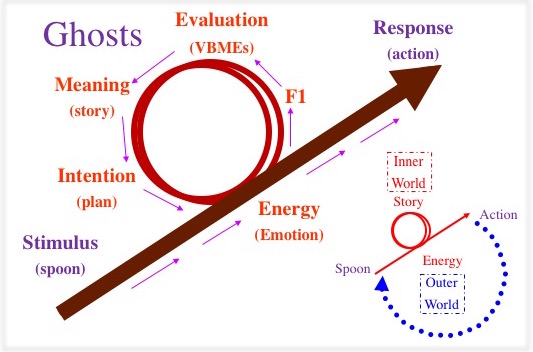
Everyone struggles with ghosts, usually the residue of our childhood or other significant emotional traumas. These are resolvable — if we will do the work. In my case, the ghost has been the disappointments wherein I have attempted to promote myself, either
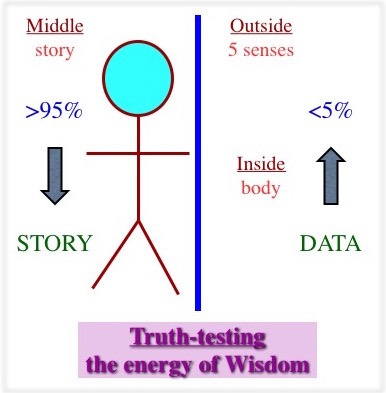
In my last post, I talked about awareness as the essential principle of Gestalt Therapy. Here I want to pick up on two other equally important principles of Gestalt: Contact and Personal Responsibility. I do this because my principal orientation is that
I will be taking a break for a couple of weeks from posting to this blog; I will be in the mountains of Washington State for a week (without internet connection) and then going to Ontario for a couple of weeks —