In my last post, I talked about awareness as the essential principle of Gestalt Therapy. Here I want to pick up on two other equally important principles of Gestalt: Contact and Personal Responsibility. I do this because my principal orientation is that of Gestalt — I have many other trainings, but Gestalt remains my basic orientation and emphasizes being fully alive.
This is not to say that other therapeutic orientations are not equally valid (Family Systems, Cognitive Behavioural, Transactional Analysis, and others); it is simply that Gestalt has been most conducive to who I am. Years ago, a mentor of mine said that there are three basic aspects that a therapist needs: a theoretical orientation, extensive work with clients, and the resolving on one’s own personal struggles. The theoretical orientation is useful when talking with colleagues after the therapy session yet is the least important of the three skill of therapy. During the actual session, one is often flying by the seat of one’s pants — there is limited time to think about theory. The second basic aspect is practical work with clients, especially supervised by a more senior therapist (the colleague after the session); it is essential to learning to be present in session. Third and most important is the personal growth of the therapist — if one’s own issues are not resolved, they almost certainly will become points at which the therapy becomes stuck. This is because the primary tool/skill that the therapist brings is his or her own humanity.
Translating this into the process of being fully alive means first to understand what you are doing for yourself in the process. Second engage in the skills of living so as to develop an effective toolbox. Finally challenge yourself so as to resolve the issues that hold you back.
My orientation as therapist is Gestalt; my skill is my own humanity.
I noted last post that awareness is “attention to one’s spontaneously emerging perceptions.” Contact is my ability to be present to the immediacy of now. At that time, I introduced the Action Model (reproduced here) with its First Order perception (F1), Evaluation, Meaning, Intention, Energy, and Response. Contact is my ability to hold these various aspects in my awareness without grasping one or more in immediate reactivity. For example, while in heated conversation with another, can I hold the immediacy of tension in my face while I recall a previous conflict with a sibling, while noting my anger and desire be in conflict, perhaps with awareness of my immediate surroundings and the words being spoken by the other. No one of course does all of this perfectly yet the more I can attend to this complexity, the more I am in contact with my environment, the more I am able to choose my responses.
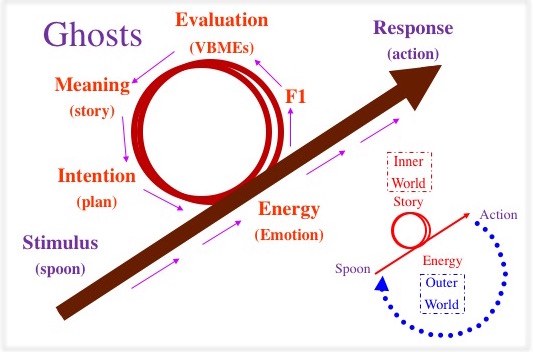
The skill associated with Contact is that of patience and awareness. For you the reader, as you are able, pause and look at a chair, a bus, a street sign, a person and note that these are all complex images. What are you attending to with your awareness? What body response are you having? What meaning are you giving to your awareness? What (subtle or not) energetic response is there? What immediate action is associated with your experience (even if not overt movement). In training yourself this way over time, you gradually develop the skill of being in contact with now, and you develop associations between these many areas of awareness. All this becomes the basis of how you respond to the immediacy of the present moment.
Personal Responsibility is also a manifestation of this complex interaction. The best way I can explain this is with another metaphor: a pot of stew (with a spoon in it) sitting on a stove being heated. It is one of the best metaphors I have of the human mind.
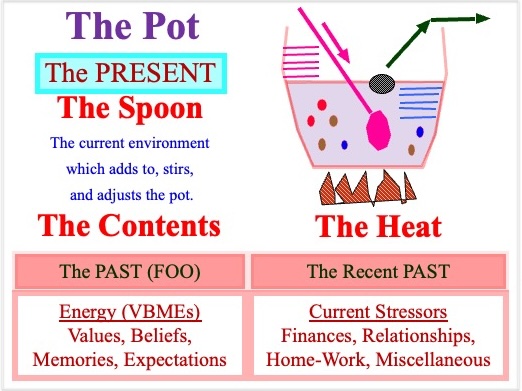
It is a pot of Energy; the contents of the pot are aspects of who I am — my values, beliefs, memories, and expectations (my VBMEs, the same as noted as Evaluation in the Action Model). All this arises from my past, most of it learned as part of growing up in my Family of Origin (FOO). The heat is my recent past, adding further energy to the pot: the current stressors influencing my present (finances, relationships, home and work situations, and miscellaneous aspects such as what I saw in my email last night or heard on the internet this morning). There is also a spoon in the pot, my current environment, which adds to, stirs, and adjusts the contents, adding more energy.
All this leads to movement of the contents within the pot. When stuff comes to the surface, we call it a Thought or Feeling. When it bubbles out of the pot, we can it an Action.
As noted, I consider it as one of my best metaphor of the nature of the Mind. What does it demonstrate?
First, actions empty the pot! Actions are the only way in which the pot is emptied. If you want to reduce emotional energy, it has to be turned into action! More about this later.
Second, imagine if you put a spoon into the pot and brought out a carrot. Would you ever say ‘the spoon made the carrot’?
No! It makes no sense. The carrot was already in the pot — the spoon merely brought it to the surface.
Why, then, do you say, “You made me angry” or “You made me do it”? This is saying that ‘the spoon made the carrot’!
If you take this metaphor seriously (and I do, very seriously), I am fully responsible for all that I think, feel, and do! Certainly there are spoons, yet I create my world! I have no one to blame and I am fully responsible for all my thoughts, feelings, and actions, for all that happens to me. In fact, the word blame does not exist in my vocabulary.
Note also that this metaphor is a relational model. The output of one pot becomes the spoon of the next pot as we together create what we call reality. Together, these three skills (of awareness, contact and personal responsibility) allow me to dance with my world, both as an individual and as part of a relational system.

 Awakening From Your Anger
Leave a comment