Tag: change management

  • Re-branding

    So, what is this rebranding of my blog all about? First, the switch-over has been much more complicated and I am uncertain how long the transition will take, but it will certainly delay my engagement. For now, here is the first post that I planned:

    Human beings are social creatures; that has been our success (and angst) for millenia. Yet it is my belief that we have never before been as angry (enraged might be a better word) with each other and with our cultural institutions as we are now. We are in crisis; we feel powerless and scared by our ineffectiveness in dealing with the current risks of climate change and/or the resurgence of possible nuclear winter. And we do not effectively talk about it.

    This was the focus of the earlier rendition of this blog as The Human Side of Global Warming. In rebranding the blog as Awakening From Your Anger, I am wanting to shift the focus to what can we as individuals do in responding to this crisis. My basic premise is that unresolved anger is dangerous, yet resolved anger is powerful.

    I have taught anger management for almost 25 years. I honestly believe that I have/had the best anger management program in North America but I have never been able to sell it because I step out of the cultural box too much — I encourage people to be angry so that they can work to resolution. At a later stage, I will quote from some of the document in my book Blowing Out the Darkness but space precudes this at the moment.

    In her 2017 book Braving the Wilderness[1], Brené Brown talks about a state that she calls High Lonesome; this was early in the first presidency of Donald Trump. She notes, “The world feels high lonesome and hearbroken to me right now. We’ve sorted ourselves into factions based on our politics and ideology. We’ve turned away for one another and toward blame and rage. We’ve lonely and untethered. And scared. e border.

    Brown further notes, “wouldn’t you think that all of the sorting by politics and beliefs we’ve been doing would lead to more social interaction? … Shouldn’t ‘You’re either with us or against us’ have led to closer ties among the like-minded? The answer to these questions is a resounding and surprising no. At the same time [as] sorting is on the rise, so is loneliness.”

    Now (2024 November 9th), with Trump as American President Elect, I imagine this is what many American Democrats are feeling right now — scared and lonely. And even though the Republicans have had resounding success in the election, Brown notes that, “Ideological bunkers protect us from everything except loneliness and disconnection.” I thus suspect that, in spite all the bravado and excitement, there are many Republicans who are wondering as to what the future offers. Equally, for we Canadians, many of us are caught in the same questions.

    As noted above, the focus of this blog is now how can we use our anger as a powerful force for good. How can we use our loneliness as individuals, social creatures still, come together in responding to our social crises. Coincidentally, an excellent article today in the Guardian (Authoritarians like Trump love fear, defeatism, surrender. Do not give them what they want) parallels the kind of ideas I will be exploring. We are in crisis; we are not defeated. 

    I intend several posts each week and I invite interaction. Although my posts will make suggestions, I invite us to come together, to find ways to engage with each other as we seek greater authenticity and greater effectiveness.


    [1] Quoted in “High Lonesome,” Psychotherapy Networker, Nov/Dec 2017, https://www.psychotherapynetworker.org/article/high-lonesome/, accessed 2024 November 8th.

    .

  • Feedback on my Books, Blowing Out the Darkness.

    Blowing Out the Darkness

    I have continued to promote my books as I still want to have an impact, and I believe what I have written is important.

    My publisher, Ewings Publishing, suggested I hire some professional reviewers who would provide independent objective assessment of my writings. Attached are these assessments.

    The disclaimer provided notes:

    Book Viewpoint Critic

    Overview

    Our book review service comprises a team of readers with a keen eye and genuine passion, for providing thorough reviews to authors, publishers, and literary agents. Recognizing the impact reviews can have on the success of a book we are committed to delivering quality, objective feedback aimed at helping books realize their full potential.

    The Critics

    Our review panel consists of book enthusiasts with an appreciation for literature and a sharp eye for detail in writing. Comprising critics, published authors, librarians, and avid readers, our diverse team ensures a rounded and comprehensive review process from day one. Each reviewer is carefully selected based on their expertise in genres or themes to ensure that every book receives a critique, from someone who truly understands its nuances and context. 

    Disclaimer

    Please be aware: even as we work hard to provide holistic, constructive reviews, all opinions of the external reviewers are strictly subjective and based on the reading experience of the reviewer. Reviews imply value and informational feedback but never guarantee or promise a particular result. Moreover, all reviews are done with integrity and honesty, and our service payment is not biased at all on the outcome of the reviews. The feedback shall only be one of the various tools that authors and publishers use to fine-tune their work.

    Promotional Evaluations: These evaluations are tailored for marketing purposes. Can be used on covers, websites, and promotional materials to enhance book sales.

    Feedback on Blowing Out the Darkness: The Management of Emotional Life Issues, Especially Anger and Rage. (Metairie, LA: The Ewings Publishing LLC, 2023), https://davidmacquarriebooks.com

    Blowing Out the Darkness

    The Management of Emotional Life Issues, Especially Anger and Rage

    by Dave MacQuarrie

    “A masterful blend of practical tools and philosophical insights, “Blowing out the Darkness” delivers a new, innovative route for navigation of all dark emotional realms. In creating this book, Dr. Dave MacQuarrie, MD PhD, has constructed through this book a cast iron guide that doesn’t let one single lapse occur in addressing the pragmatic dimensions of ’emotional regulation while pushing through to the very bedrock of emotional well-being laid by philosophy.’ His wedding of the cognitive and emotional processes is unparalleled, giving the reader a holistic framework that strengthens comprehension and application. This is a must-have volume for anyone who wants to navigate and transform their emotional landscape effectively.”

    Dr. Emily Roberts, Clinical Psychologist

    “This is a game-changer for both therapists and clients. With a focus on authentic personal growth and societal impact, this book offers timely insight for transformative exchanges that will resonate across the world today. Dave MacQuarrie, MD, PhD, gives practitioners tools and viewpoints directed at the enrichment of individual well-being and, therefore, positive social change—making it a must-have volume for any serious person who cares about emotional health and personal development.”

    John Matthews, Therapist

    “Blowing Out the Darkness” is a resource, for anyone seeking to navigate their journey. The book takes an approach to exploring and managing emotions like anger and rage offering solutions along with a deep dive into the theoretical aspects of emotional processes. MacQuarrie guides readers in acquiring the emotional tools for transforming and achieving effective emotional regulation and personal development. This blend of applications and insightful perspectives makes the book engaging not only for therapists and their clients but also for anyone interested, in emotional wellness.”

    Sarah Wilson, Life Coach

    “Blowing Out the Darkness” is a must in the field of mental health. Dave MacQuarrie has particularly nailed the integration of emotional and rational bits in therapy, which has proven very  effective for long-term healing. This is a rather unique, all-rounded approach to combining practical tools with deep philosophical insight. Possible to equip therapists and clientsalike with the right skills toward emotional well-being and personal growth that could last. That should make this very necessary in therapeutic practices.”

    Dr. Karen Brown, Psychiatrist

    “Enlightening and practical, ‘Blowing Out the Darkness’ lays the groundwork for managing one’s emotions in a way that is conducive to the betterment of society. This wonderful book should be read by all who want to improve their emotional well-being and give back some of that to society. Dave MacQuarrie shares his insights, provides actionable strategies, and supports them with powerful examples—a marvelous combination that secures this work for a wide, eager audience.”

    Michael Thompson, Social Worker

    “Blowing Out the Darkness” by Dave MacQuarrie is such an innovative and far-reaching vision of emotional management, skillfully wedding practical strategies with profound insights it makes the most complex emotional concepts anytime relevant and digestible to apply. His analysis is very captivating to the reader because he provides a comprehensive framework for emotional well-being in regards to investigating society’s problems and personal growth. The impact of MacQuarrie’s work does not remain limited to individual emotional challenges but further spreads their occurrence across society. As such, this book becomes a very important source for meaningful personal and social change.”

    Laura Green, Emotional Wellness

    “‘Blowing Out the Darkness’ gives insight into the human emotional system in great depth. The practical use of his theories by Dave MacQuarrie is exceptionally valuable to both professionals and individuals alike. With a thorough explanation of the techniques of emotional management, this book is endowed by what users need to indeed really be abreast of their emotions. The insights are very vital to MacQuarrie, and requisite for every human being desiring to improve in aspects of emotional intelligence and real personal growth.”

    Dr. Steven Harris, Neuroscientist

    “’Blowing Out the Darkness’ by Dave MacQuarrie is an insightful book in every sense of the term, as it seeks to challenge the conventional approaches to emotional health. He gives effective tools and quite a deep, existentially profound setting of philosophical perspective that is very transformative. He provides a balanced approach to both the emotional and rational aspects of treatment, rendering an all-rounded framework for understanding and managing feelings such as anger and rage. The deep exploration in the book is not just another prescriptive guide to the human emotional system. It is rich in furnishing one with many skills to achieve ongoing emotional well-being and growth. ‘Blowing Out the Darkness’ is packed with value both for professionals in the field and anyone seeking ways to enhance emotional wellness.” 

    Rachel Adams, Counselor

    “Dave MacQuarrie has constructed in ‘Blowing Out the Darkness’ a powerful resource for the management of emotional life issues. His emphasis on authenticity and change in society differentiates the book from others in this field. MacQuarrie’s treatment of these highly individualistic emotional challenges also opens onto the effect of such in society as a whole. This exhaustive guide embodies both practical tools and deep insights, making it a very necessary read for any conscientious person concerned about personal growth and positive societal transformation.”

    James Lee, Behavioral Therapist

    “Blowing Out the Darkness” is an enlightening read, replete with practical skills for emotional management. At the same time, what stood out for me was how Dave MacQuarrie could interweave subjective experience with objective understanding. Here is a volume that gives readers tools to effectively manage their emotional landscape. His approach is both insightful and pragmatic; therefore, this book is a must-read for all those interested in improving their emotional well-being and personal growth.”

    Jessica Turner, Educator
  • A New Workshop: What Am I Doing Here?

    The Art Of Relating

    The Art of Relating

    What does it take to live a great relationship, a great partnership, a great friendship? Why is it so difficult for most of us?

    There are skills that allow this to happen! Of course, it takes a lifetime to fully utilize these skills — yet much can be done in a few months. And of course, you have to know what these skills are.

    Join us for a one-day workshop as we explore these skills, looking at how they can be utilized in your life, looking at what to focus on. Much can be gained in one day, the first steps of a new life, one that starts you in more successful direction.

    Dave is a retired physician-psychotherapist who has spent his life exploring these skills, focusing on anger management and conflict resolution because he believes anger is the canary in the coal mine of our dysfunctional culture. His qualifications include a Master’s degree in Applied Behavioral Sciences, several diplomas in each of Gestalt Therapy and Neuro-Linguistic Programming, plus a variety of other trainings. He also has a PhD in Wisdom Studies. His major areas of interest were and continue to be those of ‘Anger, Rage and Violation’ and ‘Communication As Emotional Process’. His publications include Blowing Out The Darkness: The Management of Emotional Life Issues, especially Anger and Rage (2008) and Acedia, The Darkness Within, and the darkness of Climate Change (2012).

    Dave has had his own relationship struggles; these form the base of his journey.

    Date:                        Saturday, January 29th

    Time:                       0730am – 1730pm Pacific

    Location:      In Person (Burnaby, BC) and via Zoom, TBA

    Cost: $125 CDN (payable by InterAc to [email protected])

    Further information available upon registration

  • The Need For A Coup, Part 2

    Complexity3This is my second and concluding post on the need for a coup. Earlier I noted Schmookler, in The Parable Of The Tribes, suggesting that a civilization based on power (the original basis by which civilizations emerge) is not sustainable: it demonstrates neither synergy, enhancing the welfare or all, nor viability, sustainable in its continuing existence.

    Schmookler also notes that justice could be the antidote of power, thereby underscoring both synergy and viability. Justice requires:

    • “where power is exercised . . . it should not be used to benefit the wielder of power at the expense of the health of the system as a whole” and
    • “where different parts of the system have conflicts of interest, the conflicts should be resolved not by their differences in power but by some moral principle which, if always followed, would ultimately be to the benefit of all in the system.”

    As a species, we have not yet demonstrated the capability of synergy and viability — world governance, such as it is, is by tenuous cooperative agreement, the limits of which have been demonstrated by Trump’s threat to withdraw from the Paris agreement. Again, simply as one example of the many instances of inequitable dynamics, Trump’s stance is that of power; it is not that of justice. Nor is power a stance of cooperation; it is a stance of domination! And it is not sustainable: either it is stopped, or the system itself will deteriorate to the point of collapse (e.g., the predictable outcome of global warming).

    So how then does one deal with such insanity, in which it is necessary to develop power over power, and yet act justly. I have seen nothing in the past years to suggest an effective outcome. All of the efforts of the social movements of the past century (including feminism, racial discrimination, the environmental movement, et cetera) have been the attempt of the “people” to get the “1%” to cooperate, and have had only limited success.

    Much of what has been suggested thus far is in the nature of civil disobedience. And whereas I believe it is an important tool is opposing power, it is the attempt of the weak to convince the strong to desist certain actions. It does not seem to offer any significant shift in the maturity of the strong, certainly not those who function from the power of domination.

    Thus my suggestion that we need a coup! But in contrast to most coups where one form of domination simply replaces another form of domination, we need a coup in which justice replaces domination. And the coup needs to be international, including all of the major powers of the world. Although I often use the USA as an example, I am not naïve in believing that it is the only source of difficulties on this planet.

    Furthermore, the only examples of sustainable justice of which I am aware have been within indigenous cultures — cultures that have resisted civilization, albeit without great success up to this point. Our track record of “civilized” process has not been very successful otherwise.

    And hence, my best guess is that such a coup must come from indigenous sources, as the power to resist domination and act justly. Again in my limited exposure to cultural issues, it is the native people of North America who seem most apt to engage in sustained resistance (witness Standing Rock and Kinder-Morgan). They also have a cultural heritage that honored justice in much richer fashion than has European-based culture.

    Thus my hope . . .

    Links Of Note

    Two Dark American Truths From Las Vegas (20171002)

    Gun violence in America, explained in 17 maps and charts (20171002)

    These two links discuss the ineffectiveness of modern attempts to limit the use of power, both in preventing individual tragedies and in developing just resolutions to such forces that underlie these tragedies.

    U.S. Climate Change Policy: Made in California (20170927)

    An interesting example of how the interplay of legality and power work in our culture. To quote the lead-in: “A peculiar confluence of history, legal precedent and defiance has set the stage for a regulatory mutiny in California that would reverberate throughout the country.” Legally, California can regulate independently of national concerns, and controls at least a third of the auto industry, with a sizable impact on how industry must react. I am reminded of a statement that our culture has a legal system, perhaps sometimes a justice system.

  • The Need For A Coup, Part 1

    Complexity3I said in my last post that I would consider the possibility of a coup. At some level, I truly accept that the need for a coup is the only way in which humanity will survive. I’m not a historian, nor a philosopher, nor do I have a military background, so what follows will simply be my random thoughts regarding the issues that confront us as a civilization.

    First, as noted in my original first post of this blog (see my home page), Laszlo (in Evolution: The General Theory, 1996) wrote that we are in a cascade of crises, and that we must extend ourselves into a new maturity, else we will likely perish as a species (or at least as a civilization). I also recall from my PhD research, Toynbee in A Study Of History (1946) considered that in the failing of civilizations, new ones arise at the periphery (of the old collapsing civilization) wherein a small group arises who both represents a new energy of purpose while espousing a new religion, meanwhile opposed by the old tyranny. In my dissertation, I suggested that the small group was the Cultural Creatives and the new religion was our maturing relationship with ecology. The current difficulty with both the Cultural Creatives and the ecology movement, though, is that they are disorganized, and do not present a coordinated front to oppose the oppressive forces of our current civilization. Furthermore, this past century is the first occurrence in which we as a species have come to be both a global village and a power dynamic capable of altering the dynamics of the entire ecosystem of our world; there is essentially no periphery for a new civilization — we must confront the center of the old.

    I also noted in my posts about power (beginning 2016-08-16) that civilization(s) arose because the human species came into relationship with power, a relationship different from that of all other previous species. Schmookler in The Parable Of The Tribes[1] indicated that “our destructiveness as a species and of our current culture . . . is a simple consequence of our creativity, a tragedy representative of the inevitable options for power” — and that there is “no way to return the dangerous djinni of human power back into the bottle.” In addition, “The laws of man require power, for power can [only] be controlled with power. The challenge is to design systems that use power to disarm power. Only in such an order can mankind be free.” Perhaps mankind will evolve to “control the actions of all to the degree needed to protect the well-being of the whole.”

    Schmookler mentions a number of relevant definitions:

    • system: an aggregate the elements of which interact (and therefore no element of the system can be understood in isolation)
    • synergy: a pattern whereby each part functions in a way that enhances the welfare of the other parts as well as its own
    • viability: the ability to maintain without diminution whatever it is upon which its continued existence depends

    Our civilization is definitely a system, yet it is neither synergistic nor viable. Our civilization is based on power, not synergy and viability. We compete rather than cooperate. We control by short-term domination rather than by consideration of the long-term. We demonstrate immense creativity, but we do not consider the impact of our creativity on future generations (in either our consumerism or our technological advances).

    To be continued

    Links suggestive of our cultural insanity

    Heartless world watches while Rohingya nightmare continues (20170928)

    An example of the inability of our species to deal with power.

    Trump doesn’t get it on Puerto Rico. He just proved it by lashing out at San Juan’s mayor. (20170930)

    I am suggesting this link, not as a critique of Trump (which it is), but as an indication of the need for definitive action in stopping this kind of tribalism, a stance that likely results in major deterioration of justice and viability. The current system is not healthy.

    Homeland Security to monitor social media accounts of immigrants and citizens (20170926)

    Where does surveillance stop? When is it effective? Here we seem to be moving to a police state, again with a major deterioration of justice and vitality.

    Even This Data Guru Is Creeped Out By What Anonymous Location Data Reveals About Us (20170926)

    So easy, and with enough computer power, likely also easy to cross-map details of how groups of people interact. Truly, Big Brother is watching.

    [1] Schmookler, A. B. (1995). Parable of the tribes: The Problem of Power in Social Evolution. New York, NY: State University of New York.

  • Ongoing Backlash

    The management of power requires personal authority.
    The Power of Personal Authority

    Not much to report this week. I am still travelling, and hence not as invested in writing my blog. Most of what I read in the various sources I tap is that the world is continuing to react to Trump’s decision to exit the Paris Accord. For me this is a good thing, because it may well be the galvanizing point at which the world starts to recognize how seriously the climate issue truly is. Hopefully . . .

    Otherwise, I continue my search for a way in which to utilize my skill set in the issues of global warming. Essentially my proficiency is that of personal transformation — believing that society itself is a system of individuals, and that change comes from small shifts in the cultural milieu. Again, hopefully . . .

    This week, I’m presenting workshops in Ontario, exploring the skills of Authenticity. I’ll be returning in October to present Blowing Out The Darkness (my emotional/anger management workshop) and Partners Coming Together (my relationhship workshop — to which individuals can also come). I’ve also decided to expand my on-line presence by offering video coaching using one of the platforms such as Skype (my preference is Zoom.us). If interested, contact me via my website. More later.

    Some links concerning Trump

    World promises to stand and deliver after Trump’s ‘train wreck’ climate decision (20170602)

    A good summary of the multiple reactions to Trump’s decision to withdraw from the Paris Accord.

    We may be surprised at how things play out… (20170603)

    I’ve previoiusly noted the possibility that Trump’s exit from the Paris Accord may have surprising outcomes — this article also supports that.

  • Anger #31 Loose Ends And Final Comments

    Comment: The final email. Hopefully you have gained from this program. I wish you well!

    MacQuarrie Email Program — Loose Ends and Final Comments

    Happy2Congratulations.

    You have completed the thirty emails of this program. I know that this has required a lot of work on your part. I also hope that it has been an effective program for you, and that you have obtained the outcome you wish from it (Email #01).

    At this point, I would very much appreciate feedback from you as to its effectiveness, especially what parts have been most useful, and what not. Please email me at [email protected].

    My thoughts as to how you can continue:

    • be aware that as you learn your triggers and become more skillful in managing yourself, you will be changing the system within which you function.
      • people will not like this, and will attempt to sabotage you. Don’t violate them as they do so; play with the sabotage.
      • it is not likely that they want you to resume being angry; they may actually want you to be more healthy. However, your changes require that they themselves change. Perhaps your anger has allowed them to avoid their own anger, or served some other purpose within the system. Now they must find another way to cope, and are not prepared for this. Hence, they sabotage you and others so as to avoid their own issues — this is the nature of systems.
    • manage your energy. People won’t like it; manage yourself safely (Email #02 and #25).
      • as much as possible (safely), stop violations by others.
    • learn the messages of your anger.
    • deal with conflict. The only person who can initiate change is yourself.
      • practice the skills of creative communication, cooperation, and challenge
    • on occasion, dive deeper into your issues, perhaps with therapy.
      • be aware that these learnings of the past few months will fade. The activities and tasks must be practiced for an extended time before they become second nature. Expect this — come back (or find another program) in six months or a year.

    And especially, recognize that you can act your way into a new way of thinking; you cannot think your way into a new way of acting (it is action that creates change). Growth is a balance of acting and assessing — risking is essential.

    Challenge yourself. For me, I am often sad about the ways in which we have created ourselves as human beings, how traumatized we are. Learn how to step into the shoes of others so as to get how difficultly they live their lives, and why they may be criticizing you (Email #30 — Dealing With Other Angry People). For example, they have likely been traumatized themselves such that they are bitter; explore how the trauma arises for them in the present in your actual contact with them.

    Most important — be a participant-observer of your own internal conflicts, watching for those sailors who demonstrate wisdom (Email #19 Why We Avoid). Develop your Captain.

    I learned to deal with conflict by being challenged in how I functioned — overall a very painful process. When I had had my therapy practice for a few years, I was running a group within a community organization, supposedly an association with high integrity. Gradually I came to suspect that they had many undesirable characteristics, but I did not then have the skill to challenge them effectively. Eventually I refused to work with them, a decision that was hotly challenged. It took me three months to settle my anxiety, and come to terms that I was making a good decision for myself. But it was not easy.

    Several years later, someone complained to the College who governed my license. I was able to defend myself, but it took me six weeks to settle my anxiety.

    Again after a few years, another complaint — this time it took six hours to settle my anxiety. It was now simply an opportunity to demonstrate that I was living my own values.

    I also learned how to function by requesting feedback from others. Much of this was part of the therapy processes I attended (as participant); later, I made it a habit to request feedback from the groups I was running. The skills of maturity are best learned through feedback.

    If you want more from me, read my books (see below), subscribe to this blog, or ask questions of me ([email protected]).

    If convenient, attend one of my workshops; usually they are listed on my website (A Place Two Be). I also do individual work with clients, usually by some kind of video conferencing such as Zoom (my preference compared to Skype). There is a cost for these, but I am open to sliding scale depending on need.

    Keep well; you deserve it.

    Thank you. I hope you have both enjoyed and benefited from this program.

    Dave’s Books:

    MacQuarrie, D. (2008). Blowing out the darkness: The management of emotional life issues, especially anger and rage. Bloomington, IN: AuthorHouse.

    MacQuarrie, D. (2012). Acedia, the darkness within, and the darkness of climate change. Bloomington, IN: AuthorHouse.

    Both are available from AuthorHouse, and there may be a Kindle edition on Amazon.

  • Anger #30 Dealing With Other Angry People

    Comment: Angry people tend to attract angry responses, likely from other angry people. If you are to live otherwise, you will need to know how to respond to other’s who are angry.

    MacQuarrie Email Program #30 — Dealing With Other Angry People

    angerface3
    Anger is a masque of deeper issues.

    In Email #01, I indicated your anger will tell you there is a difficulty, but it will not tell you if the issue is within you (powerlessness — something inappropriate within your own beliefs), or in others (conflict — something inappropriate with those around you). The primary intention of the Blowing Out method has been to release the Energy and explore the Message — to empty the Pot, and reduce the likelihood of the Pot filling again.

    Hopefully, by this point in time, you have developed considerable skill in managing your own anger. However, as you undoubtedly realize, you are not alone in having difficulty with anger. So what do you do when you encounter someone else who is angry?

    Previously, you might have escalated with them, with a less than desirable outcome. Your task for this email is to explore what you can do differently in such circumstances.

    You probably know already that it will not do much good to suggest that they check out Angry? Change Your Life in 90 Days. Actually, the best way to recommend this program is to demonstrate to others that, compared with a few months ago, you are now much more able to manage your anger — actions speak louder than words.

    So, how to deal with someone else’s anger (explore these suggestions to see if you agree):

    • first, monitor yourself, especially your voice tone, muscle tension, and body language. You want to be able to engage (or not) by choice, not by your own reactivity.
    • minimize escalation
      • minimize eye contact, neither too little (often interpreted as weakness) nor too much (often confrontational) — be aware there are major variations within cultures. For example, sometimes lack of eye contact is a sign of respect.
      • assume a relaxed posture, and especially avoid pointing.
      • speak with moderate tone, and especially no profanity.
      • listen, listen, listen. Appreciate suggestions; be thankful for contributions.
        • if you will listen to them, they may be willing to listen to you.
      • invite time-outs to problem-solve; make an appointment to resume.
        • when safe, discharge your own energy so as not to contaminate your next event.

    Angry#30-PPositionsWhen complete, the following is a way to explore what happened (especially useful here, also in many other circumstances):

    • as usual, act out the situation — when you utilize your body, you are much more likely to access your other-than-conscious mind, and obtain richer data.
      • first, step into your own shoes (#1) to explore the event
      • second, act out the event from the perspective of the other (#2)
      • then, watch the action from the side (#3), as well as standing on a chair as you move around the event (elevated 3rd). You will gain different information from different positions.
    • finally, if you were dissatisfied with the original outcome, consider what else you could have done, similar to the exploration of Email #20 What Gets You Angry?

    Dealing with ‘difficult people’ is actually a very complex process, partly because conflict is both normal and essential to the development of relationship, be it a group of two people or of twenty-two. When groups are forming, people are unfamiliar with each other — conflict occurs as people honestly sort their needs, and come to agreements as to how to act. Honesty is needed; niceness is often not effective in resolution. Everyone is doing their best to cope, some less effectively than others!

    Those people who could be called ‘difficult’ are simply those with less skill (and perhaps have grown up in less than ideal circumstances). Most of the time, such people are demonstrating limited skill when the group itself is immature in its development. As a general rule, I assume that conflict represents immaturity of a group until it becomes very obvious that the individual is truly interruptive to the functioning of a group.

    From my perspective, difficulties need to be corrected when they interfere with long-term relationship and/or the performance of tasks. Such correction however requires considerable time, often up to ten hours (or more) for resolution — a lot of work. My standards are these:

    • if I am the facilitator of a time-limited group, I will identify interruptive behaviors (simply name them so others are aware), tolerate them, or stop them as feasible.
    • if a long-term group (marriage, friendship, or work group), I will resolve, challenge, or stop inappropriate behaviors. I will also work hard to identify the ghosts and hidden agendas that often underlie conflict.

    Something more needs to happen with truly difficult people — those who continue to be interruptive (major immaturity) and/or those who violate others (toxic). Some thoughts:

    • although much has been made of the concept of empathy in modern therapeutic circles, my experience (and that of my mentors) has been that empathy is very limited in its use.
      • empathy is useful for the development of safety and relationship, especially that of trust. However, it does not encourage growth, and is often conducive to continuing immaturity.
      • challenge (frustration) is much more promoting of growth.
    • early in my career as a therapist, one of my mentors pointed out the need for what he called killer instinct, best summarized by a definition from the 18th century: A gentlemen is one who does not hurt the feelings of another, unintentionally!
      • If I need to stop someone, I do so calmly and deliberately — it is a stance of clarity, not of anger! And I stop them.
    • it is important to recognize that people who violate others are limited in resources, and therefore are likely to escalate when challenged, possibly to dangerous levels.
      • another mentor pointed out that toxic forces are responsive neither to reason nor to empathy. Thus, the risk of escalation — be careful.

    Coming next: Closure

  • Anger #29 Responding To Children

    Comment: Child discipline is fraught with ‘shoulds,’ and thus a place of major difficulty. Child discipline is more accurately discipline of the parent so as to provide consistency and nurturing.

    MacQuarrie Email Program #29 — Responding To Children

    Angry#29a-TasksI chose this topic as part of the program because children are a part of the lives of everyone. Children are a source of major joy, and also of significant anger. Children are developing into individuals, and therefore resist the efforts of others to manage them. Thus, responding to children is equivalent to managing the third limb of a triangle — fraught with difficulty.

    The task in this email is complex — learning to parent with care and consistency. Be aware that it is easy to become overwhelmed with all the ‘shoulds’ in this field. The bottom line is safety and respect. What are your beliefs as to how children should behave? What are you seeking?

    Although most people attempt to parent well, parenting is still an isolated phenomenon within the private family. As children, many of us have been traumatized in families; I certainly had been. As such, most of us received almost no training in emotional or relationship dynamics, other than the emotional field of our own families. Because of this, we are at great risk of recreating such patterns when we themselves have children.

    There is a lot I could say about why our culture frequently traumatizes children, but it would take much space. I therefore confine my remarks to skills that are needed in responding to children.

    The needs of children are age-dependent; difficulties occur because of inherent age-related tasks. Children have more dreams; parents are more orientated to reality. Younger children are focused on family, learning to model family dynamics; teens are relating to peers, and learning independence. Note the directions children are moving (young children towards parants; teens away) People can only hear you when they are moving towards you; thus younger children listen; teens much less so.

    Angry#29b-SECFor me, the simplest way to describe all these needs is in terms of safety, energy, and choice (the primary characteristics of the Triune Brain — Email #04). All children need safety (not rules, but boundaries within which they can explore), extensive nurturing (energy which adds to safety), and age-appropriate choice (risking within the boundaries of safety). Between ages 0-2, they principally need safety and nurturing.

    Difficulties usually begin with the ‘terrible twos,’ and the ‘trying threes.’ Here the primary need remains safety — children between two and ten simply do not have enough life experience to make good decisions of safety; however, the additional need is to educate them towards good choice. This is called child discipline; however, it is more accurately ‘parent discipline,’ the need to provide consistency of safety and nurturing. Parents have difficulty usually because they want to control energy (the expressiveness of children), rather than safety and choice.

    There are two systems I advocate for the younger age group: 1-2-3 Magic (Tom Phelan) and Inner Discipline (Barbara Colorosa). 1-2-3 Magic emphasizes the energy management (positive energy to encourage appropriate behaviours, and absence of energy to discourage undesirable behaviours (criticism is negative energy, and a form of energy reward — as is too much explaining; remember, children want energy, and negative energy is better than no energy). Inner Discipline emphasizes age-appropriate choice. Both systems emphasize safety; both require discipline on the part of parents — consistency of caring, rather than energetic negative reward.

    For the age group of 10-18, the child is gradually allowed to assume responsibility and accountability for both safety and age-appropriate choice, transferring safety issues to the older teen — such that adult-adult relations can develop as the child enters their 20s, perhaps as a form of mentoring on the part of the parent. Sometimes, such consistency is encouraging that of risk-taking, and other times is restrictive due to safety concerns.

    Angry#29c-PACThe most useful way I have of thinking about responding to children again arises from Transactional Analysis, the therapy I introduced in Email #13 Who Are My Sailors? (TA is generally very good at explanations). There I suggested each person consistently has five sailors (nurturing parent, NP; critical parent, CP; adult, A; adapted child, AC; and natural child, NC).

    • The Parents operate from beliefs, the Adults from thoughtful evaluation, and the Childs from feelings.
    • ‘Grown-ups’ have all five states; ‘children’ only C states.
    • CP operates from ‘shoulds;’ AC is the sneaky Child.

    In general, effective communication is with equivalent sailors (e.g., P-P or C-C), and poor communication when levels are crossed (e.g., P-C, P-A, or A-C). Thus, the most difficult situations occur between CP (‘you should’) and AC (‘I don’t want to!’).

    Most parenting conflicts occur between CP and AC, a crossed transaction, in which the parent attempts to control the behavior of the child, independent of issues of safety and choice. Given that we all have Child sailors, younger children are predominantly Childs and teens are often Childs (while learning to have Parent and Adult sailors, eventually Captains — effective Adults).

    Such crossed transactions are recipes for difficulty, especially with teens. The essential parenting need is Adult — set clean boundaries that you yourself can manage. The most effective way that I know is to ‘out-child’ the child — the skill of playfulness, together with an Adult (to provide safety). Can you be in a state of wonder? Do not lecture (P-C); do not argue (C-C). In each case, you will lose. Set boundaries (A), and wonder how the teen will respond (C).

    For example, the teen wants to borrow the car, but never contributes gas. Set the car keys on the table with the instruction that the keys are available when they are replaced with $20 (to be refunded if the car is returned with a full tank of gas); otherwise the keys remain on the table. What will the teen do in response? Probably argue — do not engage. Possibly sulk or cajole — do not engage. Do not lecture. The discipline is to stay with the parameter of: Keys = $20.

    Some other reading material to consider. Tom Phelan’s Surviving Your Adolescents is excellent; if possible, find the first edition — better information from my perspective. Also read Change: Principles of problem formation and problem resolution by Watzlawick et al.; it is the primary source whereby I learned to play.

    Coming next: Loose ends

  • Anger #28 Intimacy And Relationship

    Comment: In some fashion, we all want intimacy, but we are unwilling to risk, and thus we shift to psychological games with predictable negative outcomes. “Here we go again!” Sad.

    MacQuarrie Email Program #28 — Intimacy and Relationship

    Angry#28c-Relating
    The Skills Of Relating

    A friend of mine, a cultural anthropologist, asked approximately 40,000 people how they wanted to live their lives? Essentially everyone said they wanted a sense of aliveness, personal integrity, authentic relationships, and the ability to contribute — to be able to gift to others. My friend also noted in his research that our culture is characterized by domination, greed, and self-righteousness — essentially these are the same 40,000 people, just different sailors present.

    So how then do we get what we say we want? It is not easy — it is risking being vulnerable so as to give permission to the other to be vulnerable also. I summarize it as: 3Rs:

    • Reveal self,
    • Risk not knowing what will happen, and
    • Requesting closeness — Let me know you. Please risk with me.)

    The task of this email is for you to explore your vulnerability, and if you are willing to risk. How willing are you to have a successful relationship? Always it requires effort, and risking.

    Vulnerability is the willingness to be powerless, bringing a clean thoughtful stance to issues, risking criticism (not knowing what will happen, and able to pick oneself up if the attempt does not work). Overall, men in our culture repress their feelings, and lack relationship skills; underneath this, they are actually terrified, especially of being criticized by women. Thus, the best example I have of men risking is in sexual approach. (What if the woman (or possible mate) says No?) Women in our culture experience the pressure to nurture, and do the dance of deception; generally, they are more emotionally mature than men, although they are often indirect, and act as victims. For women, the best example of being vulnerable is when they are willing to express unpleasant feedback directly. These features may be changing for younger generations; however, I do not have enough evidence to judge.

    Be that as it may, we all want intimacy and connection. In Email #12, I identified what I call the three laws of experience: We want positives, it is easier to get negatives, and negatives are better than nothing. These laws determine the difference between intimacy and psychological games.

    A therapy that helped me make clear distinctions here was Transactional Analysis. (Briefly I indicated this therapy in Email #13 Sailors On A Ship.) TA is about transactions — interaction.

    In TA, intimacy is an unpredictable transaction with a possible positive payoff. It is high energy, high contact, and high risk, but when successful, it is very satisfying. In contrast, a psychological game is an other-than-conscious transaction with a predictable negative outcome. It is high energy, high contact, and low risk. Notice the differences between these interactions:

    • intimacy: high risk, positive outcome (very satisfying), unpredictable.
    • psychological game: low risk, negative outcome (negative is easier to get and better than nothing) , predictable.

    Throughout these emails, I have repeatedly emphasized that life has required many of us live with major blocks to awareness, living into acedia rather than wisdom. Thus most people derive the energy they want via psychological games, keeping the process at the other-than-conscious level so as to block awareness of predictable negative outcomes. Sad. If you can say “Here we go again . . .,” you are a participant in a psychological game!

    Angry#28a-Drama1The classic game is known as the Karpman Drama Triangle. Here there are three roles: the persecutor (P), the victim (V), and the rescuer (R). P is criticizing V (giving energy to V), R comes along and attempts to stop this “obvious” inappropriate behavior, thereby giving energy to both P and V. Suppose each starts with 100 units of energy, and each transaction is 60 units.

    Angry#28b-Drama2Persecutor (P) blames victim (V), transferring 60 units. Rescuer also gives 60 units, 30 units to each of P and V. At the end of this round, P has 70 units, R has 40 units and V has 190 units. The basic question is: Who is winning? The victim always wins! But the game is unstable (sooner or later, someone runs out of energy). So, in order to keep the drama going, the players alternate roles. For example, Victim becomes Rescuer, and Rescuer becomes Victim. The game goes on. As an example, husband comes home drunk; wife (P) blames husband (V). Next morning, husband has a hangover (V); wife (R/V) says: “Stay in bed; I’ll get you breakfast. You had a rough night, so somebody (i.e., me) has to take care of you.”

    As for resolution, Eric Berne (the TA therapist who studied psychological games in detail) stated “The only way to stop a game is to stop it!” Simplistically, you cannot play tennis with yourself (it takes two to play)! So when one player walks off the court, the game ends.

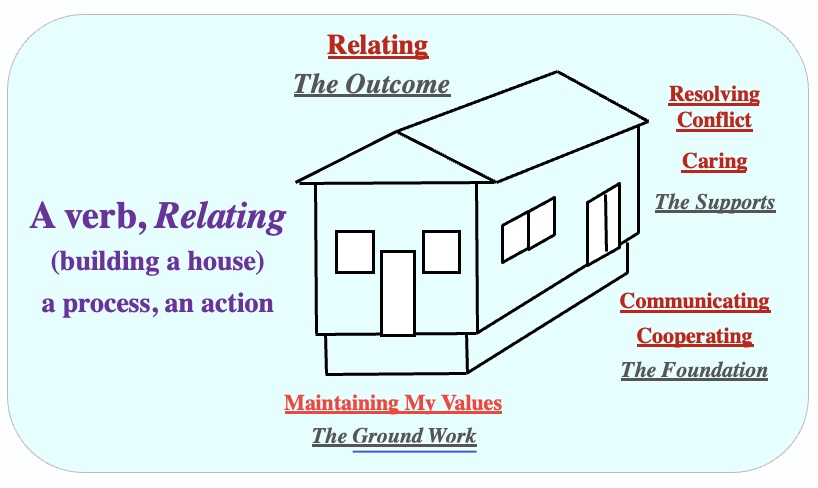
    In comparison, effective relationship requires hard work. A host of skills are needed:

    • maintaining values — the groundwork, with often subtle differences between the individuals.
    • communicating and cooperating. Couples need to do much more than communicate — especially they need to cooperate in problem solving.
    • Angry#26b-Options1caring and resolving conflict. Caring is sometimes just as much work as resolving conflict. Problem solving (#27) is essential.
      • relationships do best when there are at least five positives for every negative.
      • blame has no place in relationship — blame is based on a right-wrong mentality, whereas everyone is always doing their best. When inappropriate behaviors exist, the basic question is whether the action was intended, or not. And do the individuals wish to act into better behaviors.
        • Sudden start-up of conflict is especially harmful.
      • it is necessary for the individuals to reveal themselves, especially their differences (a potential source of conflict) as feedback (not criticism).
      • Feedback (healthy) says “This is who I am;” criticism (unhealthy) says: This is who you should be.”

    All of this, especially cooperation and gift-giving, is the basis of effective relating. Repairs of harm (e.g., authentic apologies) are essential. Management of energy (Emails #25#26) is mandatory.

    The essential stances are:

    • if one of us has a problem, it is our problem! It is simply where the pain surfaces.
    • the person who has the pain has the responsibility to initiate discussion.

    Coming next: Responding to Children