In this post, I am going to outline briefly the skills necessary so as to live fully; subsequent post (chapters of the future book) will develop the nature of these skills and the means of acquiring them. Initially, the discussions will be somewhat abstract because I am seeking to develop a common language between myself and the reader.
As a therapist, I am very aware of the need for clarity; I often define the skill of good communication as the ability to recover from bad communication. Unfortunately, written communication makes that skill difficult to achieve; hence my need to ensure clarity.
A primary question here is who and what are we as human beings? I will be presenting a variety of answers to this question and invite you the reader to delve deep into both my answers and your own. Let me state first that I am not claiming to be an authority in these answers, only that I have spent much of my life attempting to answer these questions — they define who I am and how I interact with people.
My first answer is that, like all biological creatures, we are energy transformers (by energy, I mean the ability to do work, which for biological purposes means the ability to create some kind of change). I interact with what life offers, especially the presence of other human beings, process what they offer (their energy) and convert this to my response (my energy, offering my attempt to create change). Between us, we dance with each other’s energy (hopefully under-standing each other in the process).
This word understanding is one that is vital to our conversation. With my clients, I draw two simple diagrams. The first stick figure is using a magnifying glass to analyse an object, saying “Yes, I understand.” The second stick figure is standing under the same object, in awe of the mystery that the object represents. Despite the profound scientific advances of the past few hundred years, we really grasp little of the profound mystery that underlies what we call reality. Thus I call the first analysis over-standing and the second true under-standing, usually spelling the words with a hyphen to underlie the mystery. Over-standing, for me, is the bobby prize!
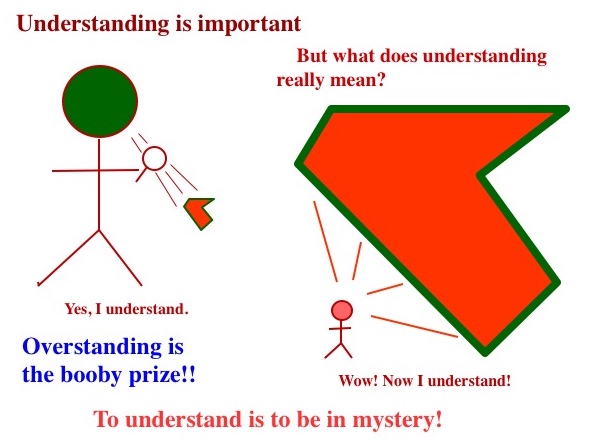
My second answer to the question of who and what we are as human beings is that we are meaning makers; the sophistication with which we do this is perhaps unique amongst biological creatures — it is both our profound skill and our trap. Consider the following simple story:
The Story
A business man had just turned off the lights in the store when a man appeared and demanded money. The owner opened the cash register. The contents of the cash register were scooped up and the man sped away. A member of the police force was notified promptly.
Choose your response to each of these statements about the story: True, False, or Not Sure
1. A man appeared after the owner had turned off the lights.
2. The robber was a man.
3. The man who opened the cash register was the owner.
4. After the man had scooped up the contents of the cash register, he ran away.
5. While the cash register contained money, the story does not state how much.
6. The story concerns a series of events in which only three persons are referred to: the owner of the store, a man who demanded money and a member of the police force.
Looks simple — anything but! I contend the answers to the first five are Not Sure. For example, #1, the story says a business man turned off the lights — where does it say the business man and the owner are the same person. #2. Where does it say a robbery took place — perhaps the man was drunk and driving dangerously when he/she sped away in a car. I contend #6 is False — the word only limits the choices to either true or false!
The point of this story is that we respond to meaning — we make assumptions about the actual data that is available (The Story). We fill in the blanks of our assumptions. You might note that the word assume can be spelled ‘ass-u-me’! Yet we cannot not assume — we never have all the data! The best that we can do is to be aware of our assumptions and be open to other interpretations. Such failure to do so unfortunately underlies much of the crises of our modern so-called ‘civilization.’
One aspect of being fully alive is such awareness and more. My original training as a therapist was in the field of Gestalt Therapy. For me, it is the basis of being fully alive. There, awareness is the primary skill (in Gestalt, awareness is defined as ‘attention to one’s spontaneously emerging experience — it is much much more than attention to what one is thinking or what one is assuming).
The second core principle/skill of Gestalt is contact — attention to the actual data that is present, both the data provided by the outside world (this post, for example) and the ongoing moment-by-moment shifts in my body-mind experience as I create my reality. The third core principle/skill is personal responsibility — I alone create my experience. The word blame does not exist in Gestalt Therapy.
Beyond these skills are others that we will come to. How do I create and manage my own life energy, my emotions? How do I manage my internal complexity, especially my internal conflicts and my judgments of self or others. How do I manage my external relationships, especially my conflicts.
My third answer to the question of who and what we are is that we are relational. We are never individuals — we are only individuals in relation to others. In the complexity of the modern world, with the risks of nuclear war and climate change, a fundamental question is that of ‘What is mine to contribute?’
Part of this is my relationship to the grand scheme of the universe. Is there a supreme being or energy/force?’ The loss of religiosity over the past four centuries has had many consequences, some good, some not so good. Many of us recognize a sense of futility and/or sense something missing — sorting this question is a significant part of the search to be fully alive, of what is mine to contribute.
In future posts, I will offer simple models (concepts and/or metaphors) that allow all of this to be processed — the journey to being fully alive.

 Awakening From Your Anger
Leave a reply to usuallybouquet716319fce1 Cancel reply